All comparisons
Works with AD eContent SolutionsSyndication & feeds

Anglera + AD eContent Solutions

The bottom line

If you're an AD member, keep eContent — it is the cheapest path to a validated baseline record for the SKUs the pool covers, and the Connector keeps those records current as suppliers push changes. Add Anglera to complete the SKUs the pool never covers and to turn the shared baseline into content you own — differentiated from the other members receiving the exact same record.

AD eContent Solutions and Anglera solve different halves of the problem — this page is about the seam between them.
The frame for this comparison

Product data is a practice, not a project.

AD eContent's question is whether a manufacturer-approved record exists in the member PIM for the SKUs its suppliers pushed through the Connector — validated, categorized, ready for hundreds of members to pull; Anglera's question is whether every SKU on YOUR item file, the pool's and the ones it never covered, actually carries the trade size, the WOG rating, and the certification your counter customer filters on, and reads like you rather than like every other member — work that recurs with each supplier reissue, not a one-time load.

01

Ground it

Mine every spec from every source.

Every value traced to a document you can open. The catalog is only as honest as what it was built from.

02

Align it

Aim the catalog at the buyer who actually buys.

Grounded data still loses if it answers questions nobody asked. Alignment is what turns specs into conversion.

03

Keep it alive

Product data is a practice, not a project.

Markets move, suppliers reissue, buyers change what they ask for. A catalog that is right in March is wrong by August unless something is watching.

Capability by capability

Where AD eContent Solutions stops.

Scored against public documentation. Grouped by the three acts — so you can see which ones AD eContent Solutions leaves on your desk.

01

Ground it

Mine every spec from every source.
Source mining
Where does it get specs from?
AD eContent SolutionsLimited

Ingests supplier feeds via Connector; AD-funded SKU build-out

AngleraYes

PDFs, spec tables, drawings, manuals, images, sites

Schema discovery
Does it find attributes that aren't in your schema yet?
AD eContent SolutionsNo

Taxonomy set by member-supplier committees, not signal discovery

AngleraYes

Proposes fields your schema never had

Governed vocabulary
Does it turn messy free-text into a governed pick list?
AD eContent SolutionsLimited

Governance validates completeness against AD's attribute schema

AngleraYes

Normalizes and governs allowed values, versioned

Taxonomy & classification
Can it classify every SKU into your hierarchy?
AD eContent SolutionsLimited

AD-defined category tree; mapping to your schema is manual

AngleraYes

Auto-classifies; channel and marketplace mapping

Citations & provenance
Can you see where any given value came from?
AD eContent SolutionsNo

Manufacturer-approved records; no per-value source citations

AngleraYes

Every value cites its source doc and page

02

Align it

Aim the catalog at the buyer who actually buys.
Buyer personas
Is the content written for your buyer, or generically?
AD eContent SolutionsNo

Identical content delivered to every subscribing member

AngleraYes

B2B specifier and B2C shopper enriched differently

Review, search & social signals
Does it learn what buyers ask from the live market?
AD eContent SolutionsNo

No review or search-signal feedback loop found

AngleraYes

Reviews, search, competitor rails, social — fed back

Copy & SEO
Does it write original, channel-ready copy?
AD eContent SolutionsLimited

Standardized supplier-approved descriptions, shared by all members

AngleraYes

Original copy per persona and channel

Product imagery
Can it produce usable images for SKUs that lack them?
AD eContent SolutionsLimited

Distributes supplier digital assets; no generation for photoless SKUs

AngleraYes

Generates studio-grade imagery for photoless SKUs

03

Keep it alive

Product data is a practice, not a project.
Continuous re-enrichment
What happens when the market moves after go-live?
AD eContent SolutionsLimited

Connector auto-detects supplier changes; pool SKUs only

AngleraYes

Re-enriches on its own after go-live

Quality scoring
Does it score its own output and track catalog health?
AD eContent SolutionsLimited

Completeness validation flags invalid SKUs before publish

AngleraYes

Scored against your standards; nothing publishes below bar

Write-back
Does enriched data land back in your system of record?
AD eContent SolutionsYour team

Members match UPC/MPN and map fields themselves

AngleraYes

Writes back to PIM, ERP, warehouse, commerce

API, MCP & webhooks
Can your own tools and agents drive it headlessly?
AD eContent SolutionsNo

No public developer docs found; member-portal delivery

AngleraYes

API, webhooks, and MCP servers

Who does the work
Does it do the work, or help your team do it?
AD eContent SolutionsLimited

AD builds pool content; your team owns match and gaps

AngleraYes

Anglera owns the work; review is a guardrail

KeyYesships itLimitedlimited or gatedYour teamyour team still does itNodoesn't do itAnglera differentiator
What “buyer signals” actually means

Six signals sitting in your market right now.

“Buyer signals” is the emptiest phrase in this category, so here is the literal thing. Each of these is an observation from a live market, the gap it exposes, and the field that gets created as a result.

Search signal·internal site-search logs on an AD electrical member's webstore

"1/2 emt compression connector raintight" recurs and lands on a page of 40 connectors. Pool records carry trade size as '1/2"', '0.50 IN', and 'half-inch' across brands, and the raintight rating appears only mid-description.

Trade size is a governed enum and raintight (UL 514B, wet locations) is a boolean. Both are trapped in inconsistent title and description text, so the facet rail can't narrow and the electrician scrolls or leaves.

Field createdtrade_size (enum) and raintight_rated (boolean), lifted out of prosetrade size normalized to 1/2 | 3/4 | 1 | 1-1/4 | 1-1/2 | 2 | 2-1/2 | 3 | 4 — one format across every brand the pool feeds
Supplier signal·the manufacturer submittal sheet attached to a pool record for a lead-free brass ball valve

The submittal states full port, 600 WOG, NPT ends, NSF/ANSI 61 certified. The record every member received says 'lead-free brass ball valve' plus a marketing paragraph, with the submittal linked as a PDF.

The engineer specifying the valve needs port type, WOG rating, and the NSF listing as filterable fields. The values exist one click upstream in a document the pool distributes as an attachment, not as data.

Field createdport_type (enum), pressure_rating_wog_psi (integer), end_connection (enum), nsf_ansi_61 (boolean)end connection normalized to Threaded NPT | Sweat | Press | Flanged | PEX crimp; port to Full | Standard | Reduced
Competitor signal·a search-results check on a top-selling condensate pump's part number

The first page is a dozen distributor product pages — several visibly AD members — carrying the same manufacturer-authored paragraph, bullets, and title. The page ranking above them all rewrote its content around shutoff head and safety-switch behavior.

Identical pool content cannot win the ranking or the AI answer. The attributes buyers actually compare on — shutoff head, tank capacity, switch type — are the raw material for the one page that does.

Field createdshutoff_head_ft (integer), tank_capacity_gal (decimal), safety_switch (enum)safety switch normalized to None | Overflow shutoff only | Overflow shutoff + alarm contact
Why catalogs rot

Pennies per SKU buys sameness

The pool's economics are its argument: AD buys SKU production capacity collectively, so a member pays pennies for a record that would cost dollars to build alone. But follow the structure. The record is manufacturer-approved by design — the supplier's paragraph, the supplier's bullets, the supplier's chosen attributes — and it is delivered identically to every member who subscribes. Your product page for a 1/2-inch EMT connector is, word for word, the page of the AD member two towns over, and close kin to the DPA and NetPlus member pages fed by parallel pools. Search engines and AI answer engines have to pick one; duplicated content means it usually isn't yours. Then there's the seam AD itself documents: matching pool records to your item file is your job — UPC where you have it, manufacturer-plus-part-number where you don't, VLOOKUP suggested — and so is mapping AD's fields into your ERP's, and so is everything the pool doesn't carry: private label, kits, regional lines, legacy part numbers. Cancel participation and the licensed catalog goes dark, because it was never your asset. The pool is a genuinely good raw-material contract. It is not, and structurally cannot be, your differentiation.

Messy in, governed out.

Values are normalized into a governed, versioned set of allowed values — so a filter works, and keeps working after the next import.

Nominal Size
3/4 in0.75"3/4"19mm3/4 inchDN20
0.75 in (DN20)

Six suppliers, six spellings, one physical size. Filters only work once they agree.

Finish
BlkblackBLACK MATTEMatte BlkRAL 9005
Black — Matte

Free text makes a colour filter useless. A governed value makes it a facet.

Material
SS316316 StainlessStainless Steel 316A4 Stainless
Stainless Steel — 316 / A4

Same alloy, four vocabularies, plus a trade name. Buyers search all of them.

And the part nobody else does

We don't just fill the template you handed us.

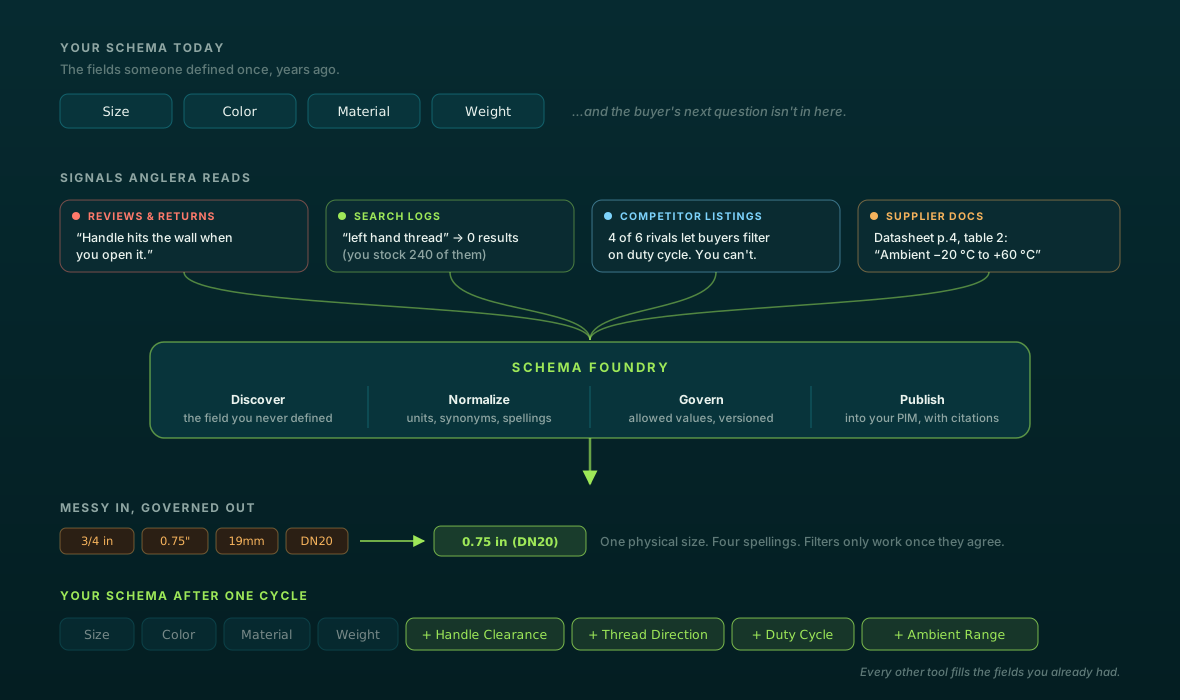
Filling the fields you defined has an invisible ceiling: a catalog can hit 100% complete and still miss the attribute that loses the sale, because completeness is measured against a schema someone drew years ago. Schema Foundry reads competitor listings, buyer searches, review complaints and your supplier docs, and proposes the fields you never defined — which is where AD eContent Solutions stops.

How Schema Foundry works
Schema Foundry: signals from reviews, search logs, competitor listings and supplier documents reveal attributes missing from your schema; the Foundry discovers, normalizes and governs them, so your schema ends the cycle with more fields than it started with.

What AD eContent Solutions does

AD (Affiliated Distributors) is North America's largest member-owned buying and marketing group for construction and industrial products — 1,000-plus independent distributors and 9,000-plus branches across electrical, plumbing, PVF, HVAC, industrial, safety, bearings and power transmission, and building-materials divisions. Its eContent program, run by the AD eCommerce Solutions team, is a member-funded shared content pool: AD collectively buys SKU production capacity, ingests supplier data through the AD eContent Supplier Connector (powered by dataX.ai, with 100-plus direct supplier connections plus PIM channels like Salsify), validates it through AD's data-governance process, and stages manufacturer-approved records in an AD Member PIM for hundreds of member distributors to pull into their webstores, with Unilog as a longtime delivery-side platform partner. Members match pool records to their own item files by UPC or manufacturer-name-plus-part-number and map AD's fields into their ERP and eCommerce schemas.

Pricing: Member-gated and not public. AD describes a collaborative-investment model — members share ongoing production costs across divisions and pay 'pennies per SKU rather than dollars' — delivered as a benefit of AD membership plus program participation fees (estimate; specific fees are not published).

AD eContent Solutions website

When AD eContent Solutions is the right call

AD member distributors in electrical, plumbing, HVAC, PVF, and industrial who need broad, manufacturer-approved baseline content at collective-purchasing economics. No independent distributor gets a lower per-SKU content cost than a funded pool spread across hundreds of members.

We'd rather tell you here than in month three of an implementation.

Capability verdicts reviewed against AD eContent Solutions's public documentation on July 17, 2026. Vendors ship quickly — if something here is out of date, tell us and we'll correct it.

See it on your own SKUs.

Bring one category and your supplier files. In 30 minutes you'll see it enriched — complete, structured, and consistent enough to launch on — plus the attributes your schema didn't have yet.

Book a demo