Your catalog can be
100% complete and still wrong.
Completeness is measured against a schema someone drew years ago. If the field that loses the sale isn't in it, the score can't see the problem — and neither can any tool that takes your schema as a given. Which is all of them.
Anglera's day job is finishing your catalog: every SKU complete, structured, correct and consistent, fast enough to launch on. Schema Foundry is what happens after that — the part that questions the schema itself, instead of just filling the template you were handed.

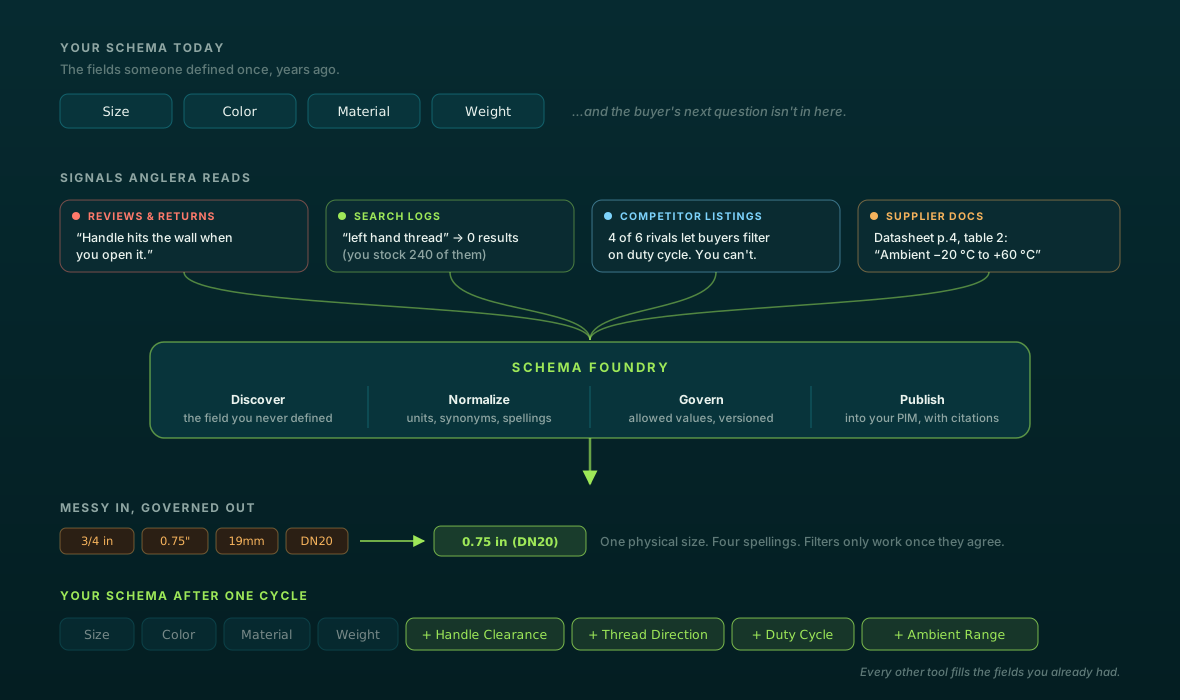
Where a missing field announces itself.
A missing attribute is never silent. It shows up as a complaint, a dead search, a competitor's filter, a rejected listing. The signal is always there — the question is whether anything is reading it.
“Handle hits the wall when you open it” shows up across the 2- and 3-star reviews on a brass ball valve — and in the return reasons behind it.
Clearance is why the product came back, and no field anywhere describes it.
Handle Clearance (fully open)Millimetres, measured from valve centreline“left hand thread” is searched steadily on your own site and returns zero results — while you stock 240 left-hand-threaded SKUs.
You have the products. You do not have the attribute, so search cannot find them.
Thread DirectionRight-hand (RH) · Left-hand (LH)Contractors comparing compressors argue about noise in decibels months before any RFQ mentions it.
The dB rating is sitting in the supplier PDF. It is not a field, so it is not a filter.
Sound Level (dB)dB(A) at 1 m, integerFour of six competitors let a buyer filter welders by duty cycle. Your category has no such field.
Buyers who filter on duty cycle never see your catalog at all.
Duty Cycle% at rated amperage (e.g. 60% @ 200 A)Page 4 of the datasheet has “Ambient operating range −20 °C to +60 °C” in a table nobody ever mapped.
The data arrived years ago and died in a PDF because no field was waiting for it.
Ambient Operating RangeMin/max °C pairListings bounce for a missing Country of Origin that is printed on the packaging and in the customs paperwork.
A required field for the channel that was never required by the PIM.
Country of OriginISO 3166-1 alpha-2A discovered field is worthless until the values agree.
Finding the attribute is half of it. Six suppliers will send you the same value spelled six ways, and a filter built on free text is a filter that doesn't work. So the Foundry normalizes, then governs: allowed values, versioned, with the synonyms mapped in.
3/4 in0.75"3/4"19mm3/4 inchDN200.75 in (DN20)Six suppliers, six spellings, one physical size. Filters only work once they agree.
BlkblackBLACK MATTEMatte BlkRAL 9005Black — MatteFree text makes a colour filter useless. A governed value makes it a facet.
SS316316 StainlessStainless Steel 316A4 StainlessStainless Steel — 316 / A4Same alloy, four vocabularies, plus a trade name. Buyers search all of them.
See it on a real category.
The Attribute Schema Library is Schema Foundry's output, published. Every page lists the attributes the category needs — and the ones most catalogs are missing entirely.
Reasonable objections
What is Schema Foundry?
Schema Foundry is the part of Anglera that improves your data model, not just the data inside it. It reads competitor listings, buyer search queries, review complaints, social chatter and your own supplier documents to find attributes your catalog has no field for — then proposes them, normalizes their messy values, and promotes them into governed vocabulary.
How is this different from a PIM completeness score?
A completeness score measures your catalog against the schema you already have. If the schema is missing the attribute that loses the sale, you can score 100% complete and still lose. Schema Foundry questions the schema itself — it is the only measurement that can tell you about a field you never defined.
Doesn't this mean AI inventing fields we don't want?
No. Discovered attributes are proposals, each one attached to the signal that produced it — the competitor filter rail, the search query with no results, the datasheet table. Your team promotes them, and your governance rules decide what becomes canonical. Nothing enters the schema because a model felt like it.
Where do the values come from once a field exists?
From your documents. Anglera mines supplier PDFs, spec tables, drawings, manuals and product images to populate the new attribute, and every value carries its citation — source document, page, and extraction path. Values are extracted, not generated.
What's missing from your schema?
Bring one category. We'll run Schema Foundry against it and show you the fields you don't have — and the signal that found each one. 30 minutes, your own SKUs.
Book a demo