All comparisons
Works with Distributor Data Solutions (DDS)Syndication & feeds

Anglera + Distributor Data Solutions (DDS)

The bottom line

Keep DDS if your line card overlaps its verticals — it is a clean, current, manufacturer-approved feed that saves real content labor. Add Anglera to complete the SKUs the pool never matches and to turn the shared record into owned, buyer-aligned pages. The pool is table stakes; the difference is yours to build on top of it.

Distributor Data Solutions (DDS) and Anglera solve different halves of the problem — this page is about the seam between them.
The frame for this comparison

Product data is a practice, not a project.

DDS's question is whether the manufacturer-approved record — the specs, images, and submittal PDFs the manufacturer signed off on — reached your platform in the right format and refreshed when the manufacturer revised it; Anglera's question is whether your page for that MPN says anything the hundreds of other endpoints pulling the same record do not, and whether the SKUs the pool never matched — private label, regional lines, legacy parts — ever get finished at all.

01

Ground it

Mine every spec from every source.

Every value traced to a document you can open. The catalog is only as honest as what it was built from.

02

Align it

Aim the catalog at the buyer who actually buys.

Grounded data still loses if it answers questions nobody asked. Alignment is what turns specs into conversion.

03

Keep it alive

Product data is a practice, not a project.

Markets move, suppliers reissue, buyers change what they ask for. A catalog that is right in March is wrong by August unless something is watching.

Capability by capability

Where Distributor Data Solutions (DDS) stops.

Scored against public documentation. Grouped by the three acts — so you can see which ones Distributor Data Solutions (DDS) leaves on your desk.

01

Ground it

Mine every spec from every source.
Source mining
Where does it get specs from?
Distributor Data Solutions (DDS)Limited

Ingests manufacturer-supplied files and assets; no independent document mining

AngleraYes

PDFs, spec tables, drawings, manuals, images, sites

Schema discovery
Does it find attributes that aren't in your schema yet?
Distributor Data Solutions (DDS)No

Category attribute templates; no new-attribute discovery from market

AngleraYes

Proposes fields your schema never had

Governed vocabulary
Does it turn messy free-text into a governed pick list?
Distributor Data Solutions (DDS)Limited

Normalizes to DDS and ETIM standards, not your governed lists

AngleraYes

Normalizes and governs allowed values, versioned

Taxonomy & classification
Can it classify every SKU into your hierarchy?
Distributor Data Solutions (DDS)Limited

ML auto-classification; ETIM NA founding member; endpoint mapping serviced

AngleraYes

Auto-classifies; channel and marketplace mapping

Citations & provenance
Can you see where any given value came from?
Distributor Data Solutions (DDS)Limited

Manufacturer-approved sourcing; no per-value source-document citations

AngleraYes

Every value cites its source doc and page

02

Align it

Aim the catalog at the buyer who actually buys.
Buyer personas
Is the content written for your buyer, or generically?
Distributor Data Solutions (DDS)No

Same record to every subscriber; no persona tailoring

AngleraYes

B2B specifier and B2C shopper enriched differently

Review, search & social signals
Does it learn what buyers ask from the live market?
Distributor Data Solutions (DDS)No

No review, search, or social signal ingestion found

AngleraYes

Reviews, search, competitor rails, social — fed back

Copy & SEO
Does it write original, channel-ready copy?
Distributor Data Solutions (DDS)Limited

AI-optimized titles and descriptions; identical text across subscribers

AngleraYes

Original copy per persona and channel

Product imagery
Can it produce usable images for SKUs that lack them?
Distributor Data Solutions (DDS)Limited

Distributes manufacturer images, 360s, video; no generation for photoless SKUs

AngleraYes

Generates studio-grade imagery for photoless SKUs

03

Keep it alive

Product data is a practice, not a project.
Continuous re-enrichment
What happens when the market moves after go-live?
Distributor Data Solutions (DDS)Limited

Auto-refresh on manufacturer updates; no market-driven re-enrichment

AngleraYes

Re-enriches on its own after go-live

Quality scoring
Does it score its own output and track catalog health?
Distributor Data Solutions (DDS)Limited

Acadia dashboards track completeness and currency; 98% AI-approval claim

AngleraYes

Scored against your standards; nothing publishes below bar

Write-back
Does enriched data land back in your system of record?
Distributor Data Solutions (DDS)Yes

Automated exports to ERP, PIM, commerce; 450+ endpoints

AngleraYes

Writes back to PIM, ERP, warehouse, commerce

API, MCP & webhooks
Can your own tools and agents drive it headlessly?
Distributor Data Solutions (DDS)Limited

Delivery APIs claimed; no public developer portal or MCP

AngleraYes

API, webhooks, and MCP servers

Who does the work
Does it do the work, or help your team do it?
Distributor Data Solutions (DDS)Limited

DDS runs matching and delivery; unmatched SKUs stay yours

AngleraYes

Anglera owns the work; review is a guardrail

KeyYesships itLimitedlimited or gatedYour teamyour team still does itNodoesn't do itAnglera differentiator
What “buyer signals” actually means

Six signals sitting in your market right now.

“Buyer signals” is the emptiest phrase in this category, so here is the literal thing. Each of these is an observation from a live market, the gap it exposes, and the field that gets created as a result.

Search signal·internal site-search logs on an electrical distributor's webstore

"3/4 emt compression connector raintight" recurs and lands on a category page of items titled from ERP short text — "CONN COMP 3/4 RT STL" — with the pool's manufacturer paragraph below. Trade size appears as 3/4", 0.75, and 3/4-IN across the assortment.

Trade size, connection method, and wet-location listing are the entire query, and none is a faceted field — so the electrician who knows exactly which fitting he needs scrolls instead of filters.

Field createdtrade_size (enum), connection_method (enum), wet_location_listed (boolean, per the UL 514B listing)trade size normalized to 1/2 | 3/4 | 1 | 1-1/4 | 1-1/2 | 2; connection method to Compression | Set-screw | Threaded
Competitor signal·a Google SERP for a hydronic circulator MPN a category manager was auditing

Eight distributor pages in the top ten carry the same manufacturer paragraph and the same bullet list, sourced from the same content feed. None states flow at a given head; the pump curve lives in a PDF attachment on every one of them.

Identical pool content means rank is decided by domain authority, not content — and the spec that actually sizes the pump (GPM at feet of head) is a chart image no search engine or AI answer can read.

Field createdflow_gpm_at_10ft_head (decimal) and connection_type (enum), lifted off the published curveconnection normalized to Flanged | Union | Sweat | NPT, with flange size carried as a separate field
Supplier signal·the submittal sheet attached to a PVC check valve's pool record at a plumbing and waterworks distributor

The submittal states EPDM seat, 0.5 psi cracking pressure, Cv 42, NSF/ANSI 61 certified. The record's attribute block says "durable corrosion-resistant construction" and links the PDF.

The engineer specifying a potable-water job needs the certification and the seat elastomer as fields; both exist one click away in a document the feed faithfully delivers and nothing parses.

Field createdseat_material (enum), cracking_pressure_psi (decimal), cv_flow_coefficient (decimal), nsf_ansi_61 (boolean)seat material normalized to EPDM | Buna-N | FKM | PTFE
Why catalogs rot

Same feed, same shelf

DDS's pitch is genuinely attractive: 1,700-plus brands, roughly 12.5 million enriched SKUs, manufacturer-approved and refreshed automatically, delivered in the format your platform wants. The catch is arithmetic. The pool covers what the pool covers — the match against your item file decides your real coverage, and the unmatched tail (private label, regional lines, kits, legacy MPNs still active in your ERP) is precisely the part of the catalog nobody else will fix for you. Then there is what a match buys: the same record every other subscribing distributor pulls. When eight distributors publish the identical manufacturer paragraph for the same MPN, Google has seven duplicates to discount and an AI answer engine has no reason to cite yours; the content that clears the pool is, by construction, the content that cannot differentiate you. And it is licensed — it arrives through a subscription and leaves with one, which is why it can be table stakes but never an asset. Anglera starts from the documents underneath the pool record — the cut sheet, the submittal, the install manual — and produces attributes and copy that land in your PIM, under your vocabulary, as content you own. Keep the feed. Build the difference on top of it.

Messy in, governed out.

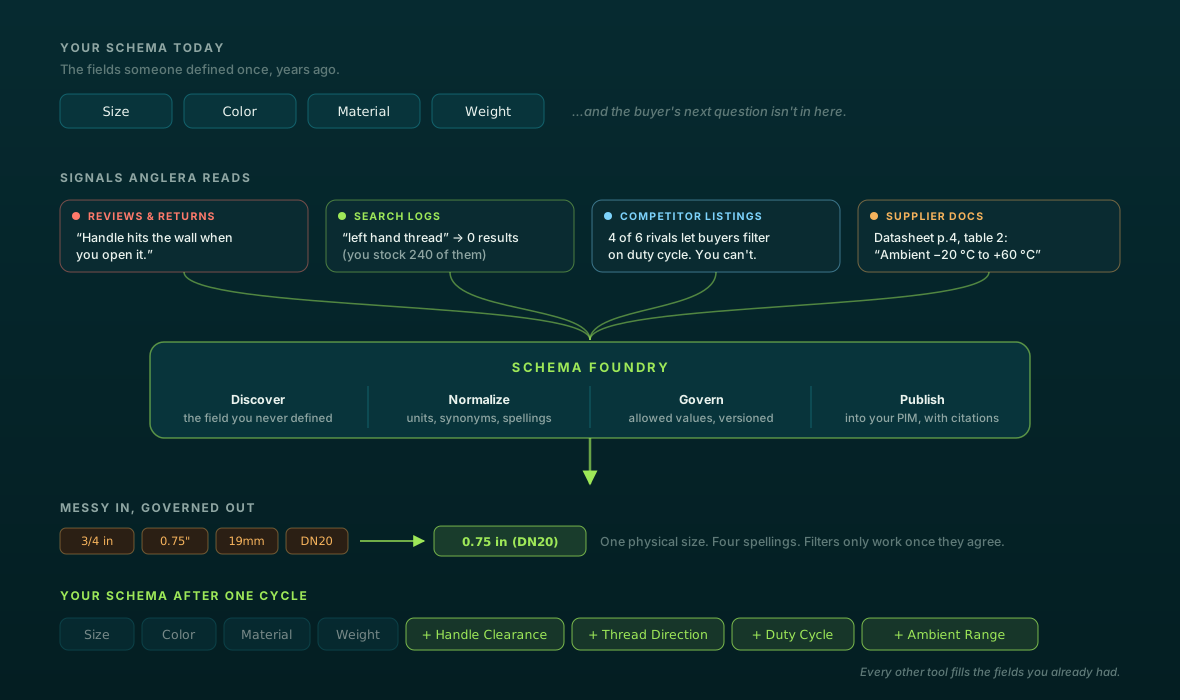
Values are normalized into a governed, versioned set of allowed values — so a filter works, and keeps working after the next import.

Nominal Size
3/4 in0.75"3/4"19mm3/4 inchDN20
0.75 in (DN20)

Six suppliers, six spellings, one physical size. Filters only work once they agree.

Finish
BlkblackBLACK MATTEMatte BlkRAL 9005
Black — Matte

Free text makes a colour filter useless. A governed value makes it a facet.

Material
SS316316 StainlessStainless Steel 316A4 Stainless
Stainless Steel — 316 / A4

Same alloy, four vocabularies, plus a trade name. Buyers search all of them.

And the part nobody else does

We don't just fill the template you handed us.

Filling the fields you defined has an invisible ceiling: a catalog can hit 100% complete and still miss the attribute that loses the sale, because completeness is measured against a schema someone drew years ago. Schema Foundry reads competitor listings, buyer searches, review complaints and your supplier docs, and proposes the fields you never defined — which is where Distributor Data Solutions (DDS) stops.

How Schema Foundry works
Schema Foundry: signals from reviews, search logs, competitor listings and supplier documents reveal attributes missing from your schema; the Foundry discovers, normalizes and governs them, so your schema ends the cycle with more fields than it started with.

What Distributor Data Solutions (DDS) does

Distributor Data Solutions (DDS) is a manufacturer-authorized product content pool and syndication service for wholesale distribution, founded in 2014 by Codale Electric Supply veterans Dale P. Holt and Matt Christensen and headquartered in Salt Lake City. It aggregates manufacturer-approved content — attributes, specs, images, 360° views, videos, and spec-sheet PDFs — from 900+ manufacturers representing roughly 1,700 brands across electrical, plumbing, HVACR, welding and gas, and industrial supply, and delivers it through its Acadia platform into distributor ERP, PIM, and ecommerce systems (BigCommerce, Optimizely, Shopify, Epicor, and others). DDS claims about 12.5 million enriched SKUs flowing to 450–475+ distributor endpoints, with automatic refreshes as manufacturers revise their data. Despite recurring buyer confusion with AD's eContent program, DDS remains independent and founder-led as of mid-2026: AD has not acquired DDS, and AD eContent is a separate service built on IDW data with its own supplier connector — a buyer comparing the two is comparing two different pools, not one company.

Pricing: Not publicly disclosed. Subscription licensing on both sides of the pool — manufacturers pay to syndicate, distributors pay for the content feed. No per-SKU rates published; treat any figures you hear as estimates.

Distributor Data Solutions (DDS) website

When Distributor Data Solutions (DDS) is the right call

Electrical, plumbing, HVACR, welding-and-gas, and industrial distributors whose brands overlap DDS's 1,700+ brand library and who need accurate manufacturer content flowing into their ecommerce, PIM, or ERP quickly. Also manufacturers in those verticals wanting one syndication point to hundreds of distributor endpoints.

We'd rather tell you here than in month three of an implementation.

Capability verdicts reviewed against Distributor Data Solutions (DDS)'s public documentation on July 17, 2026. Vendors ship quickly — if something here is out of date, tell us and we'll correct it.

See it on your own SKUs.

Bring one category and your supplier files. In 30 minutes you'll see it enriched — complete, structured, and consistent enough to launch on — plus the attributes your schema didn't have yet.

Book a demo