Keep Icecat: as a free-to-cheap baseline of brand-approved specs, images, and multilingual descriptions for IT, CE, appliance, and DIY SKUs, nothing else matches it. Add Anglera to cover the SKUs the pool doesn't carry — private label, regional lines, kits — and to build owned, buyer-aligned content on top of the shared baseline for the SKUs it does.
Icecat and Anglera solve different halves of the problem — this page is about the seam between them.
The frame for this comparison
Product data is a practice, not a project.
Icecat's question is whether a brand-approved datasheet exists for the brand-plus-MPN and arrives in identical shape at all 100,000+ channel partners — the sponsor model working exactly as designed; Anglera's question is what your page says for the private-label patch cable the pool has never heard of, and what it says differently from the other forty resellers on the SKUs the pool does cover — work that recurs with every supplier reissue, not a feed you switch on once.
01
Ground it
Mine every spec from every source.
Every value traced to a document you can open. The catalog is only as honest as what it was built from.
02
Align it
Aim the catalog at the buyer who actually buys.
Grounded data still loses if it answers questions nobody asked. Alignment is what turns specs into conversion.
03
Keep it alive
Product data is a practice, not a project.
Markets move, suppliers reissue, buyers change what they ask for. A catalog that is right in March is wrong by August unless something is watching.
Capability by capability
Where Icecat stops.
Scored against public documentation. Grouped by the three acts — so you can see which ones Icecat leaves on your desk.
01
Ground it
Mine every spec from every source.
CapabilityIcecatAnglera
Source mining
Where does it get specs from?
IcecatLimited
Editorial teams standardize brand-supplied feeds; pool SKUs only
Does it find attributes that aren't in your schema yet?
IcecatNo
Fixed per-category taxonomy; no buyer-driven attribute discovery
AngleraYes
Proposes fields your schema never had
Governed vocabulary
Does it turn messy free-text into a governed pick list?
IcecatYes
Standardized value lists per category, 70+ languages
AngleraYes
Normalizes and governs allowed values, versioned
Taxonomy & classification
Can it classify every SKU into your hierarchy?
IcecatLimited
UNSPSC-aligned Icecat tree; classifies matched pool SKUs only
AngleraYes
Auto-classifies; channel and marketplace mapping
Citations & provenance
Can you see where any given value came from?
IcecatLimited
Brand-approved datasheets; no per-value source citations
AngleraYes
Every value cites its source doc and page
02
Align it
Aim the catalog at the buyer who actually buys.
CapabilityIcecatAnglera
Buyer personas
Is the content written for your buyer, or generically?
IcecatLimited
Icecat 360 AI claims retailer-specific variants; datasheets uniform
AngleraYes
B2B specifier and B2C shopper enriched differently
Review, search & social signals
Does it learn what buyers ask from the live market?
IcecatNo
Syndicates third-party reviews; doesn't mine signals into content
AngleraYes
Reviews, search, competitor rails, social — fed back
Copy & SEO
Does it write original, channel-ready copy?
IcecatLimited
Same manufacturer marketing text for everyone; 360 AI emerging
AngleraYes
Original copy per persona and channel
Product imagery
Can it produce usable images for SKUs that lack them?
IcecatLimited
Distributes brand images, video, 360 views; no generation
AngleraYes
Generates studio-grade imagery for photoless SKUs
03
Keep it alive
Product data is a practice, not a project.
CapabilityIcecatAnglera
Continuous re-enrichment
What happens when the market moves after go-live?
IcecatLimited
Feed refreshes as brands update; covers pool SKUs only
AngleraYes
Re-enriches on its own after go-live
Quality scoring
Does it score its own output and track catalog health?
IcecatLimited
Editorial datasheet quality tiers; no catalog health scoring
AngleraYes
Scored against your standards; nothing publishes below bar
Write-back
Does enriched data land back in your system of record?
IcecatYes
XML/JSON/CSV feeds plus shop, PIM, marketplace connectors
AngleraYes
Writes back to PIM, ERP, warehouse, commerce
API, MCP & webhooks
Can your own tools and agents drive it headlessly?
IcecatYes
Open Catalog APIs, Icecat Live, MCP server since 2025
AngleraYes
API, webhooks, and MCP servers
Who does the work
Does it do the work, or help your team do it?
IcecatLimited
Sponsors and editors author pool content; gaps are yours
AngleraYes
Anglera owns the work; review is a guardrail
KeyYesships itLimitedlimited or gatedYour teamyour team still does itNodoesn't do itAnglera differentiator
What “buyer signals” actually means
Six signals sitting in your market right now.
“Buyer signals” is the emptiest phrase in this category, so here is the literal thing. Each of these is an observation from a live market, the gap it exposes, and the field that gets created as a result.
Search signal·site-search logs on an IT reseller's supplies category
"toner for HP LaserJet M404" and similar printer-model queries dominate supplies searches; the OEM cartridge datasheet lists page yield, but the compatible-printer list sits inside a marketing paragraph, and the reseller's own compatible-brand cartridges have no datasheet at all.
Compatibility is the only attribute a supplies buyer needs, and it is prose on the pool record and absent on the private-label one — so neither can drive a fits-my-printer facet.
Field createdcompatible_printer_models (list of model codes) and page_yield_pages (integer, ISO/IEC 19752)printer models normalized to manufacturer model codes (M404dn | M404dw | M404n), yield always stated against the ISO test standard
Competitor signal·Google results audit for a sponsored brand's 18V drill driver
The first five organic results show the same Open Icecat marketing paragraph word for word; the only listing with distinct copy and a populated hard-torque spec is the national marketplace seller everyone else is losing the query to.
Identical sponsored content means the page cannot win on content; the deciding attributes — hard torque, chuck capacity, masonry drilling diameter — exist in the datasheet's feature table but nobody has turned them into owned copy or facets.
Field createdmax_torque_nm (integer), chuck_capacity_mm (range), masonry_drill_max_mm (integer)battery platform normalized to a governed list (18V ONE+ | XR 18V | ProCORE 18V) instead of free-text "18 V"
Supplier signal·line-card update packet from a regional LED luminaire brand
A regional luminaire line — a top-ten revenue brand for the distributor — returns no match in either Open or Full Icecat; the photometrics exist in the supplier's IES files and a 40-page spec PDF attached to the update.
The pool's coverage logic follows sponsorship, not your line card, so the SKUs where you actually hold margin and semi-exclusivity are exactly the ones with blank pages.
Open Icecat's business model is the identical-content problem stated as a feature. A sponsoring brand pays Icecat so that its approved datasheet — title, feature table, marketing text, images — is distributed free to every registered channel partner, and Icecat is genuinely good at the mechanics: standardized value lists per category, a UNSPSC-aligned tree, 70+ languages, roughly 39 billion downloads a year. But look at it from the receiving end. Every competitor with a free login shows the same paragraph you do, because the sponsor paid for exactly that outcome. Search engines collapse duplicate content toward whoever has the most authority, which is rarely a mid-market distributor, and AI shopping answers have no reason to cite the ten-thousandth copy of a datasheet. Coverage is the second structural issue: the ~18 million free datasheets from 600+ sponsors skew to IT, CE, and appliances, and even Full Icecat's 40,000 brands don't include your private label, regional lines, or kitted items — while the crosswalk from pool records to your item file stays your team's standing chore. And Full Icecat content is licensed, not owned: end the subscription and it leaves with the feed. The pool is a fine floor. It cannot be your shelf.
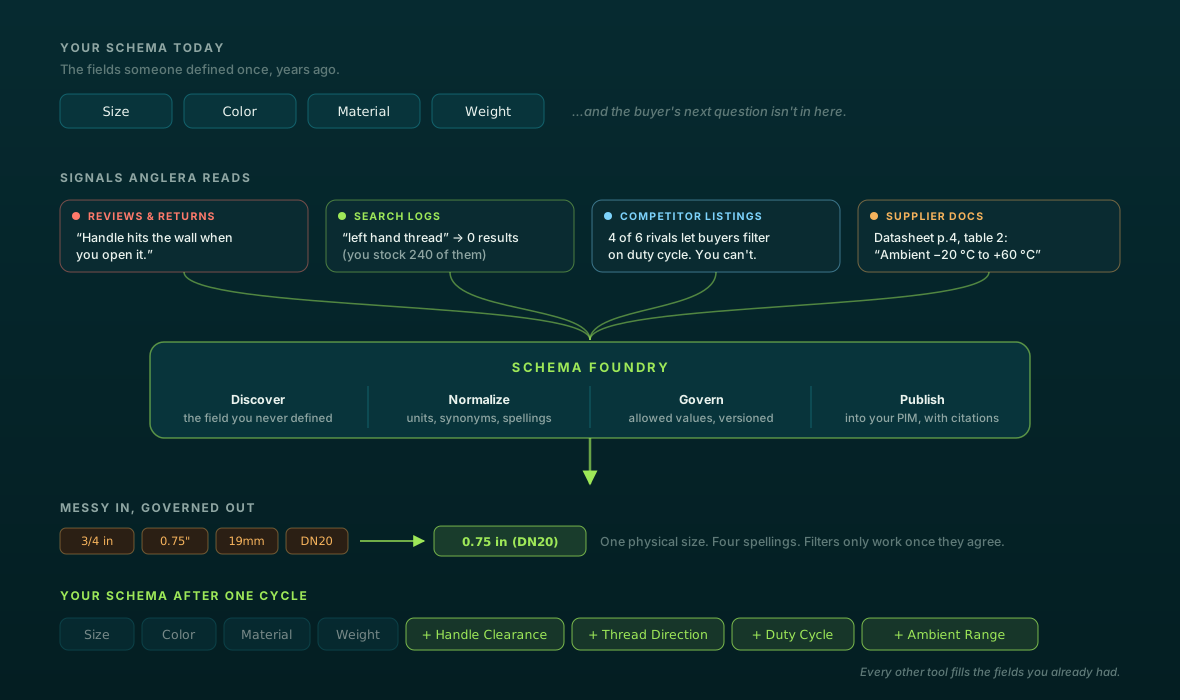
Messy in, governed out.
Values are normalized into a governed, versioned set of allowed values — so a filter works, and keeps working after the next import.
Nominal Size
3/4 in0.75"3/4"19mm3/4 inchDN20
0.75 in (DN20)
Six suppliers, six spellings, one physical size. Filters only work once they agree.
Finish
BlkblackBLACK MATTEMatte BlkRAL 9005
Black — Matte
Free text makes a colour filter useless. A governed value makes it a facet.
Material
SS316316 StainlessStainless Steel 316A4 Stainless
Stainless Steel — 316 / A4
Same alloy, four vocabularies, plus a trade name. Buyers search all of them.
And the part nobody else does
We don't just fill the template you handed us.
Filling the fields you defined has an invisible ceiling: a catalog can hit 100% complete and still miss the attribute that loses the sale, because completeness is measured against a schema someone drew years ago. Schema Foundry reads competitor listings, buyer searches, review complaints and your supplier docs, and proposes the fields you never defined — which is where Icecat stops.
Icecat N.V. is an Amsterdam-based product-content catalog and syndication company, founded in 2001 by CEO Martijn Hoogeveen and listed since 2016 on the Dutch NPEX SME exchange via depository receipts (ISIN NL0012751226) — not on Euronext. Its catalog holds roughly 29.5 million standardized datasheets across ~29,000 brands: Open Icecat gives about 18 million of them away free, funded by 600+ sponsoring brands (HP, Sony, Signify, Lego, L'Oréal, Whirlpool), while the paid Full Icecat tier extends coverage to 40,000+ brands. Content flows to 100,000+ registered channel partners in 70+ languages via XML/JSON APIs, Icecat Live, shop and marketplace connectors (Shopify, Magento, WooCommerce, PrestaShop, Amazon, Google, Mirakl), and, since September 2025, an MCP server for AI agents — roughly 39 billion datasheet downloads a year. The company also sells Icecat PIM (freemium), Icecat Studio (Amazon A+ storytelling), Icecat Commerce, and Icecat 360 AI for AI-generated, retailer-specific content. 2024 revenue was EUR 14.7M, up 11%, profitable, with growth achieved organically.
Pricing: Open Icecat is free for channel partners under an open-content license (sponsor-funded). Full Icecat is a paid subscription with published tiers (Starter, Single Vertical, Complete); brands pay annual sponsorship and Studio fees. Icecat publishes plan tables as images rather than plain-text prices, so exact rates are effectively quote-based.
Resellers and distributors in IT, consumer electronics, appliances, and DIY whose assortment is dominated by the 600+ sponsoring brands — Open Icecat is genuinely free, brand-approved, well-structured, and available in 70+ languages. Brands that want their approved content on every reseller shelf at once should sponsor it.
We'd rather tell you here than in month three of an implementation.
Capability verdicts reviewed against Icecat's public documentation on July 17, 2026. Vendors ship quickly — if something here is out of date, tell us and we'll correct it.
See it on your own SKUs.
Bring one category and your supplier files. In 30 minutes you'll see it enriched — complete, structured, and consistent enough to launch on — plus the attributes your schema didn't have yet.