Keep IDEA Connector: it is the electrical industry's authorized channel for pricing and transactional sync, and there is no substitute for that plumbing. Add Anglera on top to complete what the feed leaves thin — specs mined from cut sheets with citations, governed vocabularies, and shelf copy you own — so your pages stop being identical to every other authorized distributor's.
IDEA Connector and Anglera solve different halves of the problem — this page is about the seam between them.
The frame for this comparison
Product data is a practice, not a project.
IDEA Connector's question is whether the manufacturer's authorized record reached your ERP within 24 hours in a format it will load — the industry pipe it was built by NEMA and NAED to be; Anglera's question is whether that record actually says the interrupt rating and wire range buried in the cut sheet, and whether your page reads any differently from the other authorized distributors receiving the same feed — work that recurs with every spec revision, not a one-time cleanup.
01
Ground it
Mine every spec from every source.
Every value traced to a document you can open. The catalog is only as honest as what it was built from.
02
Align it
Aim the catalog at the buyer who actually buys.
Grounded data still loses if it answers questions nobody asked. Alignment is what turns specs into conversion.
03
Keep it alive
Product data is a practice, not a project.
Markets move, suppliers reissue, buyers change what they ask for. A catalog that is right in March is wrong by August unless something is watching.
Capability by capability
Where IDEA Connector stops.
Scored against public documentation. Grouped by the three acts — so you can see which ones IDEA Connector leaves on your desk.
01
Ground it
Mine every spec from every source.
CapabilityIDEA ConnectorAnglera
Source mining
Where does it get specs from?
IDEA ConnectorLimited
Ingests manufacturer feeds; Pro Data Services gap-fill for a fee
24-hour sync of updates; content only as fresh as submissions
AngleraYes
Re-enriches on its own after go-live
Quality scoring
Does it score its own output and track catalog health?
IDEA ConnectorYes
Data certification on 43 critical fields, quarterly quality checks
AngleraYes
Scored against your standards; nothing publishes below bar
Write-back
Does enriched data land back in your system of record?
IDEA ConnectorYes
Extracts and custom maps feed ERP, PIM, eCommerce systems
AngleraYes
Writes back to PIM, ERP, warehouse, commerce
API, MCP & webhooks
Can your own tools and agents drive it headlessly?
IDEA ConnectorLimited
Custom extracts and integrations; thin public API documentation
AngleraYes
API, webhooks, and MCP servers
Who does the work
Does it do the work, or help your team do it?
IDEA ConnectorYour team
Your team maps, matches, and enhances what the feed delivers
AngleraYes
Anglera owns the work; review is a guardrail
KeyYesships itLimitedlimited or gatedYour teamyour team still does itNodoesn't do itAnglera differentiator
What “buyer signals” actually means
Six signals sitting in your market right now.
“Buyer signals” is the emptiest phrase in this category, so here is the literal thing. Each of these is an observation from a live market, the gap it exposes, and the field that gets created as a result.
Search signal·internal site-search logs on an electrical distributor's eCommerce catalog
"3/4 compression EMT connector" is a top recurring query and dumps onto an unfiltered fittings category page. Trade size appears variously as 3/4", 0.75, and 3/4 IN across brands, and the connection method only shows up inside the description paragraph.
Trade size and connection method are the two facets a contractor narrows by, and both are sitting in free text as they arrived from the pool, so the facet rail cannot be built.
Field createdtrade_size (enum) and connection_method (enum), split out of titles and descriptionstrade size normalized to 1/2 | 3/4 | 1 | 1-1/4 | 1-1/2 | 2; connection method to Set Screw | Compression | Raintight Compression | Push-Install
Supplier signal·the manufacturer's cut sheet PDF for a plug-on miniature circuit breaker
The PDF states 10 kAIC at 120/240V, wire range 14–8 AWG Cu/Al, and terminal torque. The record that arrived through the feed says "BREAKER 2P 20A PLUG-ON" with a UPC, a price, and carton dimensions — the transactional fields are perfect.
The engineer specifying a panel schedule needs the interrupt rating and wire range; those values exist one click upstream in a document the feed references but nobody parses, so the counter still fields the phone call.
Field createdinterrupt_rating_kaic (integer), wire_range_awg (range), mounting_style (enum)mounting normalized to Plug-On | Bolt-On; conductor material to Cu | Al | Cu/Al
Competitor signal·a rival distributor's product page for a CCT-selectable LED high bay
The rival's page facets delivered lumens and selectable CCT and ranks for "high bay 4000K or 5000K selectable"; your page for the same SKU shows the identical manufacturer paragraph, because both of you receive the same authorized record.
When every subscriber publishes the same record, the winner is whoever restructures it first — the differentiating values are in the photometric file, not the feed.
Field createdcct_selectable_k (multi-value enum) and lumens_delivered (integer)CCT options normalized to 3500K | 4000K | 5000K; lumens as delivered lumens at the selected CCT, not rated LED lumens
Why catalogs rot
Authorized, identical, and rented
IDEA Connector's unit of trust is manufacturer authorization: a brand publishes one record, authorizes you to receive it, and the same record lands at every other authorized distributor — including the top-30 chains that anchor the network. That is the point of a pool, and it is also the ceiling. The 43 critical fields behind IDEA's data certification are transactional — brand, packaging, price effective date — because those are what an ERP needs to cut a PO. Descriptive content is graded, not guaranteed: IDEA scores manufacturers on content completeness precisely because population is uneven, and an ecosystem of services (IDEA's own Pro Data Services, partners like DDS) exists to fill what the feed doesn't carry. HDM is real progress — normalized attributes, values, and units across UNSPSC and ETIM, with a stated target of covering 95% of attributed SKUs — but it standardizes the record everyone receives; it cannot make your page say something your competitor's doesn't. And the content stays licensed: authorization can change, a lapsed subscription goes dark, and your private-label, kitted, and non-participating lines were never in the pool at all. Keep the feed as raw material. The shelf copy that wins the spec — cited to the cut sheet, faceted for the contractor searching by trade size and kAIC — has to be built, and owned, by you.
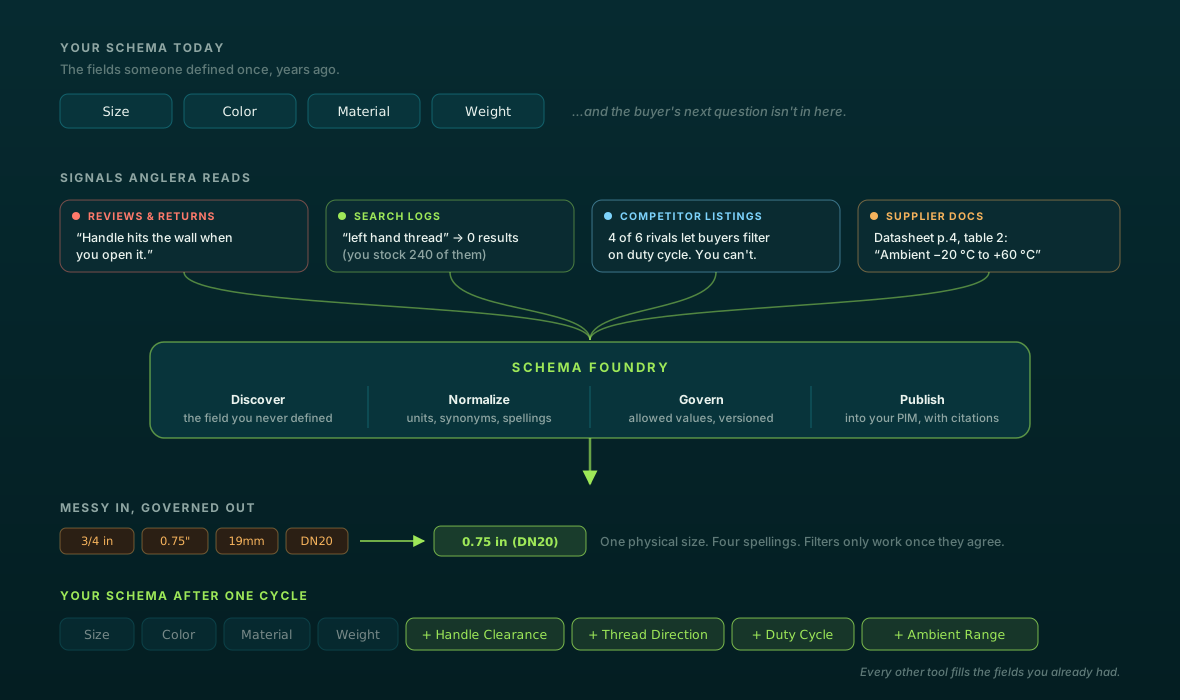
Messy in, governed out.
Values are normalized into a governed, versioned set of allowed values — so a filter works, and keeps working after the next import.
Nominal Size
3/4 in0.75"3/4"19mm3/4 inchDN20
0.75 in (DN20)
Six suppliers, six spellings, one physical size. Filters only work once they agree.
Finish
BlkblackBLACK MATTEMatte BlkRAL 9005
Black — Matte
Free text makes a colour filter useless. A governed value makes it a facet.
Material
SS316316 StainlessStainless Steel 316A4 Stainless
Stainless Steel — 316 / A4
Same alloy, four vocabularies, plus a trade name. Buyers search all of them.
And the part nobody else does
We don't just fill the template you handed us.
Filling the fields you defined has an invisible ceiling: a catalog can hit 100% complete and still miss the attribute that loses the sale, because completeness is measured against a schema someone drew years ago. Schema Foundry reads competitor listings, buyer searches, review complaints and your supplier docs, and proposes the fields you never defined — which is where IDEA Connector stops.
IDEA (Industry Data Exchange Association) is the electrical industry's own data pool, founded in 1998 by NEMA and NAED and governed by a board of manufacturers and distributors (Graybar, Lutron, Rockwell Automation, Van Meter, DSG). Its flagship IDEA Connector — the rebuilt successor to the Industry Data Warehouse (IDW), cut over in 2020 — lets manufacturers publish one authorized record of transactional, pricing, and marketing content (500+ fields, unlimited attributes, images, spec sheets, volumetrics) that syncs to authorized distributors' ERPs, PIMs, and eCommerce systems within 24 hours. The pool carries 1,000+ brands and reaches roughly the top 30 electrical distributors across thousands of locations. Its Harmonized Data Model (HDM) initiative normalizes attributes, values, and units across UNSPSC PAS/CAS and ETIM BMEcat so one manufacturer feed can syndicate in multiple formats, and IDEA partners with ETIM North America (ETIM versions 7–10 live in Connector) to push classification adoption. Patrick Knight, who joined as President in January 2025, now leads IDEA as President & CEO.
Pricing: Not public. Membership/subscription model: manufacturers pay to publish (all SKUs and attributes at no extra charge since the 2020 relaunch), distributors subscribe to receive data from brands that authorize them; IDEA Pro Data Services (cleansing, gap fill, custom syndication) is priced separately. No credible public figures.
Electrical distributors and manufacturers who need authorized price files, transactional data, and baseline product content flowing between 1,000+ brands and their ERPs. As the NAED/NEMA-founded industry utility with HDM and ETIM alignment, it is the default pipe for the vertical.
We'd rather tell you here than in month three of an implementation.
Capability verdicts reviewed against IDEA Connector's public documentation on July 17, 2026. Vendors ship quickly — if something here is out of date, tell us and we'll correct it.
See it on your own SKUs.
Bring one category and your supplier files. In 30 minutes you'll see it enriched — complete, structured, and consistent enough to launch on — plus the attributes your schema didn't have yet.