All comparisons
Works with Trade Service (Trimble)Syndication & feeds

Anglera + Trade Service (Trimble)

The bottom line

Keep Trade Service for what nothing else does as well: current MEP list and trade pricing flowing into estimating systems, price files, and Supplier Xchange quotes. Add Anglera to complete and differentiate the content layer — the unmatched SKUs the pool never covers, and owned, source-cited copy in place of the paragraph every subscriber licenses.

Trade Service (Trimble) and Anglera solve different halves of the problem — this page is about the seam between them.
The frame for this comparison

Product data is a practice, not a project.

Trade Service's question is whether the price on the quote is current when the bid goes out — its datasheet promises 'current pricing you don't have to update' and Supplier Xchange answers contractor RFQs in seconds; Anglera's question is whether the item record actually says what the fitting is — trade size, throat insulation, connection method, listing — in fields and language you own, rather than the paragraph every other subscriber licensed from the same file.

01

Ground it

Mine every spec from every source.

Every value traced to a document you can open. The catalog is only as honest as what it was built from.

02

Align it

Aim the catalog at the buyer who actually buys.

Grounded data still loses if it answers questions nobody asked. Alignment is what turns specs into conversion.

03

Keep it alive

Product data is a practice, not a project.

Markets move, suppliers reissue, buyers change what they ask for. A catalog that is right in March is wrong by August unless something is watching.

Capability by capability

Where Trade Service (Trimble) stops.

Scored against public documentation. Grouped by the three acts — so you can see which ones Trade Service (Trimble) leaves on your desk.

01

Ground it

Mine every spec from every source.
Source mining
Where does it get specs from?
Trade Service (Trimble)Limited

Aggregates manufacturer price sheets and catalog pages; pool SKUs only

AngleraYes

PDFs, spec tables, drawings, manuals, images, sites

Schema discovery
Does it find attributes that aren't in your schema yet?
Trade Service (Trimble)No

Fixed catalog fields; no discovery of new attributes

AngleraYes

Proposes fields your schema never had

Governed vocabulary
Does it turn messy free-text into a governed pick list?
Trade Service (Trimble)Limited

Standardized descriptions and codes across 500+ manufacturers; not yours

AngleraYes

Normalizes and governs allowed values, versioned

Taxonomy & classification
Can it classify every SKU into your hierarchy?
Trade Service (Trimble)Limited

Commodity and manufacturer search structure; not your hierarchy or channels

AngleraYes

Auto-classifies; channel and marketplace mapping

Citations & provenance
Can you see where any given value came from?
Trade Service (Trimble)Limited

Catalog pages and price history attached; no field-level citations

AngleraYes

Every value cites its source doc and page

02

Align it

Aim the catalog at the buyer who actually buys.
Buyer personas
Is the content written for your buyer, or generically?
Trade Service (Trimble)No

Every subscriber receives the identical record; no persona tailoring

AngleraYes

B2B specifier and B2C shopper enriched differently

Review, search & social signals
Does it learn what buyers ask from the live market?
Trade Service (Trimble)No

Supplier Xchange trend reports track RFQs, not content gaps

AngleraYes

Reviews, search, competitor rails, social — fed back

Copy & SEO
Does it write original, channel-ready copy?
Trade Service (Trimble)Limited

Expanded long descriptions; same text licensed to every subscriber

AngleraYes

Original copy per persona and channel

Product imagery
Can it produce usable images for SKUs that lack them?
Trade Service (Trimble)Limited

Product images and catalog scans; nothing generated for gaps

AngleraYes

Generates studio-grade imagery for photoless SKUs

03

Keep it alive

Product data is a practice, not a project.
Continuous re-enrichment
What happens when the market moves after go-live?
Trade Service (Trimble)Limited

Pricing constantly updated; descriptive content follows manufacturer reissues

AngleraYes

Re-enriches on its own after go-live

Quality scoring
Does it score its own output and track catalog health?
Trade Service (Trimble)No

No content quality scoring or catalog health tracking

AngleraYes

Scored against your standards; nothing publishes below bar

Write-back
Does enriched data land back in your system of record?
Trade Service (Trimble)Limited

eDataFlex loads price and item files; matching and normalization yours

AngleraYes

Writes back to PIM, ERP, warehouse, commerce

API, MCP & webhooks
Can your own tools and agents drive it headlessly?
Trade Service (Trimble)Limited

ERP feeds and Supplier Xchange connections; no public developer API

AngleraYes

API, webhooks, and MCP servers

Who does the work
Does it do the work, or help your team do it?
Trade Service (Trimble)Limited

Fully managed for pool records; unmatched items remain your work

AngleraYes

Anglera owns the work; review is a guardrail

KeyYesships itLimitedlimited or gatedYour teamyour team still does itNodoesn't do itAnglera differentiator
What “buyer signals” actually means

Six signals sitting in your market right now.

“Buyer signals” is the emptiest phrase in this category, so here is the literal thing. Each of these is an observation from a live market, the gap it exposes, and the field that gets created as a result.

Search signal·internal site-search logs on an electrical distributor's storefront

"3/4 emt connector insulated throat" recurs weekly and lands on a 400-item category page. The items carry manufacturer catalog-number titles and the pool's long description; whether the throat is insulated appears mid-paragraph for some SKUs and not at all for others.

Insulated throat and connection method are the two facts an electrician filters on, and neither is a field — so the buyer scrolls, guesses, or calls the counter for a $2 fitting.

Field createdthroat_insulated (boolean) and connection_method (enum), split out of the licensed description textconnection_method normalized to Set screw | Compression | Raintight compression; trade size snapped to 1/2 | 3/4 | 1 | 1-1/4 and carried separately from the catalog number
Supplier signal·the manufacturer cut sheet attached to a hydronic circulator's item-setup ticket at a plumbing distributor

The PDF carries the flow/head curve, 230°F max fluid temperature, flanged connection, and 115V PSC motor spec. The item record built from the pool feed says "wet rotor circulator pump" with a list price — current to the penny, silent on everything a mechanical contractor sizes against.

The sizing facts already exist upstream in a document nobody parses; the price updates on schedule while the record that should sell the pump says almost nothing.

Field createdmax_flow_gpm (decimal), max_head_ft (decimal), max_fluid_temp_f (integer), connection_type (enum)connection_type normalized to Flanged | Sweat | Threaded NPT | Union; voltage to 115V | 208-230V
Competitor signal·side-by-side check of three distributor storefronts carrying the same copper compression lug

All three product pages — yours and two rivals' — publish the identical long description, word for word, from the same subscription feed. Conductor range, stud size, and plating live inside that shared paragraph, not as fields on any of the three sites.

When every seller's page is the same page, the sale goes to price or to whoever a search engine happens to rank; the content differentiates no one because everyone licensed it.

Field createdconductor_range_awg (range), stud_size_in (enum), plating (enum), plus original application copy the feed cannot supplyplating normalized to Tin | Bare | Silver; conductor range expressed as AWG/kcmil bounds (e.g., 8 AWG–250 kcmil) instead of free text
Why catalogs rot

Priced by the minute, described like everyone

Trade Service earns its subscription on pricing currency: 'current pricing you don't have to update,' constantly refreshed, with Supplier Xchange returning contractor-specific quotes in seconds. That is a real job, and it is why the product has survived since 1931. But the descriptive layer that rides along — long descriptions, images, manufacturer catalog pages — is one file, licensed identically to every subscribing distributor in your market. The branch across town publishes the same paragraph about the same compression connector; search engines canonicalize one of you, and an AI answer citing specs cannot tell you apart. Coverage is the second structural limit. Ferguson, quoted on Trimble's own site, cross-referenced 900k SKUs 'where we have a 1:1 correlation' — the MPN/UPC crosswalk is standing work even at that scale, and everything without a 1:1 match, from private-label lines to kitted assemblies to legacy part numbers, gets nothing from the feed. Integrators who load these feeds are blunt: content from Trade Service, IDEA, or DDS 'rarely fits Eclipse's structure without heavy manipulation.' And the license means you rent it — cancel, and those fields go dark. Trade Service keeps your prices right. Anglera builds the content you compete on: mined from cut sheets, cited to source, aligned to your buyers, owned by you.

Messy in, governed out.

Values are normalized into a governed, versioned set of allowed values — so a filter works, and keeps working after the next import.

Nominal Size
3/4 in0.75"3/4"19mm3/4 inchDN20
0.75 in (DN20)

Six suppliers, six spellings, one physical size. Filters only work once they agree.

Finish
BlkblackBLACK MATTEMatte BlkRAL 9005
Black — Matte

Free text makes a colour filter useless. A governed value makes it a facet.

Material
SS316316 StainlessStainless Steel 316A4 Stainless
Stainless Steel — 316 / A4

Same alloy, four vocabularies, plus a trade name. Buyers search all of them.

And the part nobody else does

We don't just fill the template you handed us.

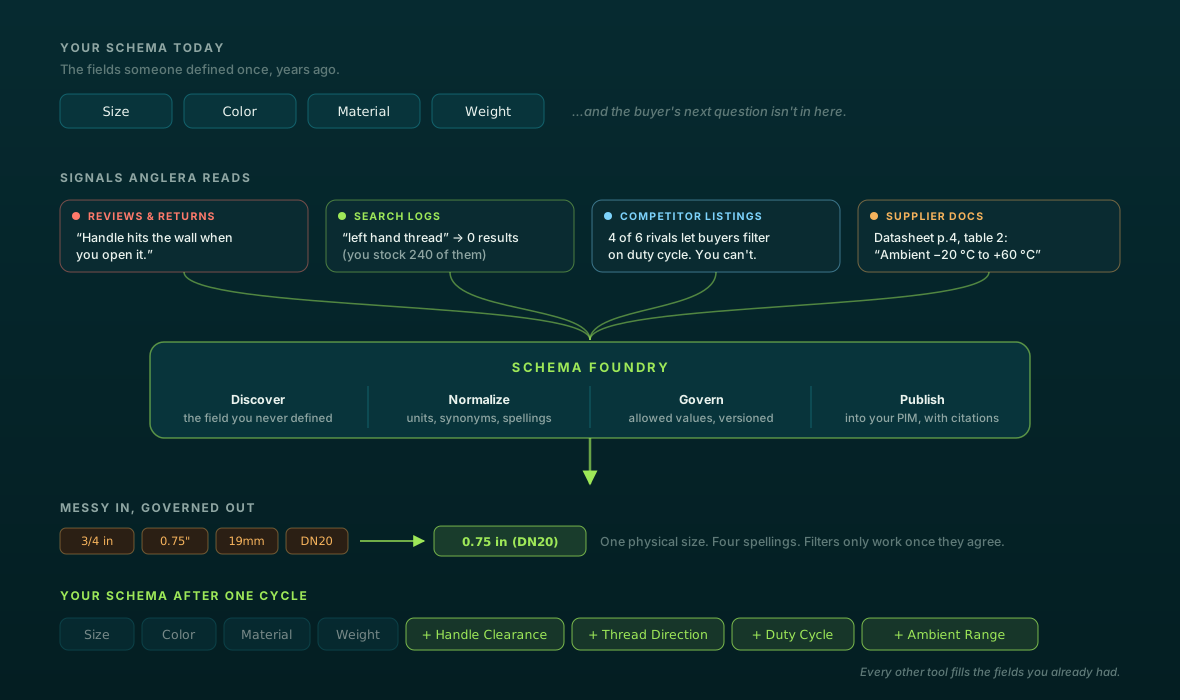
Filling the fields you defined has an invisible ceiling: a catalog can hit 100% complete and still miss the attribute that loses the sale, because completeness is measured against a schema someone drew years ago. Schema Foundry reads competitor listings, buyer searches, review complaints and your supplier docs, and proposes the fields you never defined — which is where Trade Service (Trimble) stops.

How Schema Foundry works
Schema Foundry: signals from reviews, search logs, competitor listings and supplier documents reveal attributes missing from your schema; the Foundry discovers, normalizes and governs them, so your schema ends the cycle with more fields than it started with.

What Trade Service (Trimble) does

Trade Service is the long-running product and pricing content database for the US MEP trades — electrical, plumbing and mechanical, HVAC, and PVF — founded in San Diego in 1931 as a publisher of pricing books for electrical contractors. Trimble acquired it from GF Capital Private Equity in June 2013, and it operates today as 'Trade Service, a division of Trimble Inc.' inside Trimble's construction supply-chain portfolio; the standalone tradeservice.com now redirects into trimble.com product pages. The subscription delivers current list, trade, and market pricing plus catalog content — long descriptions, UPCs, images, spec sheets, and manufacturer catalog pages — covering millions of items from over 500 manufacturers. Delivery vehicles are TRA-SER (product and pricing lookup for contractor and distributor staff), eDataFlex (automated price and item file loads into distributor ERPs), and Supplier Xchange (a real-time RFQ/quote hub connecting distributor ERP pricing to contractor estimating tools), bundled for distributors as Distributor One.

Pricing: Subscription data service; pricing not published. Sold per product (TRA-SER, eDataFlex, the Distributor One bundle). Supplier Xchange participation is free for TRA-SER and eDataFlex subscribers; NECA labor units are a paid add-on.

Trade Service (Trimble) website

When Trade Service (Trimble) is the right call

Electrical, plumbing/mechanical, and HVAC/PVF distributors and contractors whose bids and price files depend on current manufacturer pricing. Nine decades of manufacturer price-sheet relationships and update discipline make it the default pricing rail for the US MEP trades.

We'd rather tell you here than in month three of an implementation.

Capability verdicts reviewed against Trade Service (Trimble)'s public documentation on July 17, 2026. Vendors ship quickly — if something here is out of date, tell us and we'll correct it.

See it on your own SKUs.

Bring one category and your supplier files. In 30 minutes you'll see it enriched — complete, structured, and consistent enough to launch on — plus the attributes your schema didn't have yet.

Book a demo