An alternative to Vue.ai (Mad Street Den)AI enrichment tools
Anglera vs Vue.ai (Mad Street Den)
The bottom line
Buy Vue.ai if your attributes live in the photo and you want AI on-model imagery; note its catalog stack sits inside a fintech acquirer since 2025, reads images rather than supplier spec documents, and cites no sources.
Both claim to enrich product data. This page is about where that claim stops.
The frame for this comparison
Product data is a practice, not a project.
Product data is a practice, not a project — and against an enrichment-AI platform the argument is about what happens after the first pass: the SKUs the run flags for review, the tags that drift the week merchandising renames a category, and the fields whose source document nobody routed into the run.
01
Ground it
Mine every spec from every source.
Every value traced to a document you can open. The catalog is only as honest as what it was built from.
02
Align it
Aim the catalog at the buyer who actually buys.
Grounded data still loses if it answers questions nobody asked. Alignment is what turns specs into conversion.
03
Keep it alive
Product data is a practice, not a project.
Markets move, suppliers reissue, buyers change what they ask for. A catalog that is right in March is wrong by August unless something is watching.
Capability by capability
Where Vue.ai (Mad Street Den) stops.
Scored against public documentation. Grouped by the three acts — so you can see which ones Vue.ai (Mad Street Den) leaves on your desk.
01
Ground it
Mine every spec from every source.
CapabilityVue.ai (Mad Street Den)Anglera
Source mining
Where does it get specs from?
Vue.ai (Mad Street Den)Limited
Images, labels, OCR text, EAN lookups; not supplier spec docs
Does it find attributes that aren't in your schema yet?
Vue.ai (Mad Street Den)No
Custom taxonomy builder; customer defines the attribute set
AngleraYes
Proposes fields your schema never had
Governed vocabulary
Does it turn messy free-text into a governed pick list?
Vue.ai (Mad Street Den)Limited
Tags against preset taxonomies; no versioned vocabulary governance shown
AngleraYes
Normalizes and governs allowed values, versioned
Taxonomy & classification
Can it classify every SKU into your hierarchy?
Vue.ai (Mad Street Den)Yes
Auto category prediction into custom taxonomies; core strength
AngleraYes
Auto-classifies; channel and marketplace mapping
Citations & provenance
Can you see where any given value came from?
Vue.ai (Mad Street Den)No
QA dashboard only; no source citation per value
AngleraYes
Every value cites its source doc and page
02
Align it
Aim the catalog at the buyer who actually buys.
CapabilityVue.ai (Mad Street Den)Anglera
Buyer personas
Is the content written for your buyer, or generically?
Vue.ai (Mad Street Den)Limited
Descriptions in any tone; attributes not persona-differentiated
AngleraYes
B2B specifier and B2C shopper enriched differently
Review, search & social signals
Does it learn what buyers ask from the live market?
Vue.ai (Mad Street Den)Limited
Assortment analysis against user interest; reports to merchandisers
AngleraYes
Reviews, search, competitor rails, social — fed back
Copy & SEO
Does it write original, channel-ready copy?
Vue.ai (Mad Street Den)Yes
GenAI titles and descriptions in configurable tone, style
AngleraYes
Original copy per persona and channel
Product imagery
Can it produce usable images for SKUs that lack them?
Vue.ai (Mad Street Den)Yes
VueModel generates on-model photos from mannequin shots; fashion-focused
AngleraYes
Generates studio-grade imagery for photoless SKUs
03
Keep it alive
Product data is a practice, not a project.
CapabilityVue.ai (Mad Street Den)Anglera
Continuous re-enrichment
What happens when the market moves after go-live?
Vue.ai (Mad Street Den)Your team
Batch tagging runs; engine learns from QA inputs
AngleraYes
Re-enriches on its own after go-live
Quality scoring
Does it score its own output and track catalog health?
Vue.ai (Mad Street Den)Limited
QA dashboard tracks tag accuracy; no completeness scoring
AngleraYes
Scored against your standards; nothing publishes below bar
Write-back
Does enriched data land back in your system of record?
Vue.ai (Mad Street Den)Yes
Exports to PIM, DAM, CMS via API or CSV
AngleraYes
Writes back to PIM, ERP, warehouse, commerce
API, MCP & webhooks
Can your own tools and agents drive it headlessly?
Vue.ai (Mad Street Den)Limited
REST API and SDK; no MCP server found
AngleraYes
API, webhooks, and MCP servers
Who does the work
Does it do the work, or help your team do it?
Vue.ai (Mad Street Den)Your team
Software plus QA dashboard; customer team owns output
AngleraYes
Anglera owns the work; review is a guardrail
KeyYesships itLimitedlimited or gatedYour teamyour team still does itNodoesn't do itAnglera differentiator
What “buyer signals” actually means
Six signals sitting in your market right now.
“Buyer signals” is the emptiest phrase in this category, so here is the literal thing. Each of these is an observation from a live market, the gap it exposes, and the field that gets created as a result.
Search signal·internal site search logs, footwear
"2e wide", "4e running shoe", "wide fit d width" — recurring queries landing on zero-result or full-category pages
Width is a fit fact, not a visual one: a photo shows the shoe, not whether the last is D or 2E. It lives in the supplier's size grid, so it reaches the tag set only if someone routes that grid in and maps its labels to codes — and reaches the facet only if the taxonomy has a field waiting for it.
Field createdshoe_width_codeUS width codes: AA, A, B, D, 2E, 4E, 6E — one value per variant, mapped from the supplier's own grid ("Wide" → 2E, "X-Wide" → 4E)
Review signal·Q&A tab on a 15-inch laptop backpack PDP
"It's tagged for a 15\" laptop but my 15.6\" ThinkPad won't go in — the padded sleeve is about 14.5\" across at the opening."
An image supports "laptop compartment: yes". The buyer is deciding on interior sleeve dimensions and the largest device that actually fits — two governed numeric fields whose source is the tech pack. Someone has to decide those fields exist, fix the units, and get the tech pack into the pipeline.
Field createdlaptop_sleeve_interior_dimensions_in / max_device_diagonal_inInches to one decimal, always W x H x D measured at the sleeve opening; max_device_diagonal_in as a single number, never a marketing size class
Marketplace signal·Google Merchant Center diagnostics on the apparel feed
A block of dress variants disapproved: "missing size_type", "invalid size_system" — the offers carry "Petite 8" in a free-text size field and nothing else
The tagging pass produced good on-page facets — midi, floral, sleeveless. The channel wants two governed enum fields with Google's own allowed values. Pre-set retail tag sets and custom tags both exist; what has to be built and kept is the parse from a legacy free-text string into those enums, and an owner who maintains it as the spec changes.
Field createdsize_system + size_typesize_system: US, UK, EU, DE, FR, JP, IT, BR, CN, AU. size_type: regular, petite, plus, tall, big, maternity — parsed out of the legacy free-text size string, not appended to it
Why catalogs rot
The rot starts after the first pass
A tagging run leaves a catalog in three states. Fields it filled from what it could read. Fields where the answer came back borderline and someone has to look. And fields whose source is a document nobody routed in — the cordless drill's battery platform, the downlight's field-selectable CCT, the backpack's interior sleeve width, each sitting in a spec sheet or tech pack rather than the shot. Vue.ai's Data Hub auto-retrains models on user feedback, which means somebody has to keep giving it feedback: a queue, an owner, an hour a week. That queue is what quietly stops. Then merchandising renames a category, the taxonomy shifts under the tags, and last quarter's output is confidently wrong against the new tree. The model did its job. The practice around it lapsed.
Messy in, governed out.
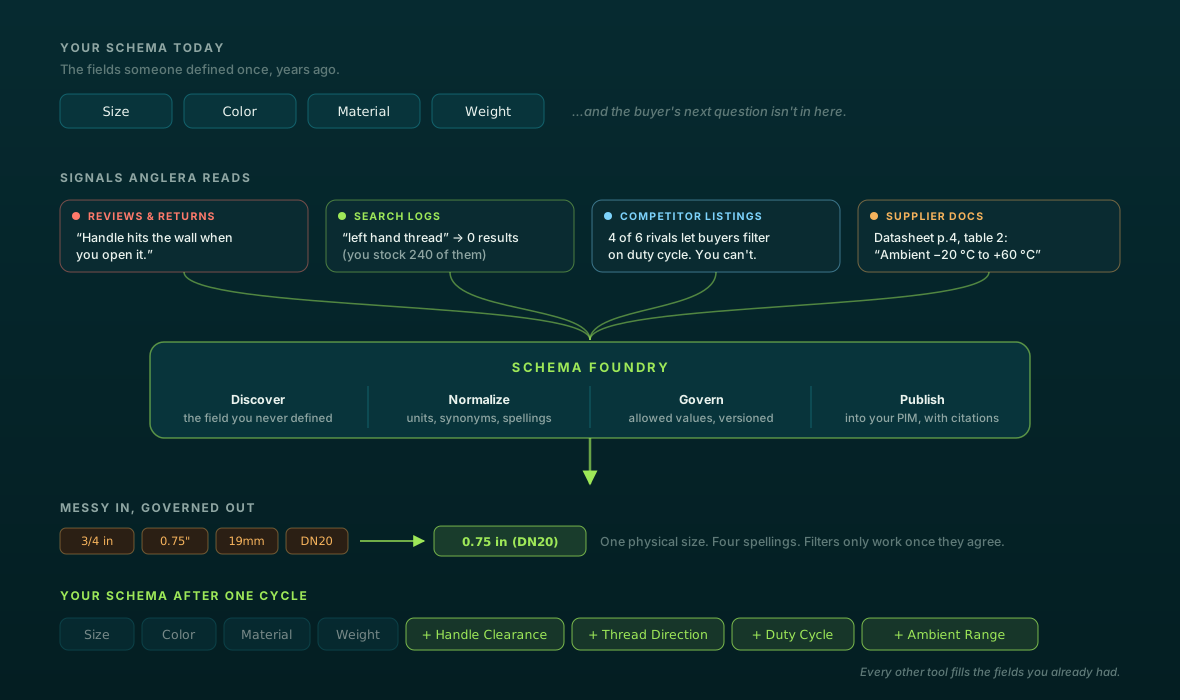
Values are normalized into a governed, versioned set of allowed values — so a filter works, and keeps working after the next import.
Nominal Size
3/4 in0.75"3/4"19mm3/4 inchDN20
0.75 in (DN20)
Six suppliers, six spellings, one physical size. Filters only work once they agree.
Finish
BlkblackBLACK MATTEMatte BlkRAL 9005
Black — Matte
Free text makes a colour filter useless. A governed value makes it a facet.
Material
SS316316 StainlessStainless Steel 316A4 Stainless
Stainless Steel — 316 / A4
Same alloy, four vocabularies, plus a trade name. Buyers search all of them.
And the part nobody else does
We don't just fill the template you handed us.
Filling the fields you defined has an invisible ceiling: a catalog can hit 100% complete and still miss the attribute that loses the sale, because completeness is measured against a schema someone drew years ago. Schema Foundry reads competitor listings, buyer searches, review complaints and your supplier docs, and proposes the fields you never defined — which is where Vue.ai (Mad Street Den) stops.
Vue.ai, from Chennai-based Mad Street Den, sells an enterprise AI platform whose retail modules include VueTag (automated product tagging via image recognition, NLP and OCR against custom taxonomies) and VueModel (AI-generated on-model fashion imagery from mannequin, ghost-mannequin or 3D input). VueTag extracts visual attributes, predicts categories, generates titles and descriptions, and exports to PIM, DAM or CMS via API or CSV. Mad Street Den was acquired by M2P Fintech in March 2025 in a reported $10-15M distress deal, and vue.ai now presents as a horizontal AI orchestration platform spanning retail, financial services, insurance, healthcare and logistics.
Pricing: Not publicly disclosed. No pricing page, tiers or per-SKU rates are published; retail product pages route to "Request Demo". Historic material referenced a self-serve VueTag app with API access gated to "VueTag Pro", but the vuetag.ai domain and its docs site no longer resolve, so that tier cannot be confirmed as current. Enterprise deals appear custom-quoted by scope and volume.
Fashion and apparel retailers needing visual attribute tagging at scale plus AI on-model imagery from mannequin shots — categories where attributes live in the photograph, not in a spec sheet.
We'd rather tell you here than in month three of an implementation.
Capability verdicts reviewed against Vue.ai (Mad Street Den)'s public documentation on July 14, 2026. Vendors ship quickly — if something here is out of date, tell us and we'll correct it.
See it on your own SKUs.
Bring one category and your supplier files. In 30 minutes you'll see it enriched — complete, structured, and consistent enough to launch on — plus the attributes your schema didn't have yet.