All comparisons
An alternative to WriterAI enrichment tools

Anglera vs Writer

The bottom line

Buy Writer if you need on-brand copy and custom agents across many departments and your attribute data is already clean. Buy Anglera if the hard part is upstream: extracting, normalizing and writing specs back to your PIM.

Both claim to enrich product data. This page is about where that claim stops.

The frame for this comparison

Product data is a practice, not a project.

Writer's own PDP walkthrough states the direction of flow plainly — the app "pulls details from your product information management (PIM) system" and generates retailer-specific copy for Amazon and Sephora — so the comparison isn't about who writes better copy; it's about what's sitting in that record on the second pass, six months after launch, when the SPF still lives in the product title and the water-resistance minutes were never captured at all.

01

Ground it

Mine every spec from every source.

Every value traced to a document you can open. The catalog is only as honest as what it was built from.

02

Align it

Aim the catalog at the buyer who actually buys.

Grounded data still loses if it answers questions nobody asked. Alignment is what turns specs into conversion.

03

Keep it alive

Product data is a practice, not a project.

Markets move, suppliers reissue, buyers change what they ask for. A catalog that is right in March is wrong by August unless something is watching.
Capability by capability

Where Writer stops.

Scored against public documentation. Grouped by the three acts — so you can see which ones Writer leaves on your desk.

01

Ground it

Mine every spec from every source.
Source mining
Where does it get specs from?
WriterYes

Vision plus Knowledge Graph ingest PDFs, images, docs, web crawls

AngleraYes

PDFs, spec tables, drawings, manuals, images, sites

Schema discovery
Does it find attributes that aren't in your schema yet?
WriterNo

No product schema concept; no attribute discovery or proposals

AngleraYes

Proposes fields your schema never had

Governed vocabulary
Does it turn messy free-text into a governed pick list?
WriterLimited

Governed brand termbank for prose, not attribute values

AngleraYes

Normalizes and governs allowed values, versioned

Taxonomy & classification
Can it classify every SKU into your hierarchy?
WriterNo

No SKU classification or channel category mapping

AngleraYes

Auto-classifies; channel and marketplace mapping

Citations & provenance
Can you see where any given value came from?
WriterLimited

Knowledge Graph gives inline citations to source files

AngleraYes

Every value cites its source doc and page

02

Align it

Aim the catalog at the buyer who actually buys.
Buyer personas
Is the content written for your buyer, or generically?
WriterLimited

Brand voice and audience tone; language only

AngleraYes

B2B specifier and B2C shopper enriched differently

Review, search & social signals
Does it learn what buyers ask from the live market?
WriterLimited

Web search tool available; no buyer-signal loop

AngleraYes

Reviews, search, competitor rails, social — fed back

Copy & SEO
Does it write original, channel-ready copy?
WriterYes

Core strength; dedicated product description and PDP agents

AngleraYes

Original copy per persona and channel

Product imagery
Can it produce usable images for SKUs that lack them?
WriterNo

Palmyra Vision reads images; no image generation

AngleraYes

Generates studio-grade imagery for photoless SKUs

03

Keep it alive

Product data is a practice, not a project.
Continuous re-enrichment
What happens when the market moves after go-live?
WriterLimited

Event-triggered agents; no autonomous SKU re-enrichment

AngleraYes

Re-enriches on its own after go-live

Quality scoring
Does it score its own output and track catalog health?
WriterNo

Scores prose against brand rules, not catalog data

AngleraYes

Scored against your standards; nothing publishes below bar

Write-back
Does enriched data land back in your system of record?
WriterLimited

Connectors and HTTP blocks write; no PIM connector

AngleraYes

Writes back to PIM, ERP, warehouse, commerce

API, MCP & webhooks
Can your own tools and agents drive it headlessly?
WriterYes

Full REST API, official MCP server, HTTP triggers

AngleraYes

API, webhooks, and MCP servers

Who does the work
Does it do the work, or help your team do it?
WriterYour team

Software platform; your team builds and runs agents

AngleraYes

Anglera owns the work; review is a guardrail

KeyYesships itLimitedlimited or gatedYour teamyour team still does itNodoesn't do itAnglera differentiator
What “buyer signals” actually means

Six signals sitting in your market right now.

“Buyer signals” is the emptiest phrase in this category, so here is the literal thing. Each of these is an observation from a live market, the gap it exposes, and the field that gets created as a result.

Review signal·one-star reviews on a retailer's PDP for a mineral sunscreen stick

"Wore this surfing and it was gone in twenty minutes" turns up again and again, next to "is this the 80-minute one or the 40?" The page says water-resistant, great for the beach.

Water resistance is a tested, time-bound number printed on the drug facts panel — 40 or 80 minutes — and the record carries an adjective in its place. No sentence, however well written, can state a number the record doesn't hold, and that number decides both the purchase and the return.

Field createdwater_resistance_min (integer, minutes), spf (integer), uv_filter_type (enum), broad_spectrum (boolean)water_resistance_min constrained to 40 | 80 | Not water resistant; uv_filter_type normalised to Mineral | Chemical | Hybrid, read off the drug facts panel rather than the marketing line
Competitor signal·the filter rail on a national retailer's stand mixer category page, where two rival brands appear and ours doesn't

Shoppers can narrow by bowl capacity (4.5 / 5 / 6 / 7 qt) and by motor wattage. Two competing 6-quart mixers are filterable. Our 6-quart model isn't — its capacity exists only inside the description paragraph, as "a generous 6-quart stainless bowl".

The retailer builds that facet from a structured field it was sent. Prose in the description doesn't populate it, however well the prose is written, so the SKU is missing from the shelf the shopper is actually browsing.

Field createdbowl_capacity_qt (decimal), motor_power_w (integer), head_style (enum), attachment_hub (boolean)capacity stored in quarts with a litre equivalent carried alongside; head_style normalised to Tilt-head | Bowl-lift
Social signal·a large-breed subreddit thread asking which kibble is actually safe for a growing puppy

Commenters photograph the back of the bag and paste the AAFCO statement, because the brand pages don't show it. The question underneath never changes: what's the calcium percentage, and is the food formulated for growth of large-size dogs, 70 lb or more as an adult?

The life-stage statement and the large-breed growth qualifier are regulated text printed on the bag and absent from the record. A page built from that record can describe puppy nutrition warmly and still leave the one disqualifying question unanswered — which is why the answer ends up on Reddit instead of the PDP.

Field createdaafco_life_stage (enum), large_breed_growth_statement (boolean), calcium_pct_dry_matter (decimal), kcal_per_cup (integer)aafco_life_stage normalised to Growth | Maintenance | All Life Stages | Growth including large-size dogs (70 lb+) | Not AAFCO-substantiated
Why catalogs rot

Generation reads the record it is pointed at

Writer's walkthrough describes the flow: the app pulls name, descriptions, benefits and usage instructions from the PIM, and its AI Studio build steps start with "Define inputs: Select data from your PIM." Its retail page also lists automated checks that verify retailer specs, legal claims and required fields. All of that operates on whatever record it is pointed at. So the standing question isn't how the copy reads — it's what the record said on the day it was read. If water-resistance minutes were never captured, or the SPF exists only inside the product title, that is the input. Formulations get reformulated. Suppliers revise spec sheets. Completing and re-checking attributes against a schema is a recurring job that sits upstream of generation: the PIM stores the record, Anglera does the work of filling it, Writer reads it. A stack, not a fight.

Messy in, governed out.

Values are normalized into a governed, versioned set of allowed values — so a filter works, and keeps working after the next import.

Nominal Size
3/4 in0.75"3/4"19mm3/4 inchDN20
0.75 in (DN20)

Six suppliers, six spellings, one physical size. Filters only work once they agree.

Finish
BlkblackBLACK MATTEMatte BlkRAL 9005
Black — Matte

Free text makes a colour filter useless. A governed value makes it a facet.

Material
SS316316 StainlessStainless Steel 316A4 Stainless
Stainless Steel — 316 / A4

Same alloy, four vocabularies, plus a trade name. Buyers search all of them.

And the part nobody else does

We don't just fill the template you handed us.

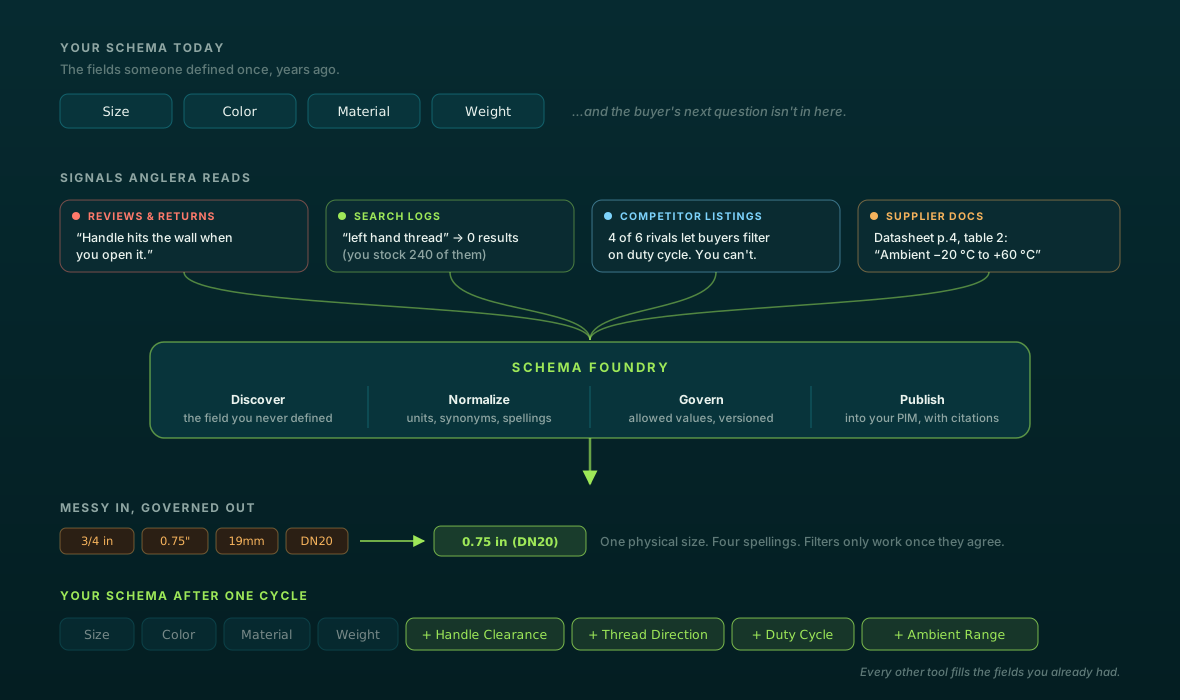
Filling the fields you defined has an invisible ceiling: a catalog can hit 100% complete and still miss the attribute that loses the sale, because completeness is measured against a schema someone drew years ago. Schema Foundry reads competitor listings, buyer searches, review complaints and your supplier docs, and proposes the fields you never defined — which is where Writer stops.

How Schema Foundry works
Schema Foundry: signals from reviews, search logs, competitor listings and supplier documents reveal attributes missing from your schema; the Foundry discovers, normalizes and governs them, so your schema ends the cycle with more fields than it started with.

What Writer does

Writer is an enterprise generative AI platform, now positioned around agentic work: business teams build and deploy AI agents and apps on Writer's proprietary Palmyra LLM family, with graph-based RAG, guardrails, and connectors to systems like Salesforce, Slack, and Google Workspace. Its Agent Library ships 100+ prebuilt agents, including retail and CPG agents for product descriptions, PDP copy, and PDP translation. Retailers like Adore Me use it to generate on-brand, SEO-optimized product descriptions at scale, and enterprise customers include Mars, Prudential, Qualcomm, Uber, and Salesforce.

Pricing: Per-seat SaaS: a Starter tier at roughly 29 dollars per user per month billed annually (39 dollars monthly); enterprise agent deployments are custom-quoted through sales.

Writer website

When Writer is the right call

Enterprise teams standardizing on one AI platform across marketing, support and ops — brand-governed prose, 100+ prebuilt agents, and Salesforce/Slack/Workspace connectors your team builds on.

We'd rather tell you here than in month three of an implementation.

Capability verdicts reviewed against Writer's public documentation on July 14, 2026. Vendors ship quickly — if something here is out of date, tell us and we'll correct it.

See it on your own SKUs.

Bring one category and your supplier files. In 30 minutes you'll see it enriched — complete, structured, and consistent enough to launch on — plus the attributes your schema didn't have yet.

Book a demo