1WorldSync vs Informatica PIM: Which One Is Right for You?
These two platforms solve different problems, which makes a direct comparison surprisingly clarifying. 1WorldSync is the world's dominant GDSN data pool — it exists to certify and transmit GS1-structured product data to retailers and trading partners at scale. Informatica Product 360 is an enterprise PIM and MDM platform — it exists to be the authoritative internal system of record for product information, with governance workflows and AI enrichment built in.
Most buyers who land on this comparison are not actually deciding between the two; the tools serve different layers of the stack. But some are: CPG manufacturers wondering whether a GDSN membership alone is sufficient, or large enterprises evaluating whether a full MDM deployment is overkill when syndication is the primary need. This page addresses both groups honestly.
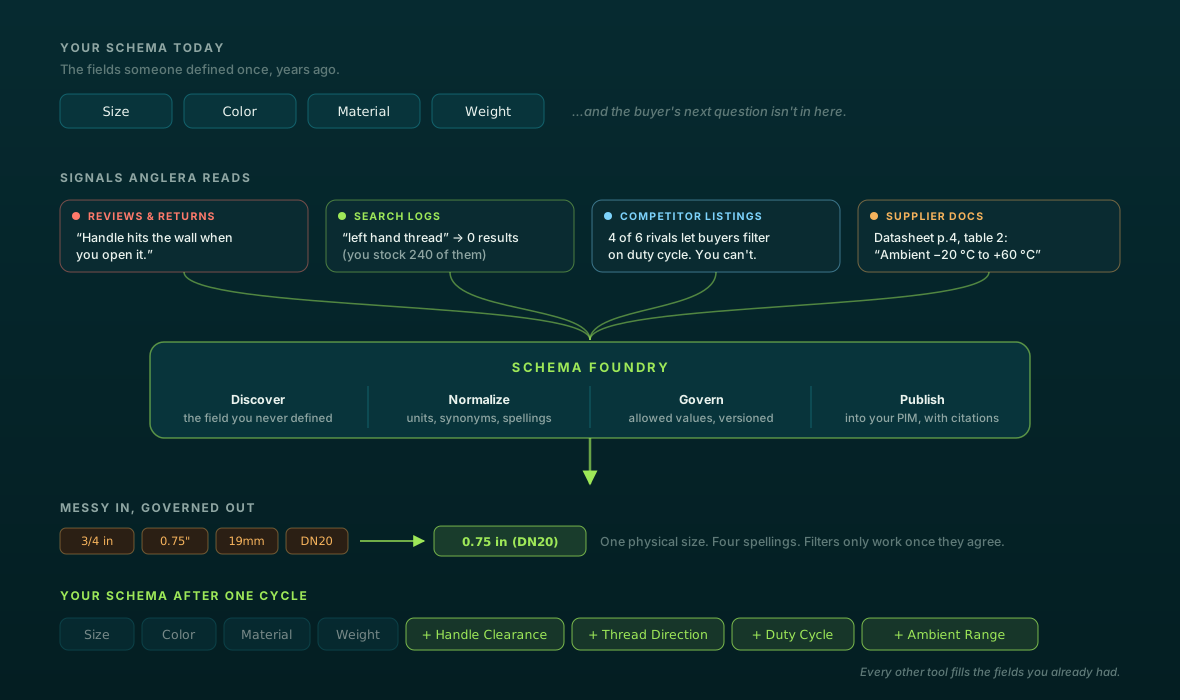
Neither platform enriches your data before ingesting it. That upstream work — sourcing, cleaning, normalizing, and scoring attributes against buyer demand signals — is what Anglera handles. Whichever platform you choose as your system of record or distribution layer, Anglera fills the enrichment gap that both tools assume already happened.
| 1WorldSync | Informatica PIM | Anglera | |
|---|---|---|---|
| Primary function | GDSN data pool and product content syndication. Certifies and distributes GS1-structured product data to 14,000+ brands and trading partners across 60+ countries. | Enterprise PIM and MDM platform. Centralizes product information governance, workflow, and distribution for manufacturers, distributors, and retailers. | Enrichment layer that sits upstream of either. Sources, cleans, and scores attribute data before it enters the system of record or syndication pipeline. |
| Best-fit buyer | CPG brands and manufacturers required by major grocery chains to push GDSN-compliant content. If your buyers mandate 1WorldSync participation, the decision is already made. | Large enterprises needing a governed, auditable system of record for product data across complex hierarchies, channels, and regions — and with the budget and timeline to match. | Any team whose product attributes are incomplete, inconsistent, or unscored against buyer demand — regardless of which platform stores or distributes the final record. |
| Trading partner connectivity | De facto standard for US grocery and mass retail. Direct GDSN connections to major retail chains; GS1-certified data pool with regulatory-grade attribute validation baked in. | Broad integration framework across the enterprise data stack, but not a GDSN data pool. Trading partner distribution requires additional connectors or a separate syndicator such as 1WorldSync. | Not a syndication layer. Anglera enriches the product record before it reaches the syndicator or PIM, so downstream data quality improves across all connected trading partners. |
| Data governance and validation | GS1 schema validation and GDSN compliance rules enforced at ingestion. Validation is focused on format and regulatory completeness — not content quality or marketing richness. | Enterprise MDM governance with configurable workflow, data quality rules, role-based approvals, and audit trails across the full product lifecycle. | Attribute-level completeness scoring against buyer demand signals. Flags gaps before data enters either platform so governance catches fewer errors downstream. |
| Implementation timeline | GDSN onboarding for a mid-market manufacturer typically runs 3–6 months to get trading partner connections live, depending on catalog size and partner count. | Widely cited as a long-cycle enterprise deployment. 6–18+ months is common depending on MDM scope, data migration, and integration complexity. | Approximately 30 days from kickoff to enriched product records in production. Designed to layer into existing workflows without displacing the PIM or syndicator. |
| Pricing signal | Not publicly listed. Industry estimates: $500–$2,000/month mid-market; $25,000–$90,000+/year enterprise; implementation fees of $10,000–$100,000+. Large enterprise contracts can reach ~$1M/year. | Quote-only. Subscription-based across Standard, Professional, and Enterprise tiers; widely cited as expensive. Pricing is driven by users, data volume, and configuration scope. | Separate engagement, priced per enrichment workflow rather than per seat. Cost scales with catalog size and enrichment scope, not platform licensing. |
| AI and enrichment capability | Validation-focused. AI is applied primarily to format compliance and completeness checks against GS1 schemas — not to generating or improving attribute content. | Positions itself as an Agentic AI PIM. AI agents assist with enrichment, validation, and data management inside the platform; depth varies by tier and configuration. | Dedicated enrichment: crawls supplier and competitor sources, cleans and normalizes attributes, scores completeness against demand signals, and writes enriched data back to the PIM or pre-syndication workflow. |
How to choose between 1WorldSync and Informatica PIM
Choose 1WorldSync if your retailers require it. For CPG brands and manufacturers selling into major US grocery chains, GDSN membership is often non-negotiable — your buyers will tell you. 1WorldSync is the dominant data pool for that channel, and its network effect (14,000+ brands, 60+ countries) means your trading partners are already there. If your compliance team is asking about GS1 attributes and your channel is grocery or mass retail, start here.
Choose Informatica Product 360 if you need an enterprise system of record. If your product data challenge is internal — multiple business units contributing to the same catalog, complex approval workflows, regulatory documentation across regions, or integration across a large enterprise data stack — Informatica's MDM depth is built for that. It is a significant investment in money and implementation time, so it fits organizations where data governance is a strategic priority with dedicated resources to match, not a cleanup project.
If you need both, they can coexist. Informatica as the internal system of record, 1WorldSync as the GDSN distribution layer. Many large CPG enterprises run exactly this stack.
Neither is the right choice if your core problem is data quality. Both platforms assume the attributes you bring them are reasonably complete and accurate. If your catalog has missing values, inconsistent units, or content that underperforms against buyer search signals, resolving that upstream is the higher-leverage move — before you pay to store or syndicate the problem at scale.
Whichever you pick, the data still has to get done
Neither 1WorldSync nor Informatica Product 360 enriches your product data before it arrives. 1WorldSync validates that your attributes conform to GS1 schemas — it does not source missing values, fill incomplete fields, or score your content against what buyers are actually searching for. Informatica's AI agents work on data that already exists inside the platform — they do not crawl supplier sites, normalize units across sources, or benchmark attribute completeness against demand signals.
Anglera fills that upstream gap regardless of which platform you choose. In a typical workflow, Anglera connects to your existing sources — supplier data, web crawls, internal spreadsheets — cleans and normalizes the attributes, scores completeness against buyer demand signals, and writes enriched product records back to your PIM or pre-GDSN workflow before the data ever reaches Informatica or 1WorldSync.
The result is fewer validation failures inside 1WorldSync, fewer governance exceptions inside Informatica, and richer product content reaching your trading partners. Implementation takes approximately 30 days and does not require replacing or reconfiguring your existing platform. Your PIM stores the data; Anglera does the work that gets it there clean.
Frequently asked questions
Can 1WorldSync replace a PIM?
Not meaningfully. 1WorldSync is purpose-built for GDSN syndication — it validates and distributes GS1-structured data to trading partners. It is not designed to manage the full product information lifecycle, support internal workflow and approvals, or serve as the system of record across channels. Most organizations using 1WorldSync maintain a separate PIM or MDM platform upstream.
Does Informatica Product 360 connect to GDSN?
Not natively. Informatica Product 360 is a PIM and MDM platform, not a GDSN data pool. Organizations that need GDSN compliance typically integrate Product 360 with a separate data pool such as 1WorldSync to handle trading partner distribution.
How long does it take to implement each platform?
1WorldSync onboarding for a mid-market manufacturer typically runs 3–6 months depending on catalog size and trading partner count. Informatica Product 360 is a larger deployment — 6–18+ months is commonly cited for enterprise MDM implementations. Anglera typically reaches production-ready enriched output within approximately 30 days.
Is Informatica Product 360 the right fit for a mid-market company?
Probably not. Informatica Product 360 is designed for large enterprises with complex MDM requirements, significant data volumes, and multi-regional governance needs. Mid-market companies often find the implementation timeline, licensing cost, and organizational overhead disproportionate to the problem they are trying to solve. A lighter PIM or a targeted enrichment layer typically delivers better return on investment.
Where does Anglera fit if I already use both 1WorldSync and Informatica?
Anglera operates upstream of both. It enriches product records before they enter Informatica for governance or flow through 1WorldSync for syndication. If you already run both platforms, Anglera reduces the internal cleanup work inside Product 360 and reduces validation failures inside 1WorldSync by ensuring attributes are complete and correctly formatted before they reach either system.