1WorldSync vs Pimberly: Which Platform Fits Your Product Data Stack?
1WorldSync and Pimberly both deal in product data at scale, but they solve meaningfully different problems. 1WorldSync is a GDSN-certified data pool and syndication network — its core job is moving GS1-structured product content from brands and manufacturers to retail trading partners, including the major US grocery chains that require it. Pimberly is a cloud PIM and DAM — its core job is giving e-commerce and marketing teams a governed, single source of truth they can publish from across multiple channels. A buyer evaluating both usually has one of two situations: they are a manufacturer who primarily needs GDSN compliance and retailer onboarding, or they are a retail or commerce team that needs to centralize and govern a large, messy catalog.
The overlap exists at mid-to-large manufacturers who sell through both grocery retail (GDSN required) and direct-to-consumer or distributor channels (rich content required). In that case, the real question is not which one to pick but which one to anchor on — and whether the other belongs in the stack at all.
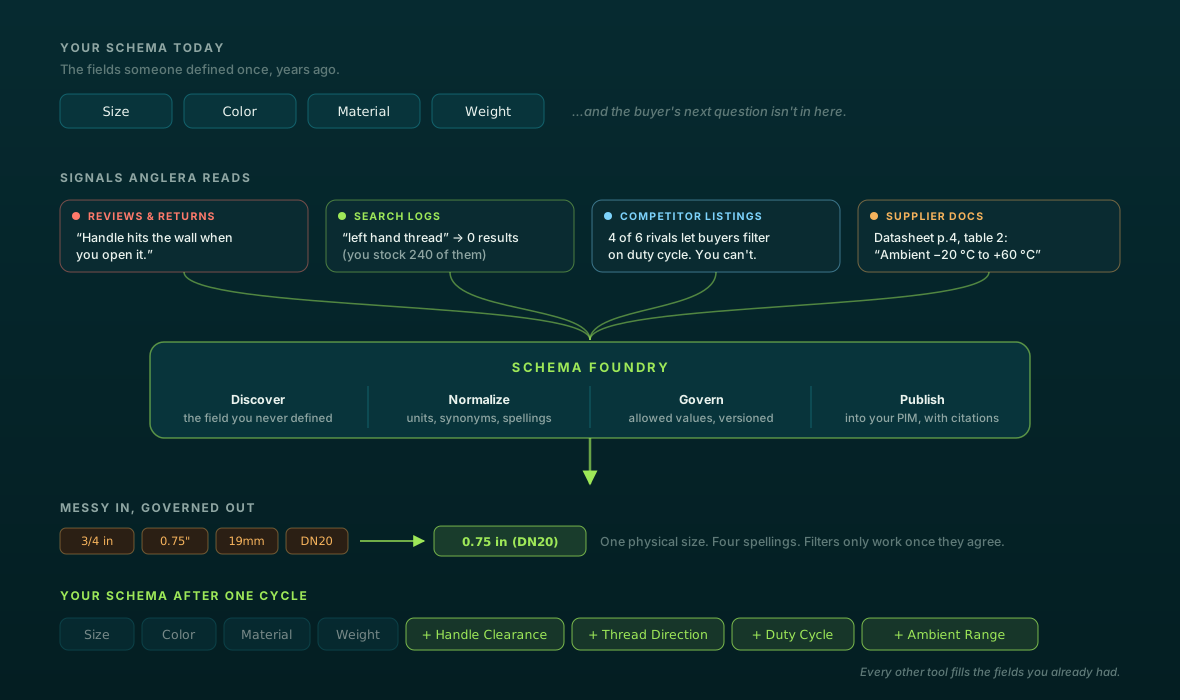
One thing neither platform does: enrich the underlying data. 1WorldSync validates that your attributes conform to GS1 schema. Pimberly enforces your own validation rules and publishes what you put in. Both assume you arrive with complete, accurate product content. That assumption is almost never true in practice, which is where a dedicated enrichment layer fits regardless of which platform you choose.
| 1WorldSync | Pimberly | Anglera | |
|---|---|---|---|
| Primary function | GDSN-certified data pool and product content orchestration — the authoritative channel for syndicating structured product data to retailers and trading partners at regulatory-grade quality | Cloud PIM + DAM — centralize product content and digital assets, enforce governance rules, and automate publishing across e-commerce channels and marketplaces | Enrichment layer that reads existing product records from either system, fills attribute gaps against buyer signals and live web sources, and writes improved data back — so both platforms receive cleaner input |
| Standards and compliance | GS1 GDSN certified; enforces structured attributes required by major retailers including GTINs, nutritional data, and HPPC specifications — retailers like Walmart and Kroger mandate this network | Configurable validation rules and channel-specific data quality checks; not a GDSN data pool and not GS1-certified for syndication | Normalizes and maps attribute values to match buyer-signal requirements and channel specs before data enters either platform's validation or distribution layer |
| Distribution reach | Directly syndicates to 14,000+ brands across 60+ countries; the de facto standard for US grocery, mass retail, and CPG trading partner networks | Publishes to e-commerce channels, marketplaces, and retailers via API connectors and feed exports; reach depends on which connectors the team configures | Channel-agnostic — enrichment improvements flow to whichever downstream destinations either platform feeds, without Anglera sitting in the distribution path |
| Digital asset management | Product images and digital assets are managed as part of structured content packages for syndication; not a full-featured DAM | Full built-in DAM — asset storage, metadata tagging, file transformation, and channel-specific renditions included in the platform | Flags missing or low-quality assets as part of SKU completeness scoring; does not store or transform assets |
| Ideal buyer | CPG brands, manufacturers, and suppliers whose retailers demand GDSN synchronization; typically operated by supply chain, data management, or regulatory compliance teams | Mid-market e-commerce and retail teams with large SKU catalogs and multiple sales channels; typically operated by marketing, merchandising, or e-commerce content teams | Any team whose downstream data quality — conversion rates, retailer acceptance, content scores — is limited by what is actually in their catalog records today |
| Pricing and investment level | Not publicly listed; industry estimates of $25,000–$90,000+/year for mid-to-large enterprise, plus $10,000–$100,000+ in implementation fees; large enterprise contracts can reach ~$1M/year | Starts at approximately $30,000/year; custom pricing scales with SKU volume and channel count; not published as fixed tiers | Priced per SKU enrichment rather than per seat or platform; adds on top of either tool without replacing it |
| Implementation complexity | Significant onboarding: GDSN registration, GS1 data model mapping, trading partner setup, and retailer-specific attribute requirements; typically takes several months | SaaS PIM with guided onboarding; implementation ranges from weeks to a few months depending on catalog size and data migration complexity | ~30-day implementation alongside whichever platform is already in place; connects to the existing data source and writes enriched records back without a rip-and-replace |
How to choose between 1WorldSync and Pimberly
Choose 1WorldSync if your primary pain is getting product data to major retail trading partners in a format they will accept. If Walmart, Kroger, Target, or another retailer has told you they require GDSN synchronization, 1WorldSync is effectively the required answer — it is the dominant US data pool and the one most large grocery chains are already connected to. The buyer here is typically a CPG brand or manufacturer, and the team driving the decision is in supply chain or regulatory compliance, not e-commerce content.
Choose Pimberly if your primary pain is internal: scattered product content, missing digital assets, inconsistent information across channels, and no clear system of record. Pimberly is built for the team managing product content — it centralizes ownership, enforces data quality rules, and automates publishing to the channels that matter for commerce. The buyer is typically a mid-market retailer, brand, or distributor whose catalog complexity has outgrown spreadsheets and ad-hoc feeds.
Consider both if you are a mid-to-large manufacturer with two distinct distribution motions: a GDSN-dependent retail channel (grocery, mass, club) that 1WorldSync serves, and a DTC or distributor channel where rich, marketing-grade content matters and Pimberly governs. In that architecture, Pimberly holds the internal source of truth and 1WorldSync handles the structured syndication feed — and they are not in competition with each other.
Whichever you pick, the data still has to get done
Whichever platform you choose, it assumes you arrive with complete, accurate product data. That assumption almost never holds.
1WorldSync validates that your attributes match GS1 schema — it does not write missing nutritional fields, source accurate dimensions, or improve thin product descriptions. Pimberly enforces the rules you configure and publishes what you put in — it does not go find what is not there. Both platforms are excellent at moving and governing product content. Neither is designed to create or improve it.
Anglera fills that gap. It connects to your existing PIM or data source, reads every SKU, enriches incomplete attributes against buyer signals and live web sources, scores completeness, and writes the improved records back. The result is cleaner data flowing into 1WorldSync's GDSN feeds — fewer retailer rejections, faster trading-partner onboarding — and higher-quality content coming out of Pimberly's channel exports — better conversion, stronger search performance, fewer customer returns.
The implementation runs alongside whichever platform is already in place in about 30 days. No new system of record. No rip-and-replace. Your PIM stores the data; Anglera does the work.
Frequently asked questions
Can 1WorldSync and Pimberly be used together?
Yes, and some mid-to-large manufacturers do exactly this. Pimberly acts as the internal product content hub where marketing and e-commerce teams manage rich content and digital assets, while 1WorldSync handles the structured GDSN syndication feed to grocery and mass-retail trading partners. Because their primary jobs are different — internal governance versus external syndication — there is minimal functional overlap, and the two platforms can feed from a common source of truth.
Is 1WorldSync a PIM?
Not primarily. 1WorldSync is a GDSN data pool and product content orchestration platform. Its core value is the certified syndication network and the GS1-structured attribute validation that major retailers require. It can hold product data, but it is not designed to be an internal system of record for a brand's full catalog the way a dedicated PIM is. Teams that need rich content management, DAM capabilities, and multi-channel publishing governance typically run a separate PIM alongside it.
Does Pimberly support GDSN syndication?
Pimberly is a PIM and DAM, not a GDSN-certified data pool. It can export structured data and connect to third-party syndication tools, but it does not natively participate in the GDSN network the way 1WorldSync does. Brands with GDSN requirements from major retailers typically need a dedicated certified data pool — such as 1WorldSync — in addition to their PIM.
Where does enrichment fit if I already have one of these platforms?
Both platforms assume you bring complete, accurate product data. In practice, most catalogs have real gaps — missing attributes, thin descriptions, unverified specifications, incomplete nutritional or compliance fields. Anglera enriches those records before they flow into your PIM or GDSN feed, so the data your platform stores and distributes is already as complete as possible. It connects to your existing system and writes enriched records back, rather than creating a third system to manage.
How long does it take to get value from Anglera alongside either platform?
Anglera typically delivers enriched SKUs within 30 days of integration. It connects to your existing PIM, data pool, or catalog source, enriches against buyer signals and live web data, scores completeness, and writes records back — no new system to operate and no changes to your existing platform configuration.