1WorldSync vs Sales Layer: GDSN Distribution vs PIM — Compared Honestly
These two tools are solving different problems, which is the most important thing to understand before comparing them. 1WorldSync is a GDSN-certified data pool — its core job is to publish GS1-validated product data to retail trading partners through the Global Data Synchronization Network. Sales Layer is a cloud PIM — its core job is to store, validate, and distribute product content from a central source of truth to channels, marketplaces, and portals. Many CPG manufacturers end up using both; most distributors and non-grocery retailers will find Sales Layer sufficient on its own.
The question of which to choose usually comes down to one thing: do your retail trading partners require GDSN compliance? If major US grocery chains, drug chains, or mass-market retailers are in your customer list and mandate GDSN delivery, 1WorldSync is effectively required — no PIM or general syndication platform substitutes for a certified data pool in that context. If GDSN compliance isn't a requirement, Sales Layer competes on a cleaner field: fast onboarding, an intuitive interface, and a Supplier Portal built for B2B workflows.
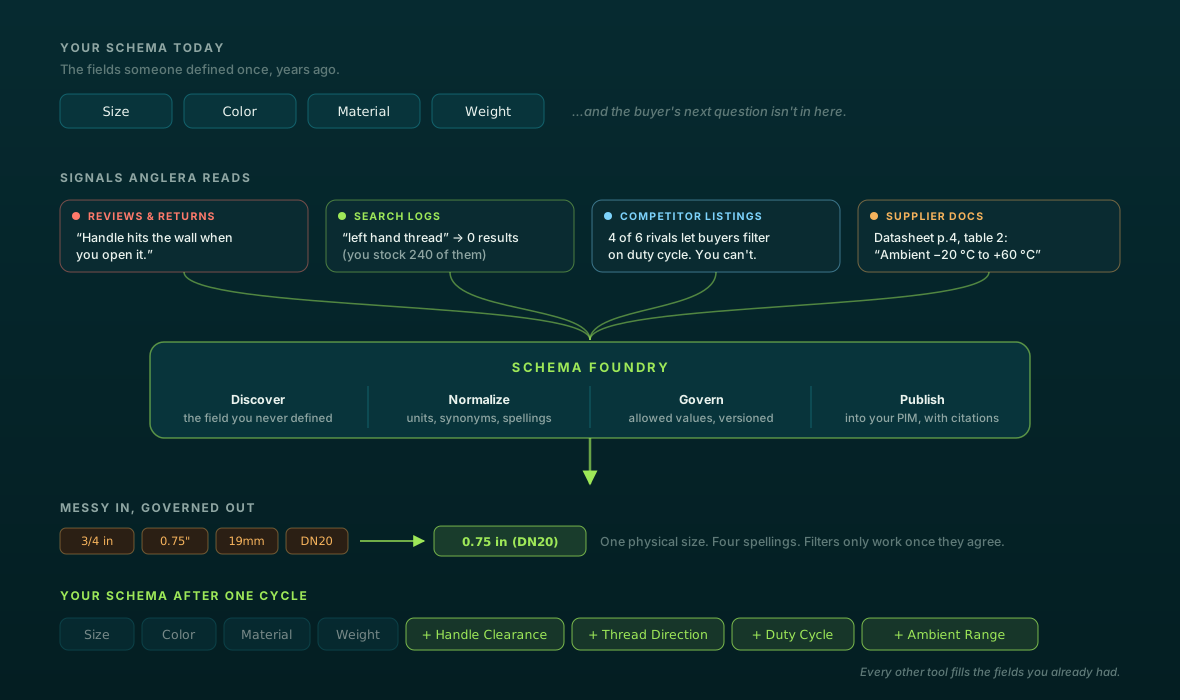
Neither platform, however, enriches the data they manage. 1WorldSync validates that your attributes conform to GS1 schemas; it does not fill in what is missing. Sales Layer centralizes and distributes what your team and suppliers enter; the completeness of outbound content is bounded by what went in. That gap — gathering missing attributes, normalizing inconsistencies, and scoring every SKU against what buyers actually search for — sits outside both platforms' scope.
| 1WorldSync | Sales Layer | Anglera | |
|---|---|---|---|
| Primary job | Publish GS1-validated product data to retail trading partners through the GDSN network. The authoritative pipeline for "did my data reach the retailer?" at scale. | Centralize product data into a single internal source of truth, then syndicate that content to channels, marketplaces, and retailer portals through connectors. | Neither platform enriches raw supplier data. Anglera fills that gap upstream — gathering, cleaning, scoring, and writing back enriched attributes before data flows outward through either system. |
| Best-fit buyer | CPG brands and manufacturers that supply major US grocery, drug, or mass-market retail chains with GDSN mandates. Also large global manufacturers operating across 60+ country trading partner networks. | Manufacturers, distributors, and retailers that need a fast-deploy PIM with supplier onboarding and multi-channel syndication, without a GDSN compliance requirement. | B2B distributors, manufacturers, and retailers with large SKU catalogs where supplier-provided data is incomplete or inconsistent — works alongside whichever platform the buyer already uses or chooses. |
| Standards and compliance | Deep GS1/GDSN standards compliance. Validates against GTINs, GLNs, and retailer-specific attribute schemas. The de facto standard for US grocery chains. Regulator-grade audit trails. | Flexible attribute modeling and internal validation rules, but not a GDSN-certified data pool. Cannot publish directly into the GDSN network. Well-suited for non-grocery channel compliance requirements. | Enriches and normalizes attributes to match whatever schema the downstream platform requires — including GDSN attribute sets, retailer-specific fields, or marketplace standards — before the data is published. |
| Trading-partner and channel reach | Direct GDSN connectivity to 14,000+ brands across 60+ countries; 1WorldSync is the de facto data pipe for major US grocery chains. Reach is built into the network itself. | Syndicates to e-commerce channels, marketplaces, and retailer portals through pre-built connectors. Reach depends on the integration library rather than a global registry. | Enriches the underlying product content so every SKU that flows through 1WorldSync's network or Sales Layer's connectors is as complete and accurate as possible before it reaches any trading partner. |
| Time to value / onboarding | Large enterprise deployments with complex trading-partner attribute mapping can take months. Significant upfront setup investment, particularly for brands onboarding to multiple retailer schemas simultaneously. | Targets 6-week onboarding. 30-day free trial available. Tiered plans let smaller teams get started without a lengthy enterprise procurement cycle. | ~30-day implementation. Runs alongside your existing PIM or syndication stack without replacing it — no rip-and-replace required. |
| Pricing | Not publicly listed. Industry estimates: $500–$2,000/month for mid-market; $25,000–$90,000+/year for enterprise, plus $10,000–$100,000+ in implementation fees. Large contracts can reach ~$1M/year. | Starts at ~$1,000/month; custom quote required for most plans. 30-day free trial. Tiered by team size and feature set (Core → Enterprise). | Separate enrichment contract; contact for pricing. Offsets the manual enrichment labor cost that neither platform eliminates on its own. |
| Content enrichment and quality | Validates that data conforms to GS1 schemas and trading-partner requirements — structural compliance, not content quality. Accurate and complete are two different things; 1WorldSync ensures the former. | Offers AI-assisted content generation and completeness scoring within the PIM. Enrichment quality depends heavily on what suppliers provide during onboarding — gaps in supplier data become gaps in the catalog. | Purpose-built for enrichment: actively gathers missing attributes from web sources, normalizes inconsistencies, scores every SKU against buyer signals, and writes enriched records back to the source of truth. |
How to choose between 1WorldSync and Sales Layer
Choose 1WorldSync if your business is a CPG brand or manufacturer supplying major US grocery, drug, or mass-market retail chains that mandate GDSN-compliant data delivery. In that context, 1WorldSync is not optional — it is the required pipe between you and your retail trading partners. It is also the right choice if you need audit-grade compliance with GS1 attribute schemas, operate across multiple country trading partner networks, or need to onboard to dozens of retailer-specific data schemas simultaneously. Budget for enterprise-level pricing and a non-trivial implementation timeline.
Choose Sales Layer if you need a modern, fast-deploy PIM as your internal source of truth and GDSN compliance is not a requirement. Sales Layer is well-suited for manufacturers, distributors, and retailers that manage product content across internal teams and multiple outbound channels, need a Supplier Portal for B2B onboarding, and want something running in weeks rather than months. Its tiered pricing and free trial make it accessible without a long procurement cycle.
Note on using both: Some mid-to-large CPG manufacturers run Sales Layer as their internal content hub and 1WorldSync for GDSN distribution to grocery retail trading partners. The two tools are not mutually exclusive — Sales Layer manages the content workflow; 1WorldSync handles the regulated distribution channel. If that is your situation, the relevant question shifts from "which one" to "how do we keep both systems fed with quality data."
Whichever you pick, the data still has to get done
Both 1WorldSync and Sales Layer move product data — but neither one enriches it. 1WorldSync validates structure against GS1 schemas and distributes what you give it; Sales Layer centralizes and syndicates what your team and suppliers enter. In both cases, the quality of the outbound data is bounded by the quality of what went in. Compliance doesn't equal completeness, and centralization doesn't equal accuracy.
That is where Anglera fits. Anglera sits upstream of your distribution step — reading from your PIM or feeding into your syndication workflow — and actively gathers missing attributes from web sources, normalizes inconsistencies across your catalog, scores every SKU against buyer signals (search behavior, category norms, retailer-specific requirements), and writes enriched records back to your source of truth. In a typical deployment: Anglera enriches the data inside Sales Layer before it syndicates to channels, or enriches the data before it publishes through 1WorldSync so what flows to trading partners is actually complete, not just structurally valid.
Implementation takes about 30 days and requires no changes to whichever platform you already use or choose. The enrichment work gets done; your PIM or data pool stays the system of record.
Frequently asked questions
Can Sales Layer replace 1WorldSync for GDSN distribution?
No. Sales Layer is a PIM and multi-channel syndication platform, not a GDSN-certified data pool. If your retail trading partners — particularly major US grocery chains — require GDSN-compliant data delivery, you need a certified data pool like 1WorldSync. Sales Layer cannot publish into the GDSN network. The two tools serve different purposes and are often used together.
Does 1WorldSync validate content quality, or just data structure?
1WorldSync validates that your data conforms to GS1 attribute schemas and trading-partner specifications — structural and regulatory compliance. It does not assess whether your product descriptions are complete, your images meet channel standards, or your attributes reflect what buyers search for. Content quality is a separate problem that neither 1WorldSync nor most PIM platforms are built to solve.
Where does Anglera fit if I'm already using 1WorldSync?
Anglera operates upstream of your 1WorldSync publishing step. It enriches and completes your product data — filling missing attributes, normalizing values, scoring against buyer signals — before the data publishes through 1WorldSync to your trading partners. 1WorldSync handles the distribution mechanics and compliance validation; Anglera handles the enrichment work that compliance alone cannot do.
Is Sales Layer a good fit for B2B distributors?
Yes, particularly if supplier onboarding is a pain point. Sales Layer's Supplier Portal is designed for B2B workflows where content arrives from multiple upstream suppliers at varying levels of completeness. It centralizes incoming data and provides validation rules. The gap it doesn't close is active enrichment: gathering attributes your suppliers didn't provide and scoring content against what downstream buyers actually expect to see.
How do the onboarding timelines compare in practice?
Sales Layer targets 6-week onboarding and offers a 30-day free trial, so teams can validate fit before committing. 1WorldSync timelines vary significantly by the complexity of your trading-partner network and the number of retailer-specific attribute schemas you need to configure — large enterprise rollouts can take several months. Anglera's ~30-day implementation is designed to layer in alongside either platform without disrupting existing workflows.