1WorldSync vs Salsify: A Buyer's Guide to Product Content Infrastructure
1WorldSync and Salsify are not direct substitutes. They coexist in the product content stack, often inside the same organization, because they solve fundamentally different problems. 1WorldSync is a GDSN data pool — the plumbing that moves GS1-structured, regulator-grade attributes to grocery chains and trading partners who require it. Salsify is a PIM and syndication platform — the system of record for digital shelf content, built for brands that want to author, manage, and activate product pages across Amazon, DTC, and omnichannel retail. Comparing them is like comparing a compliance filing system to a content management system: both matter, but they are not interchangeable.
The buyer genuinely choosing between them is usually a CPG brand, manufacturer, or distributor at a fork in the road. If your retail partners mandate GDSN sync, 1WorldSync is often not optional — it is the standard. If your growth problem is winning the digital shelf and you need rich content flowing to dozens of channels, Salsify addresses that. Some enterprise teams run both. Smaller teams have to prioritize.
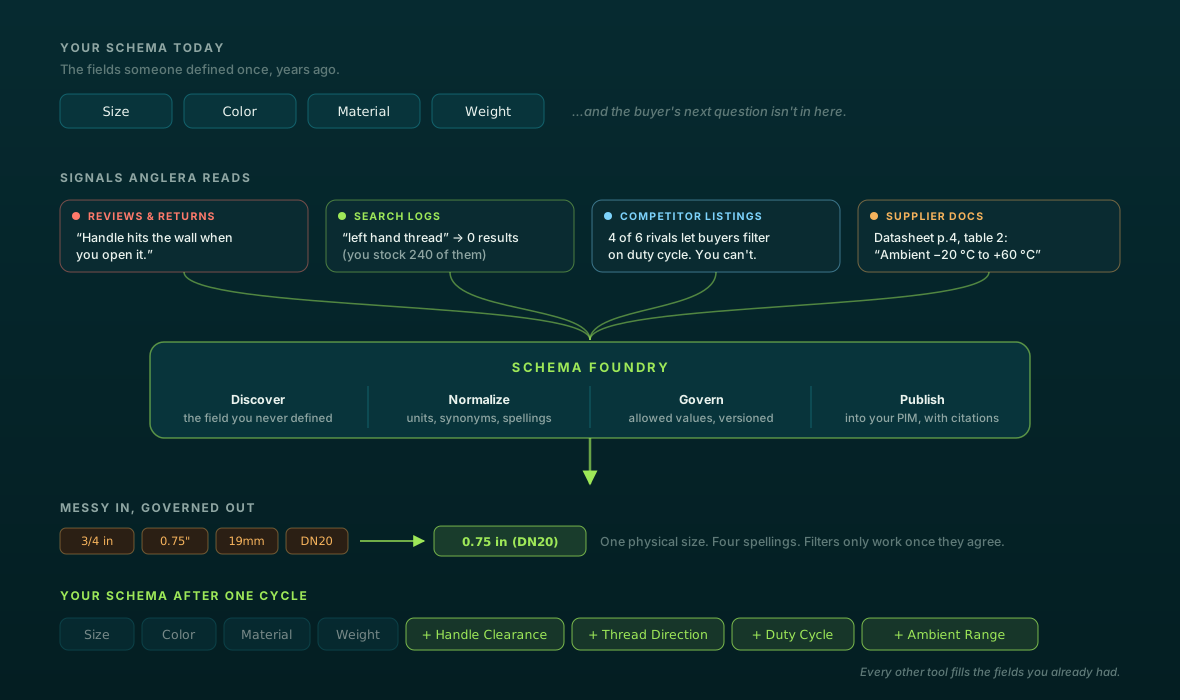
What neither platform does is enrich your underlying data. Both 1WorldSync and Salsify assume the content you put in is already complete, accurate, and optimized. That assumption is almost never true. That is the gap Anglera fills — gathering, cleaning, scoring, and enriching every SKU against buyer signals, then writing it back to whichever platform holds your data. Whichever tool you choose, the enrichment problem remains until you solve it separately.
| 1WorldSync | Salsify | Anglera | |
|---|---|---|---|
| Primary purpose | GDSN data pool and product content orchestration — validates and distributes GS1-structured attributes to retailers and trading partners at regulator-grade fidelity | PIM and Product Experience Management platform — centralizes product content as a system of record and syndicates it to digital retail channels and marketplaces | Neither stores nor distributes — enriches SKUs against buyer signals (attributes, copy, images, completeness scores) and writes clean data back to whichever platform holds it |
| Retail and trading-partner network | 14,000+ brands across 60+ countries; de facto standard for major US grocery chains; required by many retailers for GDSN compliance sync | Broad syndication network covering Amazon, Walmart, Target, and hundreds of digital channels; stronger on e-commerce and omnichannel destinations | Works upstream of syndication — ensures the content you push through either network is complete and optimized before it reaches the retailer |
| Data model and structure | GS1-compliant, rigid by design — GTINs, nutritional data, allergens, regulated attributes. Validates against retailer specs and flags non-conformance | Flexible, configurable schema built for digital shelf storytelling — rich media, marketing copy, channel-specific variants, and custom attribute sets | Schema-agnostic enrichment layer — adds, cleans, and scores attributes whether the destination schema is GS1-structured or open digital-shelf format |
| Best-fit buyer | CPG brands, food and beverage manufacturers, and suppliers for whom GDSN compliance is a retailer requirement — especially in grocery, pharma, and hardlines | Brands and distributors who need to own the digital shelf, manage product storytelling centrally, and activate consistent content across e-commerce channels | Any team with data gaps and quality problems — works alongside either platform for brands that need to improve completeness and accuracy before content ships |
| Pricing and total cost | Not publicly listed. Mid-market estimated at $500–$2,000/month; enterprise $25,000–$90,000+/year; large contracts can reach ~$1M/year. Implementation fees typically $10,000–$100,000+ | Quote-based only; tied to user count, SKU volume, and tier. Third-party onboarding commonly adds ~$16,000. Reviewers flag the platform as expensive relative to alternatives | Separate enrichment subscription priced on SKU volume. Returns cost in reduced manual cleanup hours and improved conversion on enriched product pages |
| Implementation complexity | Onboarding tied to GDSN certification; timeline depends on GS1 data readiness and the number of trading partners being connected; not a fast deploy | Typically requires a third-party consulting engagement; complex data modeling phase before syndication begins; budget consulting time alongside software cost | ~30-day implementation; connects to your existing PIM or data pool and begins enriching SKUs without disrupting your current workflow or platform choice |
| Enrichment and data quality | Validates against GS1 schemas and retailer specs; surfaces missing mandatory fields but does not fill or generate missing content — that work stays with your team | Offers completeness scoring and workflow tooling to flag gaps; relies on your team or agency to source and author the underlying content | Core function. Gathers missing attributes, cleans inconsistent data, generates and scores content against buyer signals, and surfaces actionable completeness metrics per SKU |
How to choose between 1WorldSync and Salsify
Choose 1WorldSync if GDSN compliance is non-negotiable for your business. If your grocery or mass-retail partners require structured GS1 data sync — nutritional attributes, allergen data, regulated fields — and they will not accept content that bypasses the GDSN, then 1WorldSync is the industry standard and working around it costs more than using it. It is the right tool for CPG manufacturers, food and beverage brands, and any supplier whose trading partners have made it a requirement.
Choose Salsify if your growth problem is the digital shelf. If you need a central system of record for product content that powers Amazon listings, DTC pages, and omnichannel retail simultaneously — and if rich content, digital assets, and marketing copy drive your conversion rate — Salsify addresses that. It is a better fit for brands managing hundreds of channel-specific content variants and for teams that want authoring workflows, not just data transmission.
Consider running both if you are an enterprise CPG brand with obligations on both sides. This is a common pattern: 1WorldSync for compliance and GDSN distribution to grocery chains, Salsify for digital shelf authoring and e-commerce activation. The platforms serve different audiences within the same organization — supply chain and compliance teams on the 1WorldSync side, e-commerce and marketing teams on Salsify.
Do not choose either as a substitute for enrichment. If your core problem is that your product data is incomplete, inconsistent, or missing attributes buyers search for, neither platform solves that. They distribute or store what you give them. Enrichment is a separate step that has to happen before content enters either system.
Whichever you pick, the data still has to get done
Neither 1WorldSync nor Salsify enriches your data. 1WorldSync validates structure and flags missing required fields — it cannot fill them. Salsify tracks completeness scores and routes content through approval workflows — it cannot generate missing attributes or clean inconsistent copy. Both platforms assume your product data arrives ready. It almost never does.
That assumption is where brands and distributors lose ground. A SKU missing three attributes fails retailer validation in 1WorldSync and gets suppressed or penalized on the digital shelf in Salsify. Neither platform tells you what the attribute should be — they just surface the absence.
Anglera works as the enrichment layer upstream of both. It connects to your PIM, data pool, or existing product catalog, gathers missing attributes from authoritative sources and manufacturer data, cleans inconsistent values, and scores every SKU against buyer signals — the specific attributes that drive search visibility and conversion in the channels you care about. When enrichment is complete, Anglera writes the clean data back to your source of truth: the same 1WorldSync data pool or Salsify workspace your team already works in.
The result is that whatever you chose as your platform, your content arrives there ready. Validation passes. Channel activation succeeds. The manual cleanup work that usually sits between your product catalog and your first compliant submission shrinks to near zero. Anglera's ~30-day implementation means enrichment can be running before your 1WorldSync or Salsify deployment is finished — so the first content that flows through your new platform is also your best.
Frequently asked questions
Can 1WorldSync and Salsify be used together?
Yes, and this is a common enterprise pattern. Larger CPG brands often use 1WorldSync for GDSN compliance distribution to grocery and mass-retail trading partners, while using Salsify as the system of record for digital shelf content going to Amazon, DTC, and omnichannel channels. The platforms serve different teams and different distribution paths. The downside is managing two platforms and ensuring data stays consistent between them — which is itself an argument for solving enrichment upstream before content enters either system.
Does 1WorldSync replace a PIM?
No. 1WorldSync is a data pool and syndication platform built around GS1 standards — it is designed for structured compliance data distribution, not for authoring, organizing, or managing the full breadth of your product content. Many brands use a separate PIM alongside 1WorldSync and push the relevant GS1-structured attributes into the data pool from there. If you need to manage marketing copy, digital assets, and channel variants centrally, you need a PIM or PXM like Salsify in addition to 1WorldSync.
What does Salsify offer that 1WorldSync does not?
Salsify is built for the digital shelf — rich content authoring, digital asset management, marketing copy workflows, and syndication to e-commerce channels like Amazon, Walmart.com, and DTC sites. 1WorldSync is built for structured compliance data flowing through the GDSN to trading partners who require GS1-grade attributes. Salsify gives you more flexibility in data modeling and is better suited to the marketing and e-commerce side of product content. 1WorldSync is stronger for regulated, compliance-driven distribution to grocery and mass retail.
Where does Anglera fit if I already have one of these platforms?
Anglera works as the enrichment layer before your content enters either platform. It connects to your existing product catalog or PIM, identifies missing and inconsistent attributes, enriches each SKU against buyer signals, and writes the clean data back to your source of truth. You continue using 1WorldSync or Salsify exactly as before — the difference is that your data arrives there complete and validated rather than requiring manual cleanup after the fact. Implementation typically takes about 30 days and does not require changing your existing platform setup.
How do I know which platform my business actually needs?
Start with your retail partners. If your primary grocery or mass-retail accounts require GDSN-compliant data sync, 1WorldSync is effectively mandatory — check whether your partners have listed it as a requirement. If your growth priority is winning on Amazon, DTC, or digital-first channels and you need centralized content management and rich syndication, Salsify addresses that. If you have compliance obligations on one side and digital shelf ambitions on the other, you may need both. Either way, audit your product data quality first — neither platform can compensate for incomplete or inaccurate underlying content.