Channable vs Feedonomics: A Straight Look at Both Feed Platforms
Channable and Feedonomics both solve the same distribution problem: your product catalog lives in one system, but your buyers are everywhere else. Channable is a self-serve platform where you write the rules — if/then logic that transforms attributes, maps fields, and keeps data synchronized across 2,500+ ad channels and marketplaces. Feedonomics works differently: their feed specialists handle your setup, maintain your feeds, and resolve channel errors on your behalf across 300+ destinations. You're essentially hiring a managed service rather than running a tool yourself.
The choice mostly comes down to how much control you want over the process. Channable is upfront about pricing and keeps your team in the driver's seat. Feedonomics puts pricing behind a custom quote and assumes you'd rather delegate the work than do it yourself. Both approaches are valid — the right one depends on your team's capacity and how much complexity your catalog creates across channels.
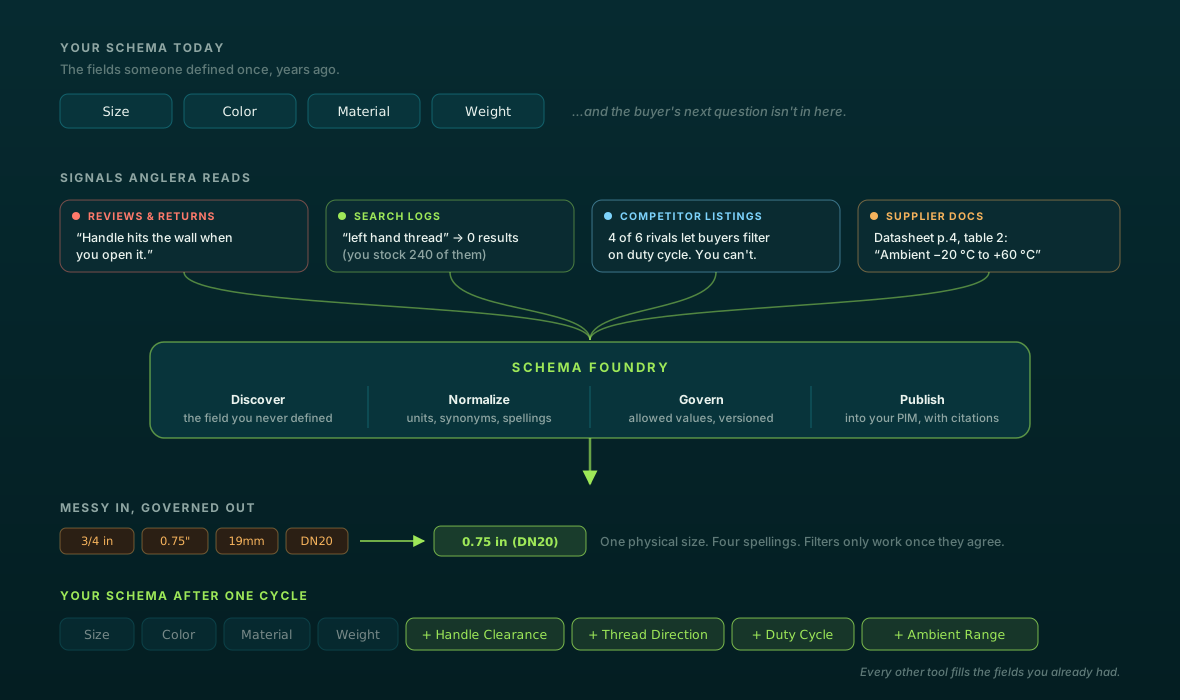
What neither platform changes is the quality of the underlying product data. Both read from your source catalog and distribute what they find, formatted for each channel but not materially improved. Thin descriptions, missing attributes, and supplier boilerplate all flow through untouched. That's a separate problem, and it's the one Anglera handles — upstream, before your feed logic runs.
| Channable | Feedonomics | Anglera | |
|---|---|---|---|
| Service model | Self-serve. You build and maintain feed rules using if/then logic. Your team is in control of every transformation. | Fully managed. Feed specialists handle setup, field mapping, error resolution, and ongoing optimization on your behalf. | Works alongside either model. Self-serve teams can point Anglera at their PIM; managed teams hand off already-enriched data to Feedonomics' specialists. |
| Channel breadth | 2,500+ ad channels, marketplaces, and shopping engines — broader than most competitors, including smaller regional and comparison platforms. | 300+ destinations, focused on high-traffic channels like Google Shopping, Amazon, Microsoft, and Walmart. Curated rather than exhaustive. | Enriches at the catalog level, so stronger content reaches every destination regardless of which platform handles distribution. |
| Pricing transparency | Public pricing starting at ~€59/month for 5,000 items. PPC automation, AI features, and order management are separate add-ons at €30–71/month each. | Custom quote only. Pricing varies by SKU count, channel count, and service tier. No public rate card. | Priced independently of your feed platform. Implementation runs about 30 days. |
| Feed transformation | Rule-based. You define transformations, field mappings, and filters. Auditable and transparent, but your team owns configuration and ongoing maintenance. | Specialists write and maintain transformation logic, optimize titles and descriptions for each channel's ranking signals, and catch errors before they affect listings. | Improves the attributes and content entering the transformation step — not the routing logic itself. Channable's rules or Feedonomics' specialists start from a stronger baseline. |
| Product data quality | Passes data through with rule-based transformations. No enrichment of underlying product content — what's in your catalog is what gets distributed. | Specialists may refine titles and descriptions for channel fit, but improvements are channel-specific rather than catalog-level enrichment. | Gathers, cleans, and enriches every SKU against buyer signals — the search terms, comparison attributes, and decision criteria real buyers use. Writes results back to your PIM. |
| Best fit | Mid-market merchants with a technical team that wants control, broad channel coverage, and predictable costs. | Enterprise retailers who want feed management handled end-to-end by specialists, especially on high-revenue channels like Amazon and Google. | B2B distributors, retailers, and manufacturers with large catalogs that need enrichment before distribution — regardless of which feed platform handles the last mile. |
How to choose between Channable and Feedonomics
If your team has the capacity to build and maintain feed logic, Channable is the more practical choice. The pricing is upfront, the channel coverage is wide, and the rule engine is something a non-developer can learn. It suits merchants who want to see exactly how their data is being transformed and adjust it themselves.
If you would rather hand that work off — or if your volume and channel mix justify specialists who know Google Shopping's ranking signals or Amazon's listing requirements — Feedonomics makes more sense. The managed model costs more and requires a custom negotiation, but teams that have tried to manage feed quality manually at scale often find the tradeoff worth it.
Team capacity and catalog complexity are the main variables. Channable suits teams that want to stay in the loop. Feedonomics suits teams that want to hand the loop off entirely.
Whichever you pick, the data still has to get done
Both platforms assume that what is in your catalog is already in good shape. They distribute data, transform formats, and keep fields synchronized — but they don't improve what the data actually says. A product description written for a supplier datasheet will reach every channel that way. A missing weight, a vague title, a feature list misaligned with how buyers actually search — all of that follows your feed to 2,500 destinations or 300.
Anglera fixes that problem one step earlier. It enriches each SKU against buyer signals and writes the results back to your PIM. When Channable's rules fire or Feedonomics' specialists run their optimization pass, they start from better raw material. The feed workflow does not change. What goes into it does.
Frequently asked questions
Can Channable connect to a PIM?
Channable can pull data via API, file feeds, or direct platform connections (Shopify, WooCommerce, Magento, and others). PIM integrations are possible but depend on your setup — some teams connect via middleware or scheduled exports. Channable does not write enriched data back to a PIM; it reads from your source and distributes to channels.
Is Feedonomics only for BigCommerce stores?
No. Feedonomics was acquired by BigCommerce in 2021 but operates as a standalone service available to merchants on Shopify, Salesforce Commerce Cloud, Magento, and other platforms. The integration is tighter for BigCommerce merchants, but Feedonomics does not require it.
Channable lists 2,500+ integrations; Feedonomics lists 300+. Does that gap matter?
It depends on where you actually sell. For high-traffic paid channels — Google, Amazon, Meta, Microsoft, Walmart — both platforms cover you. Channable's broader count matters most for regional marketplaces, comparison shopping engines, or less common platforms. If your channel mix is concentrated on the major destinations, the difference is smaller than the numbers suggest.
Where does Anglera fit if I already use one of these platforms?
Anglera works upstream of your feed platform. It enriches your catalog in your PIM — filling missing attributes, improving descriptions, scoring each SKU against buyer signals — before the data reaches Channable or Feedonomics. Your feed platform then distributes that improved content to your channels. The two layers don't overlap; they run in sequence.
Can I switch from Channable to Feedonomics later without disrupting my catalog?
In most cases, yes. The underlying product data stays in your PIM or commerce platform regardless of which feed tool distributes it. The migration effort is mostly around re-mapping feed rules and channel configurations in the new platform. If you use Anglera, your enriched catalog data stays in your PIM through any platform change.