Channable vs Informatica PIM: Feed Management or Master Data Governance?
These two platforms serve genuinely different buyers and rarely compete head-to-head. Channable is a product feed management and syndication platform: it connects your existing catalog to 2,500+ marketplaces and ad channels via rule-based automation, keeping pricing, inventory, and product data synchronized in real time. Its value is speed and reach — a retailer or merchant with decent catalog data can be distributing to dozens of channels within days.
Informatica Product 360 operates at the other end of the spectrum. It is an enterprise PIM and Master Data Management system — the authoritative source of truth for product information across large organizations. It governs, enriches via AI agents, and distributes product data within complex enterprise architectures. The pitch is MDM-grade governance: workflow approvals, data quality rules, role-based access, and an all-in-one AI stack for organizations managing tens of thousands of SKUs across suppliers, brands, and channels.
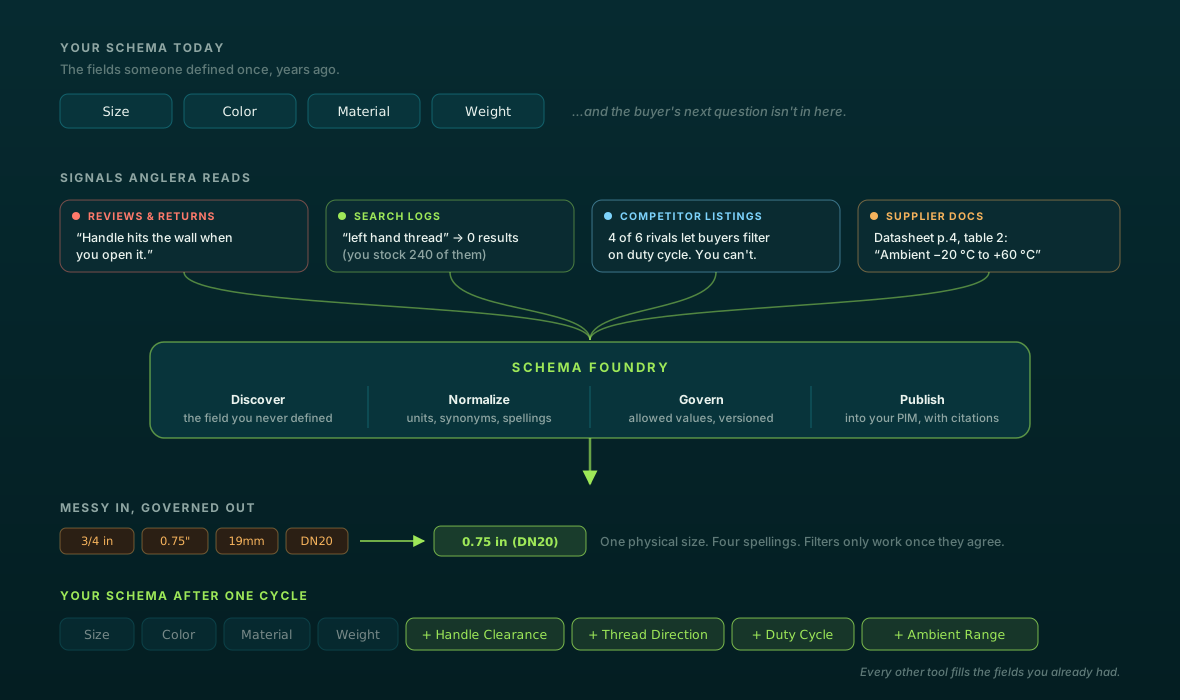
The choice usually comes down to organizational scale and where the real bottleneck sits: distribution (Channable) or master data governance (Informatica). But both platforms share a common upstream gap — the enrichment of the product content itself, tuned not to internal governance rules or channel format requirements, but to how buyers actually search, compare, and decide.
| Channable | Informatica PIM | Anglera | |
|---|---|---|---|
| Primary function | Transform and distribute product catalogs to 2,500+ marketplaces and ad channels via rule-based automation. Keeps pricing, inventory, and content synchronized across channels in real time. | Centralize, govern, and distribute product master data at enterprise scale. The authoritative system of record for product information across business units, suppliers, and channels. | Enrich every SKU against buyer signals — descriptions, attributes, search terms, completeness scoring — and write the improved content back to your PIM or catalog source. Not a PIM, not a syndication tool. |
| Who it is built for | E-commerce retailers and merchants, SMB to mid-market, who need to reach more channels without manual reformatting. Relatively fast self-service onboarding. | Large enterprise manufacturers, distributors, and retailers with complex supplier data, multi-brand governance requirements, and dedicated data management teams. | B2B distributors, retailers, and manufacturers who need buyer-ready product content — regardless of which PIM or feed platform they run. |
| Content enrichment | Rule-based field mapping and transformation — concatenate fields, apply conditions, reformat values. Does not generate enriched copy or fill missing attributes from buyer intent signals. | AI agents validate, classify, and enrich data already inside the platform. Output quality depends on the supplier copy that was loaded in; enrichment is measured against internal governance schemas. | Buyer-signal-driven enrichment — determines what each SKU is missing based on how buyers actually search and decide, fills those gaps, and scores completeness against real purchase behavior. |
| Pricing and accessibility | Transparent pricing from ~€59/month (Core Standard, 5,000 items). Add-ons for AI features, PPC, repricing, and marketplace integrations at €30–71/month each. | Quote-only enterprise pricing across Standard, Professional, and Enterprise tiers. Widely cited as expensive; cost is driven by users, data volume, and configuration scope. | ~30-day implementation that sits on top of your existing stack. No new system of record, no rip-and-replace. Works alongside Channable, Informatica, or any other catalog source. |
| Implementation timeline | SaaS onboarding; merchants typically go live within days to a few weeks. Rule authoring is ongoing but self-service and does not require a formal implementation project. | Typically 6–18 months for enterprise deployment, involving IT, data architects, and system integrators. Significant configuration, data migration, and change management required. | ~30 days to first enriched SKUs. Connects to the existing PIM or catalog source and begins enriching immediately, without disrupting the current stack. |
| Data governance | No data governance features. Channel-format validation ensures fields map correctly; content quality and completeness depend entirely on the catalog source. | Full MDM-grade governance — workflow approvals, data stewardship, quality rules, audit trails, and role-based access control. Purpose-built for regulated and complex data environments. | Scores every SKU against buyer-signal completeness and surfaces gaps prioritized by revenue impact. Does not replace a governance layer — it enriches the data that governance manages. |
| Channel distribution | 2,500+ marketplace and ad channel integrations (Google Shopping, Amazon, Meta, and hundreds more). Real-time pricing and inventory sync is a core differentiator. | Distributes product data downstream via enterprise connectors and DAM integrations; not primarily a channel syndication tool. Most enterprise deployments pair it with a separate distribution layer. | Sits upstream of channel distribution. Better enriched content in Channable or downstream of Informatica means higher-converting listings across every channel — without changing your distribution workflow. |
How to choose between Channable and Informatica PIM
Choose Channable if:
- You are an e-commerce retailer or merchant with an existing catalog (PIM, ERP, or spreadsheet) who needs to reach more channels without manual reformatting.
- Your primary bottleneck is distribution — getting existing catalog data to more places, faster, with real-time pricing and inventory sync.
- Your team is small to mid-market and you need a tool that is live in days, not months.
- Transparent, predictable pricing and self-service rule management matter to your team.
- You are already satisfied with your product content quality and the problem is reach, not enrichment.
Choose Informatica PIM if:
- You are a large enterprise manufacturer, distributor, or retailer managing tens of thousands of SKUs across multiple brands, suppliers, or business units.
- You need MDM-grade governance: workflow approvals, data stewardship, quality rules, audit trails, and role-based access control.
- Your organization has a dedicated data management or eCommerce operations team prepared to invest 6–18 months in implementation.
- You are already in the Informatica ecosystem (IICS, CDI, PowerCenter) and want a native product data governance layer.
- Budget is secondary to governance capability and enterprise integration depth.
If neither fits cleanly: Mid-market distributors evaluating Informatica should look at lighter PIM platforms — Akeneo, Salsify, or Plytix — before committing to the complexity and cost of a full MDM deployment. Channable is worth evaluating even if you already have a PIM; it does not replace a PIM, it extends the reach of whatever catalog data the PIM holds.
Whichever you pick, the data still has to get done
Channable syndicates whatever your catalog contains. Informatica governs and structures whatever your suppliers sent. Neither platform is built to answer the question buyers care about most: does this product listing contain the information that moves a buyer from search to purchase?
Anglera fills that gap for either stack. It reads your existing product data, enriches every SKU against real buyer signals — the search terms buyers actually use, the attributes they compare, the completeness gaps that cause them to leave for a competitor — and writes the improved content back to your source of truth. If you run Channable, Anglera ensures the feeds Channable distributes carry copy that converts, not just copy that maps. If you run on Informatica, Anglera enriches the master record before it propagates downstream, so governance is applied to content that was already built for buyers.
Implementation is roughly 30 days and sits on top of your existing stack — no new system of record, no parallel data pipeline, no disruption to how Channable or Informatica is already configured.
Frequently asked questions
Can Channable and Informatica PIM be used together in the same stack?
Yes — and it is a natural pairing at enterprise scale. Informatica Product 360 serves as the master data source; Channable maps and syndicates that data to marketplaces and ad channels. In that architecture, Anglera sits upstream of both: enriching the master record in Informatica with buyer-signal-driven content before Channable distributes it to channels.
Does Channable do any content enrichment, or does it only handle feed mapping?
Channable applies rule-based transformations — you can concatenate fields, reformat values, and apply conditional logic — but it does not generate enriched descriptions, fill missing attributes based on buyer intent, or score content quality. Whatever you put in, in better-mapped form, goes out to channels.
Is Informatica PIM a realistic option for a mid-market distributor?
Typically not. Informatica Product 360 is priced and architected for large enterprise organizations with dedicated IT and data governance teams. Mid-market distributors usually get faster time-to-value from a lighter PIM — Akeneo, Plytix, or Salsify — paired with a dedicated enrichment layer than from a full MDM deployment that can run 6–18 months.
Does Informatica's Agentic AI PIM eliminate the need for a separate enrichment tool?
Informatica's AI agents handle validation, classification, and enrichment against the data schema already inside the platform. They are best suited to governance-driven tasks — checking completeness against required fields, applying taxonomy, flagging anomalies. They are not designed to enrich content against buyer signals or to close the gap between what a supplier sent and what a buyer needs to see to make a purchase decision.
Where does Anglera sit relative to Channable specifically?
Anglera is upstream of Channable. It enriches your product content in the PIM or catalog source before Channable receives it. Better input content means better-converting listings across every channel Channable distributes to — without requiring any changes to your Channable rules or integrations.