Channable vs Pimberly: Feed Management vs PIM
Channable and Pimberly solve different halves of the product data problem, which is why buyers sometimes find themselves looking at both. Channable starts at the distribution end: it takes whatever catalog you already have, applies rule-based transformations, and pushes it to 2,500+ ad channels and marketplaces in real time. If your feeds are breaking and your channel team is drowning in manually maintained spreadsheets, Channable fixes that. Pimberly operates upstream: it is the system of record your catalog lives in, with workflow enforcement, validation rules, and a built-in DAM to keep digital assets alongside product content. If your data is inconsistent at the source and no one agrees on what the authoritative version of a SKU looks like, Pimberly fixes that.
The gap between them is meaningful. A mid-market distributor with 50,000 SKUs and multiple sales channels almost certainly needs a PIM before a feed manager — otherwise they will syndicate the same poor-quality data faster to more places. An e-commerce brand already running a clean Shopify or ERP catalog but struggling to maintain accurate listings across Amazon, Google Shopping, and affiliate networks needs Channable, not another data store. These two tools can coexist in the same stack, but they do not compete for the same slot.
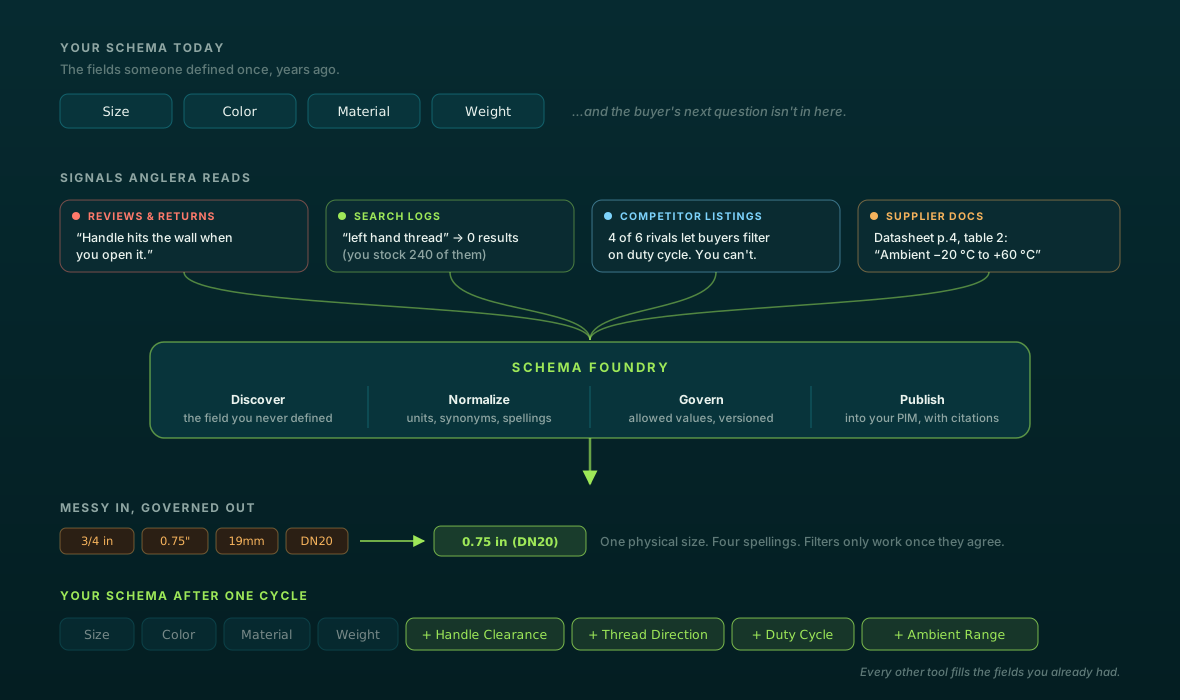
Neither platform enriches. Both assume the copy, attributes, and search terms in your source data are already good. That assumption is rarely true at scale, and it is exactly where a third layer — enrichment — earns its place regardless of which of these you choose.
| Channable | Pimberly | Anglera | |
|---|---|---|---|
| Core function | Feed management and syndication — transforms and distributes your existing catalog to 2,500+ channels and ad networks using rule-based if/then automation | Cloud PIM + DAM — centralizes product data and digital assets as the governed source of truth, then publishes to channels through built-in workflows | AI enrichment layer — gathers, cleans, and enriches every SKU against buyer signals, then writes improved content back to whichever system is the source of truth |
| Where it sits in the stack | Downstream of your catalog; pulls from Shopify, BigCommerce, ERP, or a spreadsheet and transforms data per channel requirements | Is the catalog; replaces or overlays your ERP as the authoritative product data store your team works in daily | Upstream of both; enriches content before it reaches the feed manager or leaves the PIM so every downstream channel benefits at once |
| Pricing | Starts at ~€59/month for 5,000 items (Core Standard). AI features, PPC automation, repricing, and marketplace integrations are separate add-ons at €30–71/month each | Starts at approximately $30,000/year; fully custom pricing based on SKU volume and channel count — no published tiers | Scoped to SKU count and enrichment depth; positioned as a layer alongside a PIM or feed platform, not a replacement for either |
| Data governance | No governance layer — transforms what you provide; validation is channel-schema compliance only, not content quality or completeness | Built-in completeness scoring, validation rules, and approval workflows ensure content meets defined standards before it publishes | Adds content quality scoring against buyer signals — covering gaps that completeness rules alone do not catch, such as thin descriptions or missing search terms |
| Digital asset management | Not included; distributes image URLs you supply but does not store or manage assets | Full built-in DAM — stores, tags, versions, and links images, videos, and documents directly to product records | References existing assets for enrichment context; does not replace a DAM and integrates with whatever asset store you already use |
| Channel reach | 2,500+ pre-built channel integrations including Amazon, Google Shopping, Meta, TikTok, and affiliate networks; PPC bid management and order management available as paid add-ons | Multi-channel publishing connectors for major e-commerce platforms and marketplaces, with fewer pre-built integrations than a dedicated feed manager | Channel-agnostic; enriches once in the source system so every channel Channable or Pimberly feeds receives the improved content automatically |
| Team fit | Performance marketers, e-commerce operations teams, and channel managers focused on feed accuracy and ad campaign efficiency | Product data managers, content teams, and e-commerce managers who own and govern the catalog itself across categories and brands | Works alongside either team — typically implemented in ~30 days, writing enriched content back to whoever owns the source record |
How to choose between Channable and Pimberly
Choose Channable if your catalog data is already reasonably clean and your pain is distribution: feeds breaking on Amazon, manual spreadsheet maintenance per channel, inconsistent pricing across listings, or needing to automate PPC bids from the same product feed. Channable works best when you have a functioning data source — Shopify, BigCommerce, or a reliable ERP export — and just need to get that data to more channels without it degrading along the way. The pricing is accessible: a small team can start at under €100/month and expand add-ons as volume grows.
Choose Pimberly if the pain is upstream: no single source of truth, content inconsistencies between channels, digital assets scattered across shared drives, and product teams spending hours reconciling spreadsheet versions before anything goes live. Pimberly suits mid-market e-commerce and retail companies managing large or growing SKU counts across multiple brands or categories where data governance matters before any publication happens. Budget accordingly — the ~$30,000/year starting point requires organizational buy-in and a clear ROI case.
If you are evaluating both at the same time, that is usually a signal that neither problem has been solved yet. The right sequence is almost always PIM first, feed manager second: clean, governed data syndicates well. Noisy data just fails faster at more destinations. Resolve the source-of-truth problem with Pimberly, then use Channable to distribute the result efficiently.
A note on company stage: Channable fits a lean e-commerce team that needs channel scale without a heavy platform investment. Pimberly is an enterprise-grade purchase with an enterprise price tag — the typical buyer has a dedicated product data function and a multi-year roadmap for their catalog operations.
Whichever you pick, the data still has to get done
Both Channable and Pimberly treat your product content as a given. Channable transforms and distributes whatever attributes you loaded into it. Pimberly stores and governs whatever your team entered. Neither asks whether those attributes — the descriptions, feature bullets, search terms, and category-specific fields — are actually optimized for how buyers discover and compare products today.
That gap is where Anglera operates. Anglera connects to your source data (PIM, ERP, or structured export), analyzes each SKU against buyer signals, fills missing attributes, sharpens copy, and writes the enriched content back to wherever that record lives. The result: Pimberly has better content to govern and publish, and Channable has better content to syndicate to those 2,500+ channels. Enrichment happens once, upstream, and every downstream system benefits.
Implementation typically takes around 30 days and does not require you to change platforms. Whichever tool you choose — or both — Anglera makes the data they store and distribute worth more.
Frequently asked questions
Can Channable replace a PIM?
No. Channable does not store or govern product data — it pulls from an existing source and transforms it for each channel. If you have no reliable single source of truth, adding Channable will distribute inconsistent data more efficiently, which is not an improvement. A PIM like Pimberly solves the source problem first.
Does Pimberly include channel feed management the way Channable does?
Pimberly can publish to channels and has some connectors built in, but it is not purpose-built for the breadth of channel integrations Channable provides. For teams with a large number of active ad channels or marketplace listings, Channable's 2,500+ integrations and real-time feed synchronization are difficult to replicate inside a PIM.
Can I use both Channable and Pimberly together?
Yes, and this is a natural combination. Pimberly acts as the source of truth; Channable pulls from it and distributes to channels. The two tools are not competitors — they occupy different positions in the stack. Many mid-market retailers run exactly this setup.
Where does Anglera fit if I already have one of these tools?
Anglera connects to your existing source of truth — whether that is Pimberly, a Shopify catalog Channable pulls from, or an ERP — enriches each SKU against buyer signals, and writes the improved content back. You do not replace either platform. Anglera makes the data each platform already manages more complete and more effective.
Which is better for a mid-market distributor managing 25,000+ SKUs across multiple channels?
At that scale, start with Pimberly or an equivalent PIM to establish a governed source of truth. Once your catalog is clean and structured, Channable becomes a strong option for managing channel distribution efficiently. Trying to solve distribution before governance typically means syndicating data quality problems to more places faster.