Channable vs Productsup: Which Feed Platform Is Right for You?
Both Channable and Productsup do the same fundamental job: take your product catalog and push channel-ready feeds to hundreds of marketplaces, search engines, and ad networks. Both claim 2,500+ channel connectors. Both rely on rule-based transformation to reshape your attributes into whatever format Google Shopping, Amazon, or Bol.com requires. If all you need is a connector count, the two platforms look nearly identical on paper.
The real difference is who they're built for. Channable is designed for e-commerce merchants and mid-market retailers who need a practical, self-serve feed manager with transparent monthly pricing and built-in PPC tooling. Productsup targets enterprise brands, manufacturers, and large retailers — organizations processing billions of product records per month across global retail data pools, not just ad channels. L'Oréal and PUMA-scale complexity is where Productsup earns its position.
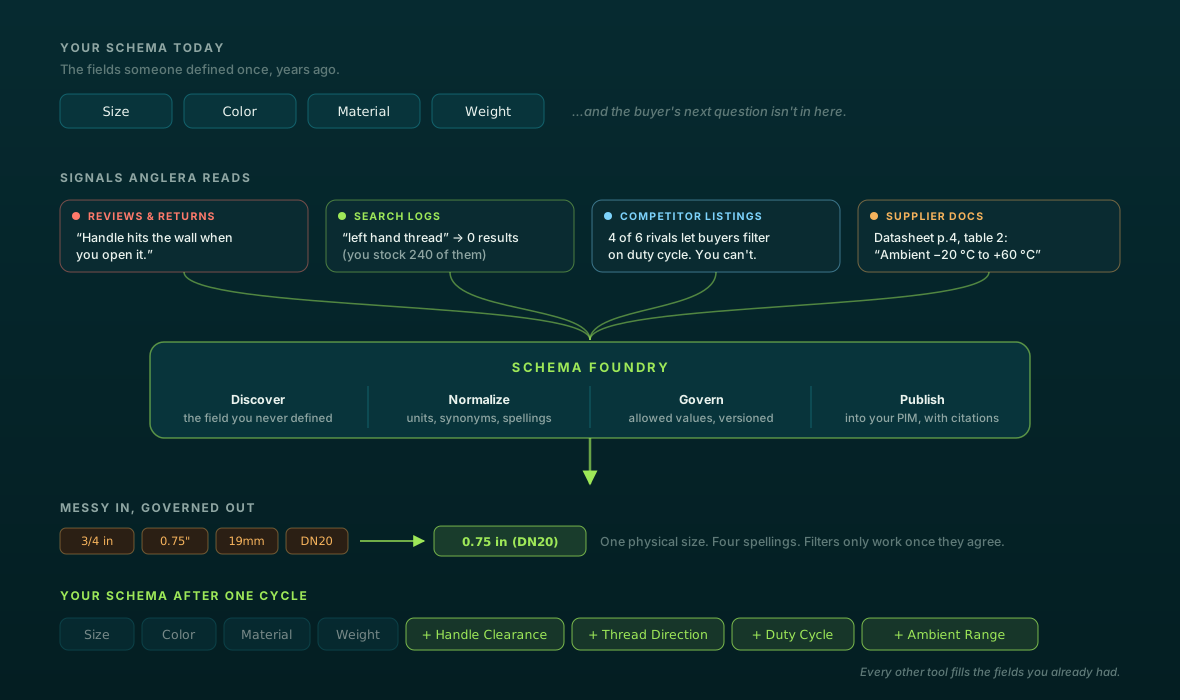
What neither platform does is improve the quality of the product data before it goes out. Both tools syndicate whatever content you give them. If your descriptions are thin, your search terms are absent, and your attributes are unedited supplier boilerplate, that content flows through to every channel at scale. That's the gap Anglera fills: AI-driven enrichment against real buyer signals, written back to your PIM before the feed is ever built.
| Channable | Productsup | Anglera | |
|---|---|---|---|
| Target buyer | E-commerce merchants and mid-market retailers managing their own feed operations, typically self-serve | Enterprise brands, manufacturers, and large retailers with complex multi-supplier, multi-channel, global distribution requirements | Serves either segment; connects to your existing PIM or data source upstream of whichever syndicator you choose |
| Pricing model | Starts around €59/month for 5,000 items (Core Standard); AI features, PPC, and marketplace integrations are separate add-ons at €30–71/month each | Custom enterprise pricing only; no published tiers — a sales conversation is required before any number is on the table | Separate enrichment subscription; ROI is measured in reduced feed rejection rates, higher channel conversion, and fewer manual content hours |
| Setup and implementation | Largely self-serve; most merchants push live feeds within days to a few weeks without a dedicated implementation team | Enterprise onboarding with a dedicated team; timeline is typically measured in months, not days | ~30-day implementation connecting to your existing PIM or ERP, independent of which syndicator you run downstream |
| Data transformation approach | Rule-based if/then logic; users build transformation rules to reshape attributes per channel requirement | Visual data flow builder with rule-based transformation at scale; handles complex supplier-to-channel attribute mapping across global retail data pools | Not transformation — content quality improvement. Anglera enriches titles, descriptions, attributes, and search terms against buyer signals before any transformation rule ever runs |
| Enrichment and content quality | None; Channable syndicates the attributes present in your source feed, reshaped to channel spec | Minimal; Productsup's strength is transformation and distribution at scale, not content generation or quality improvement | Core capability — AI-driven enrichment of product content against how buyers actually search and compare, written back to the PIM as the new source of truth |
| PPC and order management | Built-in PPC campaign automation and marketplace order management available as paid add-ons — a genuine differentiator for merchants managing ad spend inside the same tool | Not in scope; Productsup focuses on product content distribution, not ad campaign management or order operations | Out of scope; Anglera operates upstream at the data layer, not at the ad campaign or order management layer |
| Channel breadth and specialization | Strong in European marketplaces (Bol.com, Zalando, Idealo) and Google/Meta ad channels; well-suited to EU-first merchants | Deep enterprise retail data pool integrations and global brand distribution; strong for manufacturers pushing into major grocery and retail chains worldwide | Channel-agnostic; enriching at the PIM layer means every channel downstream — whichever connectors you use — receives improved content |
How to choose between Channable and Productsup
Choose Channable if you're a mid-market e-commerce merchant or retailer managing your own feed operations and want to move fast without a sales process. Channable's self-serve model, transparent per-item pricing, and built-in PPC automation make it a strong choice if your catalog is under 100,000 SKUs, your primary channels are Google Shopping, Meta, and EU marketplaces, and you want to be live in days rather than months. The add-on structure means you pay for what you actually use.
Choose Productsup if you're a global brand, large manufacturer, or major retailer with enterprise-scale requirements: complex multi-supplier data flows, retail data pool submissions, regional channel governance, and the need for a dedicated implementation team with SLA-backed support. The custom pricing model reflects that scope — build it into your budget conversation from the start. If your peer companies are L'Oréal and PUMA, Productsup is sized for you.
One honest signal to watch: if price transparency matters early in your evaluation, Channable wins by default. Productsup requires a sales conversation before any number appears. That's not unusual for enterprise software, but it adds weeks to your procurement timeline. Factor that in if you're working against a deadline.
Whichever you pick, the data still has to get done
Whichever platform you choose, it will syndicate your product content accurately, at speed, to every channel connector you activate. What it will not do is make that content better.
Most B2B distributors, manufacturers, and retailers discover this after go-live: feeds are running, but conversion is flat and sponsored placement performance underwhelms. An audit usually reveals the same things — generic titles, thin descriptions, missing search terms, and attribute sets that were never written for how a buyer actually shops. The syndicator is not the problem. The source data is.
Anglera sits upstream of both Channable and Productsup. It connects to your PIM (or ERP, or supplier feed), enriches product titles, descriptions, attributes, and search terms against real buyer signals — how your customers search, filter, and compare — then writes the improved content back to your PIM so your source of truth improves permanently, not just for one export. When Channable or Productsup next pulls your feed, the content they distribute is content that converts. Implementation takes roughly 30 days. The enrichment runs continuously as your catalog changes.
Frequently asked questions
Can Channable or Productsup enrich product descriptions?
Neither platform is built for content enrichment. Both transform and distribute the attributes you provide. Channable offers rule-based field manipulation; Productsup handles complex supplier-to-channel attribute mapping at enterprise scale. Neither generates improved descriptions, optimized titles, or buyer-signal-driven search terms. That is Anglera's job, and it happens upstream — in your PIM — before either syndicator ever sees the data.
Is Productsup worth the enterprise cost over Channable?
It depends on your operational complexity, not your budget in isolation. If you're managing feeds for a focused e-commerce operation with a known set of channels, Channable is almost certainly sufficient and considerably cheaper to start. If you're a global manufacturer submitting into retail data pools, distributing to hundreds of regional channels, and managing multi-supplier data governance, Productsup's infrastructure and onboarding depth are built for that problem. Channable is not.
Do I need Anglera if I already have Channable or Productsup running?
Only if you want the content in those feeds to be better than what your suppliers originally gave you. Channable and Productsup are distribution layers — they move data. Anglera improves it. If your products already carry complete, buyer-optimized titles, descriptions, attributes, and search terms, you may not need Anglera. Most B2B distributors find their catalog doesn't meet that bar, especially for long-tail SKUs.
Which platform has more complete marketplace coverage?
Both advertise 2,500+ channel connectors, so the headline number is the same. Channable has historically been stronger in European marketplaces (Bol.com, Zalando, Idealo) and Google and Meta ad channels. Productsup has deeper integration with enterprise retail data pools and global brand distribution networks. For specific channels you depend on, verify connector availability with both vendors before committing — the headline number does not guarantee every channel you need is production-ready.
How does Anglera's 30-day implementation work alongside a syndicator rollout?
Anglera connects to your PIM or primary data source independently of your syndicator. You can run the implementations in parallel or sequence them — Anglera first is usually preferable so that when your Channable or Productsup feeds go live, they're distributing enriched content from day one rather than retroactively replacing thin content after launch. The 30-day timeline covers connection, enrichment configuration against your categories, and the first write-back cycle to your PIM.