Channable vs Sales Layer: Feed Management vs PIM — Which Do You Actually Need?
Channable and Sales Layer are frequently compared by teams trying to get their product data under control, but they solve fundamentally different problems. Channable is a feed transformation and syndication engine — it takes your existing catalog, applies rule-based transformations, and pushes the result to 2,500+ ad channels and marketplaces in real time. Sales Layer is a cloud PIM — it centralizes, validates, and governs your product content as a structured source of truth, then distributes it outward through channel connectors and a supplier portal. Comparing them head-to-head is a bit like comparing a content repository to a publishing system: one stores and governs, the other transforms and distributes.
The reason buyers end up evaluating both at once is that the two tools often sit in sequence. You need clean, complete product content before syndication can do anything useful. If your catalog is fragmented across spreadsheets and supplier emails, adding a feed manager compounds the problem — garbage in, garbage out at scale. Sales Layer solves the upstream governance problem; Channable solves the downstream distribution problem. Many organizations eventually run both.
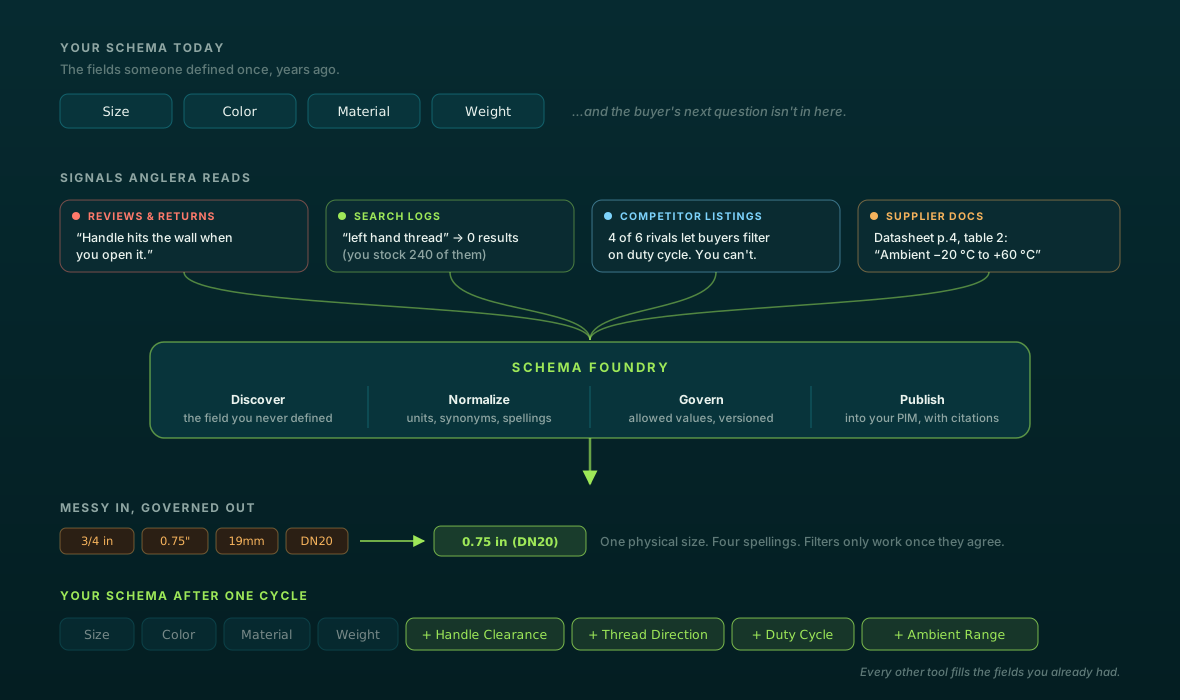
What neither tool handles is enrichment: generating the attributes that are missing, filling in incomplete specs, and scoring your content against what buyers actually search for before it enters either platform. That gap is worth keeping in mind as you evaluate both tools below.
| Channable | Sales Layer | Anglera | |
|---|---|---|---|
| Core job-to-be-done | Transform and sync your existing catalog to 2,500+ ad channels and marketplaces using rule-based (if/then) automation. Keeps pricing and inventory in real time across feeds. | Centralize, validate, and manage structured product content as a governed PIM. Distribute that content to channels, marketplaces, and retailer portals from a single source of truth. | Enriches the product content that lives in your PIM — generating missing attributes, cleaning inconsistent values, and scoring SKUs against buyer signals — before either platform sees it. |
| Channel reach and syndication depth | 2,500+ channel integrations with real-time price and inventory sync. Strong coverage of Google Shopping, Meta, Amazon, comparison engines, and niche marketplaces. PPC automation available as an add-on. | Multi-channel syndication included, with connectors to retailer portals and marketplace feeds. Fewer ad-specific integrations than a dedicated feed tool; depth of channel coverage varies by plan. | Channel-agnostic. Enriches the source catalog so that every downstream feed — whether routed through Channable or Sales Layer — carries complete, accurate content from the start. |
| Data quality and validation | Rule-based mapping surfaces format mismatches and missing required fields per channel. Does not generate or infer missing attribute values — you write the rules, it executes them. | Built-in completeness scoring and field validation flag gaps and structural errors across your catalog. Tracks quality at the SKU level but does not generate or fill in missing data. | Automatically generates missing specs, normalizes inconsistent values, and scores each SKU against buyer search signals. Writes enriched data back to the PIM so validation passes on the first attempt. |
| Supplier and content onboarding | No native supplier portal. Designed for merchants who already own and control their feed. Upstream content gathering is out of scope. | Supplier Portal included — manufacturers and vendors submit and update content directly inside Sales Layer, reducing onboarding friction and centralizing responsibility for data quality. | Enriches supplier-submitted data immediately after intake, catching and filling gaps before incomplete records propagate to downstream channels or ad feeds. |
| Pricing entry point | Starts at approximately €59/month for 5,000 items on the Core Standard plan. AI features, PPC automation, repricing, and additional marketplace integrations are separate add-ons at €30–71/month each. | Starts at approximately $1,000/month; most plans require a custom quote. A 30-day free trial is available. Pricing scales by team size and feature tier (Core through Enterprise). | Separate engagement from either platform. Contact Anglera for pricing — typically scoped per catalog size and enrichment volume. |
| Implementation speed | Feed connections and rule setup are largely self-serve and can go live quickly once your data source is connected. Time to value depends on catalog complexity and how many channels you configure. | Advertises a 6-week onboarding process with dedicated support. Structured implementation is appropriate given that you are migrating product content governance, not just connecting a feed. | Approximately 30 days to implement alongside an existing PIM or as Anglera connects to the system of record you are already deploying. |
| Best-fit company profile | E-commerce retailers and performance-marketing teams managing high-volume ad feeds and marketplace listings who need real-time sync and feed automation at scale. | Manufacturers, distributors, and retailers that need a governed product content repository, handle supplier onboarding, and want multi-channel distribution included in their PIM. | Any team that recognizes the quality entering either platform determines the performance coming out — regardless of whether the catalog lives in Sales Layer, another PIM, or a spreadsheet. |
How to choose between Channable and Sales Layer
Choose Channable if your product content is already reasonably complete and your problem is distribution — getting that catalog to the right channels in the right format, in real time, without maintaining dozens of manual exports. Channable is the right tool for e-commerce merchants and performance-marketing teams running high-volume Google Shopping, Meta, and marketplace campaigns who need feed automation and PPC management under one roof. It works best when you already have a PIM or ERP feeding clean data upstream.
Choose Sales Layer if your problem is governance — your product data is scattered across supplier spreadsheets, legacy ERPs, and email chains, and you need one place to own, validate, and distribute it. Sales Layer fits manufacturers, distributors, and retailers who need B2B supplier onboarding, a structured completeness workflow, and channel distribution as part of the PIM rather than a separate tool. The higher entry price and 6-week implementation reflect a more substantial configuration effort.
Consider running both if your scale justifies it: Sales Layer as the content source of truth and supplier portal, Channable as the ad-feed and marketplace syndication engine for high-volume, real-time channel management. This is a common stack for larger retailers with both a branded D2C presence and complex marketplace operations.
Do not expect either tool to enrich your data. If your catalog has missing specs, inconsistent attribute values, or content that has never been benchmarked against buyer search behavior, neither platform resolves that problem — Channable's rules will faithfully distribute incomplete content, and Sales Layer's validator will flag gaps without closing them.
Whichever you pick, the data still has to get done
Both Channable and Sales Layer assume your product data is already in good shape when it arrives. Channable transforms and distributes whatever you feed it — rule-based automation amplifies what is already there, for better or worse. Sales Layer validates structure and completeness, but it does not generate the missing values or infer the attributes your buyers are searching for.
Anglera fills that gap regardless of which platform you choose. It connects to your source of truth — whether that is Sales Layer, another PIM, or a structured data store — enriches every SKU by generating missing attributes, cleaning inconsistent values, and scoring content against real buyer signals, then writes the results back. By the time your catalog reaches Channable's feed engine or Sales Layer's syndication connectors, it is already complete.
The practical effect: fewer suppressed marketplace listings, higher ad relevance scores, less time writing transformation rules to work around attribute gaps in Channable, and fewer validation failures in Sales Layer. Anglera's implementation runs in approximately 30 days and operates alongside whichever platform you deploy — it does not replace either one.
Frequently asked questions
Can Channable replace a PIM like Sales Layer?
No. Channable is a feed transformation and syndication layer — it reads your catalog, applies rules, and distributes the output. It does not manage your product content repository, govern data quality across teams, or handle supplier onboarding. If you do not have a PIM, you still need one upstream of Channable.
Does Sales Layer replace the need for Channable?
Partly, depending on your channel mix. Sales Layer includes syndication connectors that cover many retailer portals and marketplaces. But if you run high-volume PPC campaigns across Google Shopping, Meta, and dozens of niche marketplaces with real-time price and inventory sync, Channable's dedicated feed engine offers more depth, more integrations, and ad-specific automation that Sales Layer does not.
Do either of these tools enrich product data — filling in missing specs or generating new attributes?
Not in any meaningful generative sense. Channable applies transformation rules you write yourself; Sales Layer validates structure and flags completeness gaps. Neither tool crawls supplier sites, infers missing specifications, or scores your content against buyer search behavior. That is the job Anglera is built for.
Where does Anglera fit if I am already using Sales Layer?
Anglera connects to Sales Layer as the source of truth, enriches product records by generating and cleaning attributes, scores them against buyer signals, and writes the results back into Sales Layer. The content that reaches your channels through Sales Layer's connectors is already complete — reducing suppressed listings and manual cleanup work.
Where does Anglera fit if I use Channable without a PIM?
Anglera enriches your source catalog — wherever it lives, whether that is an ERP export, a spreadsheet, or a data feed — before Channable picks it up. Cleaner, more complete input means fewer channel errors, fewer transformation rules needed to compensate for gaps, and better ad performance from day one.