Channable vs. Salsify: Feed Management vs. PIM
Channable and Salsify both touch product data, but they solve different problems at different points in the content supply chain. Channable is a feed management and syndication platform: e-commerce merchants and retailers use it to transform an existing catalog into channel-ready listings across 2,500+ ad networks, marketplaces, and comparison shopping engines via rule-based automation. Salsify is a Product Experience Management (PXM) platform — a PIM at its core — that brands and manufacturers use as the central system of record for product content, authoring and governing that content before it reaches retail partners.
The overlap that creates buyer confusion: both platforms distribute product data to sales channels. But the direction and the user differ. Channable works downstream — it takes whatever fields you have and maps them to channel specs at scale. Salsify works upstream — it gives brand teams a structured place to create, organize, and syndicate content that meets each retailer's requirements. A merchant running Google Shopping and Amazon likely needs Channable. A brand publishing content to 50 retail partners likely needs Salsify.
This page compares both honestly across the dimensions that matter at buying time, then explains where Anglera fits regardless of which you choose.
| Channable | Salsify | Anglera | |
|---|---|---|---|
| Primary job | Transform and synchronize an existing product catalog to 2,500+ ad channels, marketplaces, and CSEs using rule-based (if/then) automation | Serve as the system of record for product content — a PIM where brands author, organize, govern, and syndicate data to retail partners | Enrich the product data in your PIM before it reaches either platform — filling attribute gaps, improving descriptions, and scoring content against real buyer signals |
| Target user | E-commerce merchants, retailers, and agencies managing multichannel advertising and marketplace listings | Brand-side product managers, digital shelf teams, and content owners at manufacturers and CPG companies | Any organization whose SKUs need richer, more accurate, buyer-optimized content — works alongside whichever platform you choose |
| Content authoring | None — maps and transforms existing fields via rules; does not create or improve product content | Yes — centralized authoring environment with collaborative workflows, brand portals, and digital asset management | Automated enrichment: gathers missing attributes, rewrites thin copy, and scores every SKU against buyer behavior — no manual authoring required |
| Syndication reach | 2,500+ channel connectors: Google Shopping, Meta, Amazon, TikTok, Criteo, and more; real-time price and inventory sync | Syndication to retailer digital shelves via its partner network; strongest for brand-to-retailer content publishing at spec | Not a syndication platform — Anglera enriches data and writes it back to your PIM, so whichever syndication layer you use distributes higher-quality content |
| Enrichment and content quality | No enrichment — if your source data has thin descriptions or missing attributes, those gaps reach all 2,500 channels unchanged | Manual workflow tools help teams fill gaps; content quality depends entirely on team bandwidth — no automated enrichment engine | AI-driven enrichment scores every SKU against buyer signals, fills attribute gaps, and rewrites content automatically — then writes results back to your source of truth in ~30 days |
| Pricing | Transparent; Core Standard starts at ~€59/month for 5,000 items; PPC, AI, and marketplace add-ons at €30–71/month each | Quote-based only; no public pricing; costs scale with users, SKU volume, and tier; onboarding typically requires third-party consulting (~$16k reported) | Pricing on request, scoped to SKU volume; ~30-day implementation with no rip-and-replace of your existing stack |
| Implementation complexity | Self-serve; merchants can connect feeds and map fields within days; complexity grows with custom rules and channel count | Typically months; often requires a paid consulting engagement; reviewers consistently flag implementation length and total cost | ~30-day implementation; connects to your existing PIM and writes enriched data back — no new system of record required |
How to choose between Channable and Salsify
Pick Channable if you are an e-commerce merchant, retailer, or agency whose primary need is distributing an existing catalog to as many ad channels and marketplaces as possible with minimal manual effort. Channable's rule-based automation and 2,500+ connectors make it the right tool when the work is transformation and distribution, not content creation. Transparent pricing and self-serve onboarding mean smaller teams can move quickly without a consulting budget.
Pick Salsify if you are a brand or manufacturer that needs a governed, centralized home for product content before it reaches retail partners. Salsify's PIM and PXM capabilities — content authoring, workflow collaboration, digital asset management, retailer-spec syndication — are built for teams that create and maintain product content at scale and need it to meet multiple retailers' schema requirements. Plan for a longer implementation timeline and a higher total cost of ownership; Salsify is an enterprise commitment.
Do not conflate the two. A merchant who already has a PIM may find Channable is the only additional layer needed for multichannel distribution. A brand that already syndicates through Salsify may not need Channable at all if Salsify's retail partner network covers their channels. The clearest mismatch: a brand using Channable as a PIM substitute (it is not one), or a merchant evaluating Salsify for ad feed management (Salsify's channel reach skews toward retail partners, not ad networks).
Whichever you pick, the data still has to get done
Neither Channable nor Salsify enriches your product data. Channable faithfully maps and syndicates whatever fields you feed it — thin copy, sparse attributes, and missing keywords flow to all 2,500 channels unchanged. Salsify stores and governs content well, but quality depends on your team's capacity to manually fill gaps; the platform provides no automated enrichment engine.
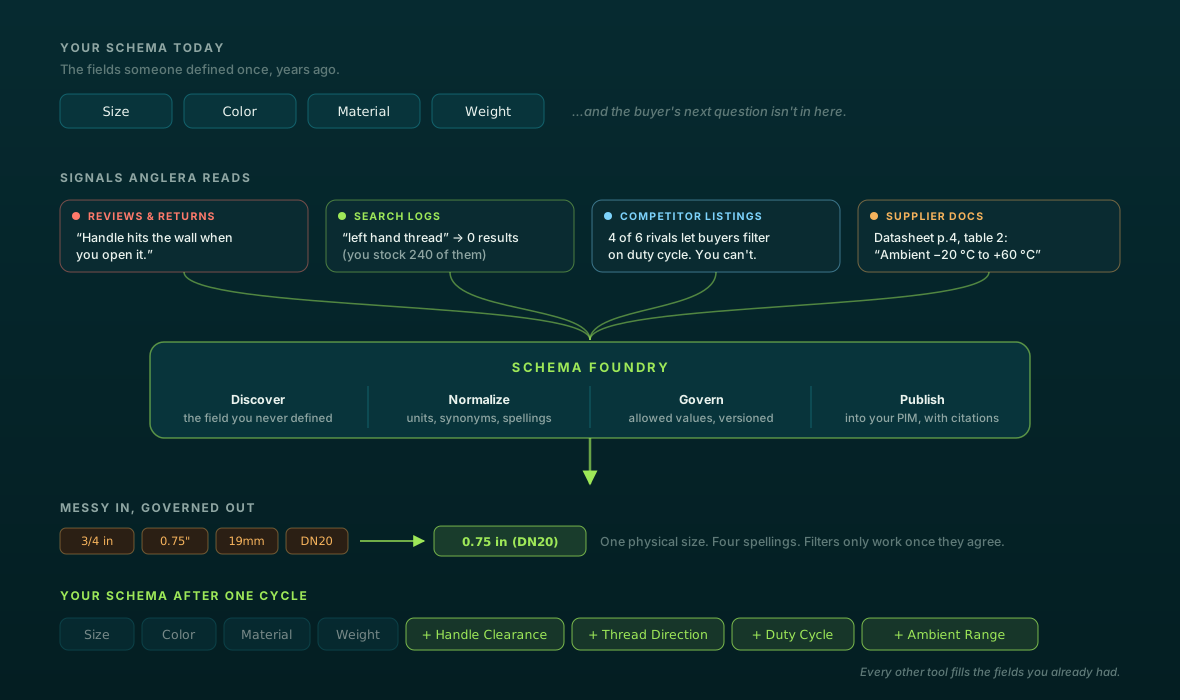
Anglera sits upstream of both. Before your catalog hits Channable's feed rules or Salsify's syndication network, Anglera gathers missing attributes, rewrites thin descriptions, and scores every SKU against how buyers actually search, compare, and decide. The enriched content writes back to your PIM — so Channable distributes better channel listings, and Salsify syndicates content that converts at the digital shelf.
Your PIM stores the data. Anglera does the work. Then Channable or Salsify takes it where it needs to go.
Frequently asked questions
Is Channable a PIM?
No. Channable is a feed management and syndication platform — it transforms and distributes product data you already have. It has no content authoring, PIM storage, or governance layer. If you need a system of record for product content, you need a separate PIM alongside Channable.
Can Salsify replace Channable for multichannel distribution?
Partially, for some use cases. Salsify has its own syndication network for brand-to-retailer publishing, which overlaps with some of what Channable does. But Channable's 2,500+ channel connectors — particularly for ad networks, CSEs, and marketplace performance feeds — go beyond Salsify's retail partner network. Merchants running paid acquisition across many channels typically still need a dedicated feed management tool.
Does either platform enrich product content automatically?
Neither does. Channable applies rule-based field transformations to whatever data you provide; it does not improve content. Salsify offers collaborative workflows that help teams manually fill gaps, but there is no automated enrichment engine. Anglera automates this layer — gathering, cleaning, enriching, and scoring product content against buyer signals — and writes the results back to your PIM before either platform touches the data.
Where does Anglera fit if I already use Channable?
Anglera enriches the data in your PIM before Channable's rules pick it up. Once Anglera writes richer attributes and improved descriptions back to your source catalog, Channable distributes that content across all your channels — so every marketplace listing and ad feed benefits simultaneously without changes to your Channable setup.
Is Salsify worth the cost for a mid-market brand?
It depends on SKU volume, retail partner count, and internal content team capacity. Salsify's total cost — platform plus the consulting onboarding that's typically required — is significant, and reviewers note it can feel expensive relative to what mid-market teams actually use. If the core need is better product content rather than a full PXM governance layer, an enrichment-first approach with a lighter PIM may deliver faster ROI.