Channable vs Stibo Systems: Which Fits Your Product Data Stack?
Channable and Stibo Systems solve different problems. Channable is a feed management and syndication engine: you feed it a catalog, define transformation rules, and it pushes channel-ready listings to 2,500+ marketplaces and ad networks. Stibo Systems makes STEP, an enterprise Master Data Management and PIM platform that acts as the authoritative system of record for product, supplier, customer, and asset data across a large organization. One is an outbound distribution layer; the other is a data governance backbone.
The comparison only gets interesting when you're a mid-to-large organization deciding how to architect your stack. A small e-commerce merchant will rarely consider STEP. A global manufacturer running multi-domain MDM is unlikely to find Channable's rule-based feed management sufficient on its own. But for the buyers in the middle — distributors, specialty retailers, and manufacturers scaling their digital shelf — the question often comes down to: do I need to govern and enrich the data first, or do I need to get it in front of buyers faster?
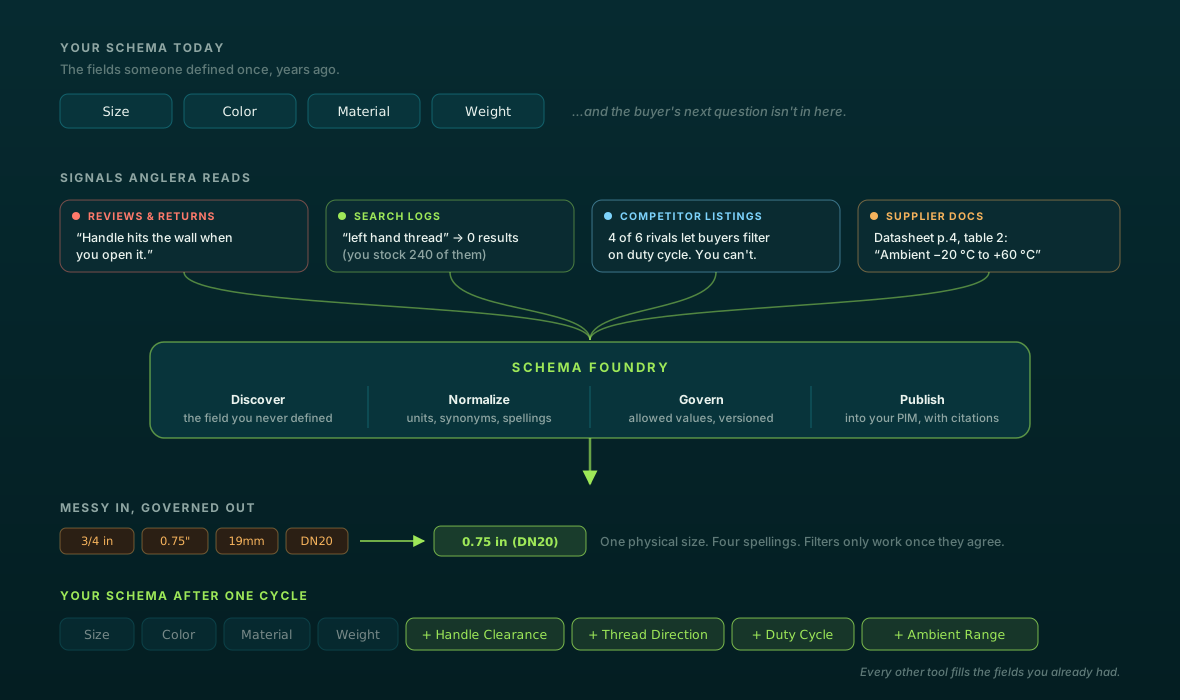
Neither platform does the enrichment work that the other assumes is already done. Channable transforms what you give it. STEP governs what you have. Neither gathers missing attributes, fills thin descriptions, scores completeness against buyer signals, or writes enriched data back to your system of record automatically. That gap is where Anglera operates — and it sits alongside either platform without replacing either.
| Channable | Stibo Systems | Anglera | |
|---|---|---|---|
| Core job to be done | Transform and distribute your product catalog to channels — marketplaces, shopping ads, retailer feeds — using rule-based automation at scale. | Govern master data across your enterprise: model data structures, enforce quality workflows, and maintain a single trusted record for product and related domains. | Enrich product attributes — gather what's missing, clean what's wrong, score completeness against buyer signals — then write results back to whatever system holds the record. |
| Data governance and modeling | Minimal. Rule-based transformations on existing data. No data modeling, workflow approvals, or governance framework. | Core strength. Full MDM governance: configurable data models, approval workflows, role-based access, auditability, and multi-domain data relationships (product, supplier, customer, asset). | Complements both: Anglera adds attribute-level quality scoring and enrichment completeness checks, giving teams visibility into what is underweight before it enters a governance workflow or leaves via a feed. |
| Channel syndication reach | Core strength. 2,500+ channel connections — Amazon, Google Shopping, Meta, TikTok, comparators, CSEs — with real-time inventory and pricing sync. PPC automation and marketplace order management available as add-ons. | Syndication is available as a module within STEP, but it is secondary to MDM governance. Enterprise teams often pair STEP with a dedicated syndication tool for broad channel reach. | Channel-agnostic. Anglera enriches attributes before they are distributed. Richer, complete data produces better feed quality in Channable and cleaner syndication exports from STEP. |
| Data enrichment and quality scoring | Not a strength. If-then rules can reformat or remap fields, but Channable cannot source missing attributes, generate descriptions, or score products against buyer expectations. | STEP includes data quality rules and validation, but enrichment — filling thin or absent attributes with sourced, AI-assisted content — is outside its scope and typically handled upstream. | Core competency. Anglera gathers attribute data from supplier sites, scrapes, and buyer signals; cleans and normalizes it; generates or completes missing fields; and scores every SKU for channel readiness before writing it back. |
| Implementation time | Fast. Feed setup for a connected catalog typically takes days to weeks depending on catalog size and channel count. No systems integrator required for standard use. | Long. Implementations routinely take several months and almost always require a certified systems integrator. Data modeling and workflow configuration alone can consume significant time before a single product is enriched. | ~30 days to first enriched SKUs. Anglera connects to an existing PIM or feed source, runs enrichment, and writes results back. No re-platforming required. |
| Pricing transparency | Transparent. Core Standard starts at ~€59/month for 5,000 items. AI features, PPC, repricing, and marketplace integrations are itemized add-ons at €30–71/month each. | Custom enterprise pricing. Scoped by users, data volume, and active modules. No public rates. Expect a formal sales cycle and a multi-year subscription commitment. | Scoped to catalog size and enrichment volume. Predictable and faster to quote than enterprise MDM. |
| Target buyer profile | E-commerce merchants and mid-market retailers who need fast, broad channel distribution. Works well when the catalog is already reasonably clean and the primary problem is reach and real-time sync. | Large enterprises — manufacturers, global distributors, multi-brand retailers — where product data is complex, multi-domain, and governed across organizational units. Significant IT and data governance investment required. | Any B2B distributor, retailer, or manufacturer whose PIM or feed tool is downstream of messy, thin, or incomplete product data. Anglera works regardless of which platform sits above or below it. |
How to choose between Channable and Stibo Systems
Choose Channable if:
- Your primary problem is getting a clean-enough catalog in front of buyers across many channels, fast.
- You are an e-commerce merchant or mid-market retailer with a single PIM or spreadsheet-driven catalog and a long list of channel integrations to maintain.
- You want transparent, predictable pricing without a multi-month procurement cycle.
- You do not need enterprise MDM governance — you need distribution.
Choose Stibo Systems STEP if:
- You are a large enterprise managing product data across multiple business units, brands, regions, or domains (supplier, customer, asset).
- Data governance is a compliance or operational requirement, not a nice-to-have. You need approval workflows, data lineage, and a single authoritative record.
- You can commit the budget, time, and integration resources that an MDM platform requires. This is a multi-year investment.
- You need a platform that can grow into full multi-domain MDM beyond product — supplier onboarding, customer data, regulatory data.
If you are somewhere in between: Mid-market distributors and manufacturers frequently outgrow Channable's feed-transformation approach but are not ready for the full weight of enterprise MDM. In that zone, the real question is often not Channable vs. STEP but rather: what PIM do you use, and is the data in it good enough to distribute? That is a different problem — and the answer to it is enrichment, not syndication or governance.
Whichever you pick, the data still has to get done
Channable assumes your product data is transformation-ready. Stibo STEP assumes your product data is worth governing. Both assumptions fall apart when attributes are missing, descriptions are thin, or SKU completeness is uneven across the catalog — which is the default state for most B2B distributors and manufacturers managing thousands of SKUs from dozens of suppliers.
Anglera sits upstream of both. It connects to your existing PIM or data source — whether that is STEP, another PIM, or a spreadsheet — enriches each SKU against buyer signals and channel requirements, and writes the enriched data back. If you are on Channable, your feeds get richer, more complete listings. If you are on STEP, your governance workflows start from higher-quality source data rather than trying to fix thin content inside the platform.
The implementation is ~30 days. Anglera does not require you to re-platform, replace your PIM, or reconfigure your channel connections. Whichever side of this comparison you land on, the enrichment problem exists independently — and it is the work that neither Channable nor STEP does for you.
Frequently asked questions
Can Channable replace a PIM or MDM platform like Stibo STEP?
No. Channable is a feed transformation and syndication layer — it reads data from wherever your catalog lives and pushes it to channels. It does not model data structures, enforce governance workflows, maintain a system of record, or manage multi-domain master data. If you need those capabilities, a PIM or MDM platform is the right starting point. Channable sits downstream of that.
Does Stibo STEP handle channel syndication on its own?
STEP includes syndication capabilities as a module, but enterprise teams with broad multi-channel distribution needs often pair it with a dedicated feed management tool. STEP's strength is governance and master data, not the real-time feed sync and 2,500+ channel integrations that Channable is built for.
Where does Anglera fit if I already have Channable or Stibo in place?
Anglera operates upstream of both. If you use Channable, Anglera enriches your catalog before feeds go out — filling thin attributes, correcting inconsistencies, and scoring SKUs so your channel listings are as complete as possible. If you use STEP, Anglera enriches data before or alongside your governance workflows, so your system of record starts from a higher baseline. In both cases, Anglera writes results back to your source of truth rather than creating a new silo.
Is Stibo Systems overkill for a mid-market company?
Likely yes, for most. STEP is engineered for large enterprises running complex, multi-domain data environments with substantial IT resources. The implementation timeline, integration requirements, and cost structure reflect that. Mid-market distributors and retailers typically need a good PIM and strong enrichment more than they need full-scale MDM governance. If the core problem is product data quality and completeness rather than enterprise data governance, there are faster paths.
How long before each tool delivers value?
Channable can deliver channel distribution value within days to weeks once your catalog is connected and rules are configured. Stibo STEP implementations typically run several months before production data is flowing through governance workflows, and often require a systems integrator throughout. Anglera is scoped to ~30 days from connection to first enriched SKUs returned to your source system.