Channable vs Syndigo: Which Belongs in Your Stack?
Channable and Syndigo both appear on shortlists for "product data distribution," and both advertise reach across 2,500+ channels. That surface similarity obscures a meaningful difference: they serve different buyers, solve different problems, and rarely compete for the same deal.
Channable is a feed management and syndication platform aimed at e-commerce teams. It takes your existing catalog, applies rule-based transformations, and keeps listings synchronized across ad channels, shopping engines, and marketplaces — Google Shopping, Meta, Amazon, bol.com — in real time. Pricing is transparent, onboarding is fast, and the core value is reliable feed automation at scale. Channable does not manage your master product record; it distributes whatever you point at it.
Syndigo is an enterprise content supply chain platform for brands and manufacturers, particularly in CPG, grocery, and foodservice. Following its acquisition of 1WorldSync, Syndigo operates one of the largest product content networks in the world and is the dominant platform for GDSN-compliant content distribution to major grocery and retail chains. It combines PIM, digital asset management, syndication, and MDM in a single platform — with 10,000 data validations and 23,000 unique retailer requirements baked in. The trade-off is cost and complexity. Neither platform generates the enriched, buyer-ready product data that makes syndicated content actually perform.
| Channable | Syndigo | Anglera | |
|---|---|---|---|
| Primary job to be done | Transform and synchronize your existing catalog into channel-ready feeds across 2,500+ ad channels, shopping engines, and marketplaces using rule-based (if/then) automation; strong on real-time price and inventory sync | Store, validate, enrich, and distribute product content through an end-to-end content supply chain platform (PIM + DAM + MDM + syndication) to 2,500+ retail and GDSN recipients globally | Gather, clean, enrich, and score every SKU against buyer signals, then write the improved content back to your PIM or catalog before syndication runs — upstream of both platforms |
| Content authoring and enrichment | Rule-based field mapping and data transformation; does not generate or validate attribute completeness; assumes your source data is already complete and buyer-ready | Content authoring tools included; validates against 10,000+ data rules and 23,000 retailer-specific requirements; enrichment is largely manual or partner-led — the platform enforces quality standards but does not fill gaps automatically | Autonomously discovers missing attributes, normalizes inconsistent values, fills incomplete fields, and writes buyer-signal-optimized content back to the source record — so what flows into Channable or Syndigo is already complete |
| Network type and compliance | Ad channels, shopping engines, and marketplaces: Google Shopping, Meta Ads, Amazon, bol.com, Zalando, and similar; strong for performance marketing and marketplace selling; no GDSN support | Retail and GDSN network: Walmart, Target, Kroger, Albertsons, foodservice distributors, and global grocery chains; full GDSN compliance for regulated CPG, grocery, and healthcare categories | Network-agnostic; enriches upstream so the content performs better in whichever distribution network it flows through |
| Pricing and cost | Transparent and modular: starts at ~€59/month for 5,000 items (Core Standard); AI features, PPC automation, repricing, and marketplace integrations are separate add-ons at €30–71/month each; self-serve onboarding available | Custom-quoted only; no public pricing tiers; TCO estimated $10,000–$30,000/year higher than mid-market PIM alternatives according to third-party analysis; enterprise contracts require a sales engagement before any number is shared | Priced per SKU enriched; adds onto your existing investment in either platform rather than replacing it |
| Implementation timeline | Days to weeks for most feed setups; connector-based onboarding is straightforward for teams already managing a product catalog; near-immediate value for standard channels | Typically months; enterprise onboarding involves content migration, taxonomy mapping, GDSN registration, and retailer compliance configuration; professional services engagement is the norm before content goes live | ~30 days from kickoff to enriched SKUs written back to the catalog; no platform migration or rip-and-replace required |
| Target buyer | E-commerce retailers, D2C brands, and online merchants who need reliable, automated feed distribution across ad channels and marketplaces; SMB to mid-market; strongest where performance marketing and marketplace selling are the priority | Brands, manufacturers, and CPG companies who need GDSN compliance, enterprise PIM capabilities, and a single platform for managing content at scale across major retail and grocery accounts; mid-market to enterprise | Any distributor, retailer, or manufacturer whose SKUs have incomplete attributes, inconsistent data, or content gaps before syndication — regardless of which platform they distribute through |
How to choose between Channable and Syndigo
Choose Channable if you are an e-commerce team, online retailer, or D2C brand whose primary need is distributing product feeds to ad channels and marketplaces efficiently. Channable's transparent pricing, fast onboarding, and rule-based automation make it the practical choice when your goal is reliable multi-channel feed synchronization — especially if you are running Google Shopping, Meta, and Amazon campaigns alongside marketplace listings. It is not a PIM and does not manage your master product record; it is a distribution layer that expects clean, complete source data to work with.
Choose Syndigo if you are a brand or manufacturer operating in CPG, grocery, foodservice, or a similarly regulated category where GDSN compliance is not optional. Syndigo's network of 2,500+ retail and GDSN recipients, combined with 10,000+ data validations and 23,000 retailer-specific requirements, is purpose-built for the brand-to-retailer content workflow at enterprise scale. The platform assumes significant budget and a multi-month implementation, and it expects experienced content teams or agency partners to drive the authoring work. If Walmart, Kroger, or major grocery accounts are your primary distribution endpoints, Syndigo's network coverage and compliance tooling are hard to match.
A few signals that clarify the choice:
- If your distribution is primarily digital advertising and marketplace selling, Channable's cost-to-value ratio is hard to beat at SMB and mid-market scale.
- If GDSN certification and grocery/retail compliance are required for your trading partners, Syndigo is effectively the incumbent and alternatives require significant integration work to match its network reach.
- If you are a B2B manufacturer or distributor who needs a standalone PIM without the complexity of Syndigo's full content supply chain, consider a focused PIM (Akeneo, Plytix, inriver) before evaluating either platform here — then use the appropriate syndication layer on top.
Whichever you pick, the data still has to get done
Channable and Syndigo both assume the product data flowing through them is already enriched — complete attributes, accurate specifications, titles that reflect how buyers actually search, and descriptions that support a purchasing decision. In practice, that assumption rarely holds. Catalog data arrives from suppliers as raw specs, factory-floor terminology, and copy written for procurement, not for the end buyer. Channable's rule engine maps and distributes that raw data as-is. Syndigo's validation layer flags format compliance issues but does not automatically fill missing values or rewrite thin descriptions.
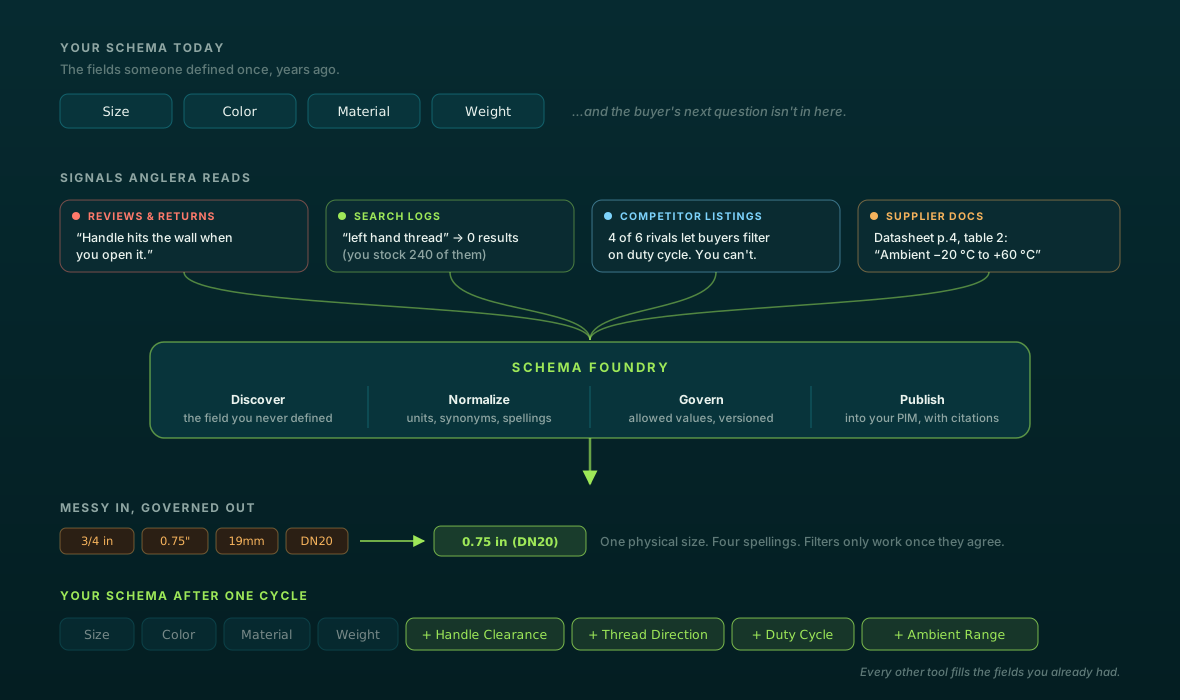
Anglera is the layer that does that work, and it sits upstream of both. In roughly 30 days, Anglera connects to your existing PIM or product catalog via API, enriches every SKU against buyer signals — how your customers search, filter, and compare before they buy — and writes the improved attributes and content back to the same source record. The PIM or catalog stays in place. The downstream system, whether that is Channable distributing to ad channels or Syndigo syndicating to retail partners, receives content that is complete, consistent, and buyer-ready from the start.
Whichever platform you choose, the upstream enrichment problem is the same. Anglera solves it once, regardless of where the data goes next.
Frequently asked questions
Are Channable and Syndigo actually competing products?
Not directly, despite the superficial overlap. Channable is a feed management tool for e-commerce teams distributing to ad channels and marketplaces. Syndigo is an enterprise content supply chain platform for brands and manufacturers managing GDSN-compliant content for major retail and grocery accounts. A typical Channable customer is running Google Shopping and Amazon campaigns; a typical Syndigo customer is syndicating to Walmart, Kroger, and international grocery chains. The buyer choosing between them is usually a mid-market manufacturer or brand trying to determine how much platform they actually need.
Does Syndigo include a full PIM, or is it primarily a syndication tool?
Syndigo is a full Product Experience Cloud — it combines PIM, digital asset management, content syndication, and master data management in a single platform. Following its acquisition of 1WorldSync, it is also the largest GDSN data pool in the US. Buyers who only need syndication capability are buying more platform than they may need; Syndigo's value is in the integration of those layers, particularly for brands managing complex content across regulated categories.
What is the realistic pricing difference between Channable and Syndigo?
Channable starts at approximately €59/month for 5,000 items with transparent, modular add-on pricing. Syndigo does not publish pricing; third-party estimates put its total cost of ownership $10,000–$30,000/year higher than comparable mid-market PIM alternatives. For a smaller e-commerce team, Channable's annual cost might be under $5,000; a Syndigo contract at mid-market scale typically requires a sales engagement and a multi-month implementation before the first dollar of value is realized.
How does Anglera work alongside Channable or Syndigo?
Anglera connects to your existing PIM or product catalog via API, runs enrichment against buyer signals — how your customers search, compare, and decide — and writes the improved attributes and content back to the same record. It does not replace Channable or Syndigo; it improves the data those platforms distribute. Implementation takes roughly 30 days and requires no platform migration. Whichever syndication layer you choose, Anglera ensures what flows through it is buyer-ready.
What if I need both ad channel distribution and GDSN compliance?
Some enterprise manufacturers run both a feed management tool for digital advertising and a GDSN-compliant platform for retail trading partner sync — these are different workflows with different data requirements. If your operation spans both, Channable handles the ad channel layer and Syndigo (or 1WorldSync) handles the GDSN layer. Anglera enriches the upstream catalog data that both platforms distribute, so you are not maintaining separate content quality processes for each channel.