Describely vs Zoovu: Choosing the Right Product Enrichment Tool
Describely and Zoovu both use "AI enrichment" in their pitch, but they are solving for different buyers with fundamentally different architectures. Comparing them head-to-head is less about which has better enrichment algorithms and more about how much platform you need — and whether enrichment is the end goal or the on-ramp to something bigger.
Describely is a point solution built for eCommerce teams. It generates product descriptions, titles, bullet points, and meta tags at scale using AI, can infer missing attributes from a SKU or title alone, and publishes directly to Shopify, WooCommerce, and Wix. The value proposition is simple: fill catalog gaps and publish SEO-ready copy fast, without hiring more copywriters. Pricing is public and accessible, starting at $28 per month.
Zoovu is a platform play. Enrichment is included in every Zoovu plan, but it is positioned as the foundation for the rest of the suite — AI search and merchandising, guided selling configurators, and an AI shopping assistant. If you adopt Zoovu for enrichment, you are also adopting a new approach to product discovery and front-end experience. That scope is a strength for buyers who want one vendor to handle enrichment and the full experience layer. It is a constraint for buyers who just want better data in the system they already own.
| Describely | Zoovu | Anglera | |
|---|---|---|---|
| Primary orientation | AI writing and content generation tool for eCommerce teams — generates SEO-ready copy (descriptions, titles, bullets, meta tags) at scale from minimal input; built to replace or augment a copywriting workflow | End-to-end product experience platform — enrichment is bundled into every plan as the foundation for AI search, guided selling configurators, and an AI shopping assistant; platform-wide strategy rather than point-solution enrichment | Enrichment layer only — reads SKUs from the PIM already in place, enriches every attribute and description against buyer signals, and writes results back to the system of record; no storefront or experience layer included |
| Target buyer | eCommerce retailers and DTC brands — native with Shopify, WooCommerce, and Wix; designed for marketing and merchandising teams that need to fill copy gaps fast without technical overhead | B2B distributors, manufacturers, and B2C retailers who want to unify product data enrichment with front-end discovery under one vendor rather than manage multiple point solutions | B2B distributors, retailers, and manufacturers with an existing PIM who need buyer-ready product data written back to the system of record — not a new storefront or discovery experience |
| Enrichment approach | Generative AI infers missing attributes and produces marketing copy from thin inputs (a SKU or title alone); output is optimized for SEO and conversion copy, not structured B2B spec completeness | Semantic AI normalizes and structures product attributes across supplier data — designed to power Zoovu's downstream search and guided selling experiences; enrichment quality is measured by its ability to fuel those experience layers | Enriches every attribute and description against buyer signals — how buyers actually search, compare, and filter — and writes structured, buyer-ready content back to the PIM; not tied to any storefront or front-end platform |
| Platform scope and integrations | Point solution — content generation and enrichment only; no search, no guided selling, no analytics; publishes to Shopify, WooCommerce, and Wix natively; not designed to write enriched data back to a standalone PIM | Full experience suite — AI Data Enrichment plus AI Search and Merchandising, Guided Selling Configurators, and AI Shopping Assistant; adopting Zoovu for enrichment typically means integrating its experience layer into the front end as well | Single-purpose enrichment that integrates with the PIM already in place; no front-end changes, no storefront work, no search platform required |
| Pricing model | Transparent and accessible — pay-as-you-go from $28/month; data enrichment priced at $0.55 per product (10-product minimum); custom enterprise plans available; no sales call required to get started | Quote-based only, billed annually; modular by product — enrichment is included in every plan, with AI Search, Guided Selling, and AI Assistant each priced separately; scales with traffic and interaction volume; no public rates | Per-SKU enrichment pricing; layers onto the existing PIM investment rather than replacing it or requiring a new front-end commitment |
| Implementation speed | Fast — connect a Shopify, WooCommerce, or Wix store, configure copy templates, and start generating; most eCommerce teams are running within days | Longer — bundling enrichment with search, guided selling, and an AI assistant means integrating multiple front-end layers into your commerce stack; implementation timeline and change management scale with the scope of the platform adoption | ~30 days from kickoff to enriched SKUs written back to the PIM; no platform migration, no front-end changes required |
| B2B and complex catalog fit | Built for eCommerce and DTC; generates strong consumer-facing copy, but has no structured model for B2B buyer intent, technical specification depth, or the attribute completeness needed for industrial and distribution catalogs | Explicitly targets B2B distributors and manufacturers — guided selling and AI search are purpose-built for complex product selection scenarios; semantic enrichment is designed to handle technical attributes and multi-level product relationships | Purpose-built for B2B distributors and manufacturers; enriches technical attributes against real buyer signals — not just reformatted supplier copy — across large catalogs with complex specification requirements |
How to choose between Describely and Zoovu
Choose Describely if you run an eCommerce store on Shopify, WooCommerce, or Wix and your primary problem is scale: you have hundreds or thousands of products with thin, missing, or inconsistent copy and you need to fill those gaps fast without hiring more writers. Describely's pay-as-you-go pricing, native platform connectors, and ability to generate reasonable copy from minimal input make it the most accessible option for teams that just need more content, faster. If your catalog is consumer-facing, your team is marketing-led, and you want to see results in days rather than months, Describely is the right starting point.
Choose Zoovu if you are a B2B distributor, manufacturer, or retailer who wants to solve enrichment and front-end product discovery under one vendor. Zoovu's real pitch is not just better product data — it is a connected system where enriched data immediately powers guided selling, AI search, and a shopping assistant. If your customers struggle to find the right product in a complex catalog and you want a platform that handles both the data quality problem and the discovery experience in one engagement, Zoovu's bundled model is worth the investment. Be clear-eyed that you are buying a platform transformation, not a plug-in: the implementation scope, annual contract, and change management are larger than a pure enrichment project.
A few signals that clarify the choice:
- If you need to be running and generating content this week on a public Shopify store, Describely's self-serve model and $28/month entry point are hard to beat.
- If you have complex B2B product catalogs with technical specifications and you want guided selling or configurators alongside enrichment, Zoovu's platform depth justifies the evaluation effort.
- If you want enrichment results written back to a PIM you already own — Akeneo, Salsify, or similar — and do not need a new search or discovery layer, neither Describely nor Zoovu is primarily designed for that workflow.
Whichever you pick, the data still has to get done
Describely and Zoovu both measure enrichment success by what happens next in their own systems: Describely by copy published to your Shopify storefront; Zoovu by how well that enriched data powers their search, guided selling, and AI assistant. Both tools are destinations — they enrich product data and consume it inside their own layer.
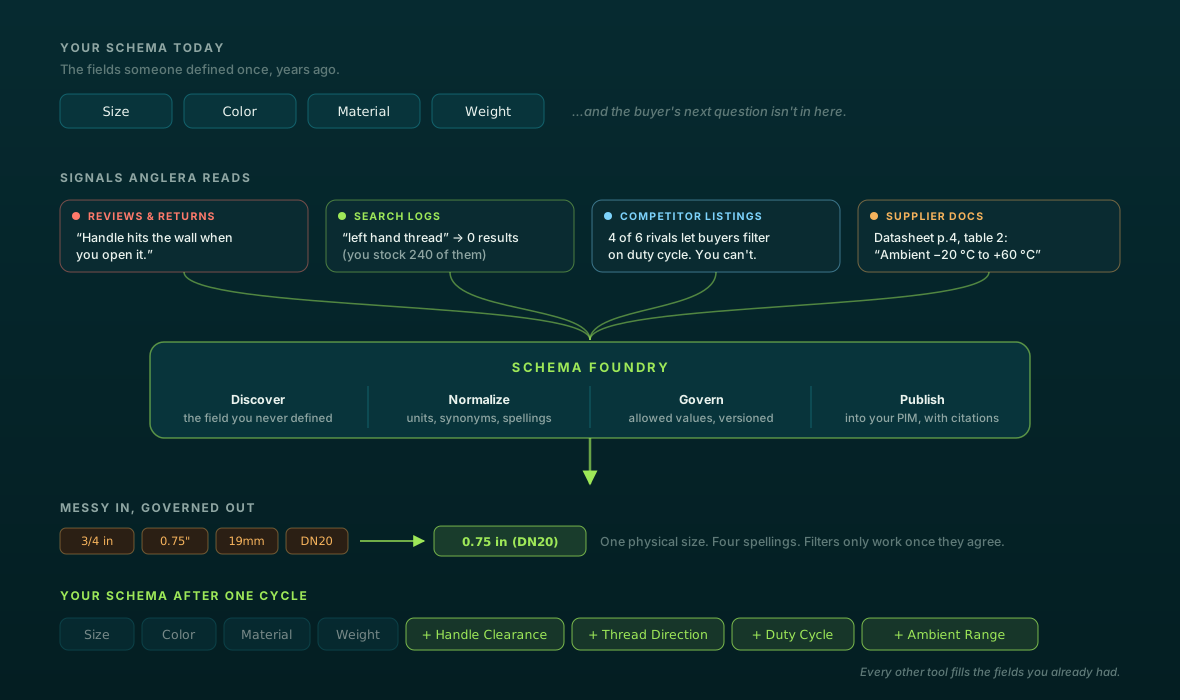
Anglera does the opposite. It connects to the PIM you already own, reads your existing SKUs, enriches every attribute and description against buyer signals — how your real customers search, compare, and filter — and writes the improved content back to the same PIM record. The system of record stays unchanged. The content inside it becomes buyer-ready. Whatever search, storefront, or experience layer sits on top of that PIM gets better data without any changes to itself.
That means Anglera is not competing with Describely or Zoovu for the same job. If you pick Describely for your Shopify store's copy workflow, Anglera can still enrich the underlying catalog data in your PIM — the structured attributes and specification completeness that Describely's copy generation draws from. If you pick Zoovu for its experience platform, Anglera can enrich the product data that feeds into Zoovu's semantic layer, so the guided selling and AI search experiences run on buyer-signal-optimized content rather than raw supplier specs. Whichever platform you choose, implementation is ~30 days with no migration required.
Frequently asked questions
What is the main difference between Describely and Zoovu?
Describely is a content generation point tool — it uses AI to write product descriptions, titles, bullets, and meta tags at scale for eCommerce teams using Shopify, WooCommerce, or Wix. Zoovu is a full product experience platform — enrichment is included in every plan, but it is the foundation for a bundled suite of AI search, guided selling configurators, and an AI shopping assistant. Describely is a faster, cheaper way to fill copy gaps on a consumer storefront. Zoovu is a platform commitment that replaces or augments your search and discovery layer alongside enriching your data.
Is Describely suitable for B2B distributors and manufacturers?
Not primarily. Describely is designed for eCommerce retailers with consumer-facing catalogs on Shopify, WooCommerce, or Wix. It generates marketing copy and infers basic attributes from thin inputs, but it does not model B2B buyer intent, technical specification depth, or the attribute completeness requirements that industrial and distribution catalogs demand. B2B distributors and manufacturers with complex product hierarchies and large SKU counts will typically find Describely's output too surface-level for their needs.
Does adopting Zoovu mean replacing my existing site search or storefront?
Not necessarily, but practically, Zoovu's value proposition is strongest when its experience layers — AI search, guided selling, AI assistant — are deployed on your front end. Adopting Zoovu purely for its data enrichment capability and leaving the rest of the suite unused is possible but unusual. Most buyers who choose Zoovu are investing in the broader platform, which means integrating Zoovu-hosted experiences into their commerce stack. That integration scope and change management are meaningfully larger than a standalone enrichment project.
How does Anglera work alongside Describely or Zoovu?
Anglera connects to the PIM you already own via API, reads your existing SKUs, enriches every attribute and description against buyer signals, and writes the improved content back to the same PIM record. If you are using Describely for copy generation on Shopify, Anglera enriches the underlying PIM data that Describely draws from — improving the structured attributes and specification completeness before copy is generated. If you are using Zoovu's experience platform, Anglera can enrich the product data feeding Zoovu's semantic layer so that guided selling and AI search run on buyer-ready content rather than raw supplier specs. Implementation is ~30 days with no migration required.
Which is cheaper — Describely or Zoovu?
Describely is significantly more accessible on price. It starts at $28 per month on a pay-as-you-go basis, with data enrichment priced at $0.55 per product — no sales call required. Zoovu is quote-based, billed annually, and modular: enrichment is included in every plan, but AI search, guided selling, and the AI assistant are each priced separately, scaling with traffic and interaction volume. Zoovu's total cost reflects a platform investment rather than a per-product enrichment fee. For teams that need to control costs or start small, Describely's pricing model is the clearer starting point.