Feedonomics vs Informatica PIM: Which Belongs in Your Stack?
Feedonomics and Informatica PIM solve different problems, and most buyers who land on this comparison are asking the wrong question. These tools are not direct competitors — they occupy different positions in the product data lifecycle. Feedonomics takes product data and pushes it everywhere: Google Shopping, Amazon, Walmart, Meta, and 300 other channels and marketplaces. Informatica Product 360 is where the data lives — an enterprise master data management and PIM platform that governs product information at the source of truth. If you need distribution breadth managed by specialists, you want Feedonomics. If you need governed, centralized product data across a complex enterprise, you want Informatica.
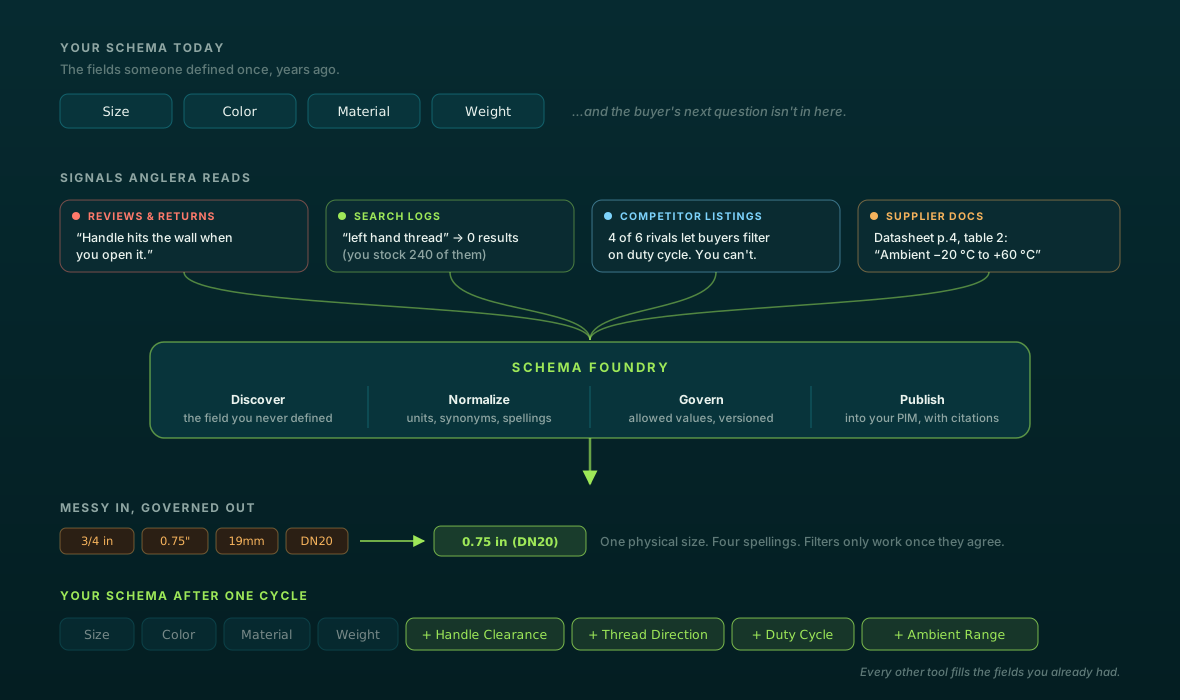
The real issue both platforms share is that they assume the incoming product data is already complete, accurate, and channel-ready. It rarely is. Feedonomics can reformat a title and remap a field, but it cannot invent a missing tensile strength spec or write a missing product description from scratch. Informatica's AI agents can enrich data that exists inside the system, but they cannot go out and retrieve what was never captured to begin with. That gap — between raw supplier data and the enriched, buyer-signal-scored records these platforms need to do their job — is where most teams lose time and revenue.
This page lays out where each tool wins, where it falls short, and how to decide which one belongs in your stack. It also addresses the enrichment gap honestly, because whichever platform you choose, incomplete product data will limit what you get out of it.
| Feedonomics | Informatica PIM | Anglera | |
|---|---|---|---|
| Primary function | Feed management and syndication — transforms, optimizes, and distributes product data across 300+ ad channels and marketplaces including Google Shopping, Amazon, Walmart, and Meta. | Master data management and PIM — centralizes and governs product information as the authoritative system of record, with workflow automation, data quality governance, and enterprise integrations. | Neither stores nor syndicates product data. Anglera enriches SKUs against buyer signals — surfacing missing specs, descriptions, and attributes — then writes clean records back to whichever system holds the source of truth. |
| Ideal buyer | Retailers, brands, and agencies that need products visible across paid and organic channels, and want feed specialists to handle setup, optimization, and ongoing error resolution without building an in-house team. | Large enterprise manufacturers, distributors, or retailers with complex MDM requirements, multi-entity data governance needs, and a requirement for a single, governed data truth across the business. | Any company running either platform whose raw product data is incomplete, inconsistent, or missing the attributes that buyers and channel algorithms expect. Works alongside the existing system — no migration required. |
| Data enrichment approach | Transforms and reformats existing data to meet each channel's schema; optimizes titles and attributes for channel performance. Does not generate missing product content or fill absent specs. | Includes AI agents that enrich, validate, and manage attributes inside the platform. Enrichment is scoped to data already in the system — the AI cannot retrieve specs or descriptions that were never captured. | Crawls manufacturer sites, supplier portals, and the open web to surface missing specs, features, and descriptions. Scores completeness against buyer signal benchmarks, then writes enriched attributes back to the source system. |
| Channel and distribution reach | 300+ pre-built channel integrations — Google, Meta, Amazon, Walmart, Microsoft Ads, TikTok, and more. Channel breadth and managed feed optimization is the core value proposition. | Distributes data to downstream channels and enterprise systems, but distribution breadth is not the primary differentiator. Integration is managed through the broader enterprise data and MDM stack. | Does not distribute to channels. Anglera's job is to make data channel-ready — complete, accurate, and scored — before Feedonomics or Informatica push it downstream. |
| Implementation model and time-to-value | Managed service: feed specialists handle setup, ongoing optimization, and error resolution. Faster time-to-value for teams without in-house feed expertise, since Feedonomics manages the operational burden. | Enterprise software implementation: typically requires a systems integrator, months of configuration, and significant IT involvement. The wide scope of MDM plus PIM means a longer runway before full value is realized. | Approximately 30-day implementation. Connects to the existing PIM or data source, runs enrichment workflows, and writes results back. No migration, no rip-and-replace, no new system of record to maintain. |
| Pricing | Custom quote only. Pricing varies by SKU count, channel count, and service tier. No revenue-share model. No public pricing. | Subscription-based with Standard, Professional, and Enterprise tiers. Custom quote only; pricing is driven by users, data volume, and configuration scope. Widely regarded as one of the more expensive options in the PIM market. | Custom pricing based on SKU volume and enrichment scope. No PIM licensing fees, no channel distribution fees — priced on the enrichment work itself. |
| Data governance | Governance scoped to feed health and channel compliance: flagging rejected listings, enforcing channel-specific attribute requirements, and maintaining feed accuracy across destinations. | Full MDM-grade governance: data quality workflows, stewardship queues, audit trails, and cross-enterprise data lineage. This is a defining strength and a key reason enterprises choose Informatica over lighter PIM alternatives. | Enrichment confidence scoring on every generated attribute; human-reviewable outputs before writes are committed. Designed to complement existing governance workflows — Anglera's outputs flow into whatever approval process is already in place. |
How to choose between Feedonomics and Informatica PIM
Choose Feedonomics if your primary pain is channel distribution. You have product data that is reasonably complete, and the problem is getting it to Google Shopping, Amazon, Walmart, and 300 other destinations in the right format — with specialists managing feed errors and optimization on your behalf. Feedonomics is purpose-built for retailers and brands that run high-volume paid and organic channel programs and want a managed-service model. It is not the right tool if you need a governed system of record, and it cannot solve a data completeness problem upstream of the feed.
Choose Informatica PIM if your problem is data governance and master data management at enterprise scale. You are a large manufacturer, distributor, or omnichannel retailer with fragmented product data across business units, complex workflows for data stewardship, and a need for a single governed truth that feeds every downstream system. Informatica Product 360 is appropriate when data complexity, compliance, and cross-enterprise integration are the core requirements — not just channel distribution. Budget accordingly: implementation is resource-intensive and Informatica is priced to match.
If you need both, these tools are compatible rather than competing. Informatica can serve as the master repository that feeds Feedonomics for distribution. Many enterprise retailers run exactly this architecture: Informatica governs and distributes the data, Feedonomics syndicates it to paid channels with channel-specific optimization. The gap in that architecture — and in either tool used alone — is that neither platform fixes missing or thin product data before it moves downstream.
Whichever you pick, the data still has to get done
Whichever platform you choose, the enrichment problem lands outside both of them.
Feedonomics optimizes what you give it. If a product is missing its key specifications, a channel-compliant title transformation does not help — the spec simply will not appear. Informatica's AI agents are powerful within the system boundary, but they enrich from data that already exists inside the platform. Neither tool goes out and finds what was never captured: the missing weight and dimensions from a supplier data sheet, the feature bullets that never made it past the product team, the compatibility specs that would drive search conversion.
Anglera connects to your existing PIM or data source — whether that is Informatica Product 360, a simpler PIM, or a flat file — reads what you have, identifies gaps against buyer signal benchmarks, and fills them by crawling manufacturer sites, supplier portals, and the open web. Every enriched attribute carries a confidence score. Outputs are human-reviewable before they are written back. Implementation runs in approximately 30 days and does not require migrating to a new system or changing your current architecture.
If you are evaluating Feedonomics, Anglera makes your feeds stronger before they reach the channel — more complete attributes mean better indexing, fewer rejected listings, and higher conversion on the other side. If you are evaluating Informatica, Anglera addresses the data quality gap that governance tools can track but cannot fill: the missing content was never in the system to govern in the first place. Pick the platform that fits your distribution or governance requirement. Anglera handles the enrichment work that both platforms assume already happened.
Frequently asked questions
Are Feedonomics and Informatica PIM competing products?
No. Feedonomics is a feed syndication and channel distribution platform. Informatica Product 360 is a master data management and PIM system. They operate at different points in the product data lifecycle and can run alongside each other — Informatica governing and storing the data, Feedonomics syndicating it to paid channels. The decision between them only arises if a buyer is trying to use one tool to cover a need the other is actually designed for.
Does Informatica PIM eliminate the need for a tool like Feedonomics?
Not typically. Informatica distributes data to downstream systems, but channel-specific feed optimization — reformatting titles for Google Shopping, enforcing Amazon's taxonomy requirements, managing rejected listings in real time — is not Informatica's core differentiator. Enterprises with heavy paid-channel programs generally still need a dedicated feed management layer. That said, lighter syndication needs may be covered by Informatica's integrations depending on channel scope.
Feedonomics has feed specialists who optimize my data — isn't that enrichment?
Feed specialists optimize data formatting and channel compliance: they remap fields, adjust titles for character limits, and resolve feed errors. That is a different job from content enrichment. If a product is missing its material composition, weight, or a key feature, a feed specialist can flag the gap but cannot fill it. Anglera fills it — by crawling source sites and supplier data to retrieve what was never captured — before the feed reaches the channel.
Informatica Product 360 already includes AI enrichment. Why would I need Anglera?
Informatica's AI agents enrich and validate attributes within the platform using data that already exists in the system. If a spec was never ingested — never captured from the supplier or manufacturer — the AI agents have nothing to work from. Anglera retrieves missing data from outside your system boundary: manufacturer sites, supplier portals, and publicly available product information. The two approaches are complementary rather than redundant.
How long does it take to implement Anglera alongside one of these platforms?
Approximately 30 days. Anglera connects to your existing data source — whether that is Informatica, a different PIM, or a flat file — without requiring a platform migration or a new system of record. Enriched attributes are written back to the same source, so your existing workflows, governance processes, and distribution pipelines continue unchanged.