Feedonomics vs Pimberly: Two Different Jobs, One Common Gap
These two tools solve fundamentally different problems, which is why comparing them requires some upfront clarity. Pimberly is a PIM and DAM — a system of record that centralizes product content, enforces governance rules, and publishes finished data to channels. Feedonomics is a feed management and syndication platform — a distribution engine that takes your existing catalog data and routes it to 300+ ad channels and marketplaces in the right format. Most teams that use both run them sequentially, not as alternatives.
If you are genuinely deciding between them, the real question is: which problem am I actually solving right now? If your product data is scattered across supplier spreadsheets, internal systems, and siloed teams with no consistent governance, Pimberly's centralization and validation tooling is the right starting point. If your catalog is already governed and the bottleneck is channel reach — getting products listed and performing on Google, Amazon, Walmart, and dozens of other destinations — Feedonomics is built for that job.
What neither tool solves is the quality problem both take for granted. Pimberly stores and governs product data, but the completeness and buyer-readiness of that data depends entirely on what suppliers and internal teams provide. Feedonomics syndicates whatever your catalog already holds. If that content is thin, keyword-poor, or written for a procurement audience rather than a buying one, both platforms efficiently move the problem downstream.
| Feedonomics | Pimberly | Anglera | |
|---|---|---|---|
| Primary function | Feed management and syndication — transforms, optimizes, and distributes existing product data to 300+ ad channels and marketplaces; a managed distribution engine, not a data store | PIM and DAM — the central system of record for storing, governing, and publishing product content across channels; purpose-built for data centralization and quality control | Enrichment layer — neither a PIM nor a syndicator; reads product data from your existing PIM, enriches every SKU against buyer signals, and writes the improved content back to the source of truth |
| Where it sits in the stack | Downstream of your catalog or PIM — pulls existing data and pushes it to channels in the correct format; does not store or govern product content itself | The system of record — the central hub that stores, validates, and governs product data before any channel publishing happens | Upstream of both — enriches content before it is stored or distributed; adapts to whichever PIM schema and governance model is already in place |
| Channel reach and publishing | 300+ ad channels and marketplaces including Google Shopping, Amazon, Microsoft Ads, Walmart, and Meta — the broadest channel coverage in the managed-feed market; this is Feedonomics' defining strength | Multi-channel publishing to e-commerce platforms, marketplaces, and retail partners via workflow automation; channel breadth is narrower than a dedicated feed syndicator | Does not publish to channels; enriches the content that Pimberly, Feedonomics, or any downstream distribution tool then sends out |
| Data governance and validation | Field mapping and feed rules ensure data meets channel specifications; validation is channel-compliance-focused — does the feed meet Google's or Amazon's technical requirements — not broad data-quality governance | Built-in validation rules, completeness scoring, and team workflow controls for enforcing data standards across contributors; governance is a core design principle, not an add-on | PIM-agnostic enrichment that works within whatever schema and governance model Pimberly or another PIM defines; no data model changes required |
| Enrichment capability | Can reformat and remap existing attributes and apply rule-based title optimization for channel specs; does not generate buyer-signal-driven content from incomplete or raw supplier data | AI tools assist with data consistency and formatting; enrichment quality depends on what suppliers and internal teams supply — no autonomous gap-filling against buyer intent signals | Autonomous enrichment driven by buyer signals — how shoppers actually search, compare, and decide — fills attribute gaps and rewrites copy without requiring a cataloger, copywriter, or offshore team |
| Service model | Fully managed service — Feedonomics specialists handle feed setup, optimization, and ongoing error resolution on your behalf; high-touch, expert-driven with your team largely hands-off on day-to-day feed management | SaaS platform — your team manages the PIM with implementation partner support typically needed for initial onboarding; ongoing governance and publishing is self-managed | ~30-day implementation; AI-driven enrichment pipeline runs continuously and automatically as SKUs are added or updated; no manual copywriting sprints or offshore catalogers required |
| Pricing and starting cost | Custom quote only; varies by SKU count, number of channels, and service tier; no public pricing and no revenue-share model | Starts at approximately $30,000/year; custom pricing based on SKU volume and channels; no fixed self-serve tiers publicly listed | Priced per SKU enriched; layers onto your existing PIM and syndication stack rather than replacing either one |
How to choose between Feedonomics and Pimberly
Choose Pimberly if your primary problem is data centralization and governance. Your product information lives in supplier spreadsheets, internal documents, and siloed systems with no consistent structure or quality control. You need validation rules, workflow approvals, and completeness scoring enforced across a team before anything goes to a channel. You also manage digital assets alongside product data and want PIM and DAM in one platform. Pimberly gives you the governed foundation that every downstream tool — including a feed syndicator — depends on.
Choose Feedonomics if your catalog is already governed and your bottleneck is channel reach. Your product data lives in a clean, governed PIM, and your problem is distribution at scale — getting accurate, compliant feeds to Google Shopping, Amazon, Walmart, Meta, and dozens of other destinations without building and maintaining that infrastructure in-house. Feedonomics' managed-service model also suits teams that want specialists handling feed optimization and error resolution rather than owning that work internally.
Consider both if you have a governance gap and a distribution gap. These tools are complementary, not competing — Pimberly as the system of record, Feedonomics as the distribution layer downstream. Many enterprise retailers and brands run them together. The sequencing matters: get the governance in place first, then optimize distribution from a clean foundation.
A few signals that clarify the choice:
- If your suppliers send inconsistent spreadsheets and your team spends time manually cleaning data, solve governance before syndication — Pimberly first.
- If you are a retailer running paid shopping ads at scale and your catalog is already in good shape, Feedonomics' channel breadth and managed service is hard to match.
- If you are a mid-market team with limited internal bandwidth for feed maintenance, Feedonomics' specialist model removes ongoing operational burden.
- If budget is a constraint, Pimberly's ~$30,000/year floor at least gives you a starting anchor; Feedonomics requires a full quote and costs scale with channel count.
Whichever you pick, the data still has to get done
Both Pimberly and Feedonomics assume the product data they work with is already complete, accurate, and buyer-ready. Pimberly assumes it when content arrives from your suppliers and internal teams. Feedonomics assumes it when the feed comes from your catalog. In practice, product content arrives as raw specs written for procurement, inconsistent attribute sets from a dozen different supplier templates, and copy that describes what a product is — not how buyers actually search for, compare, and choose it.
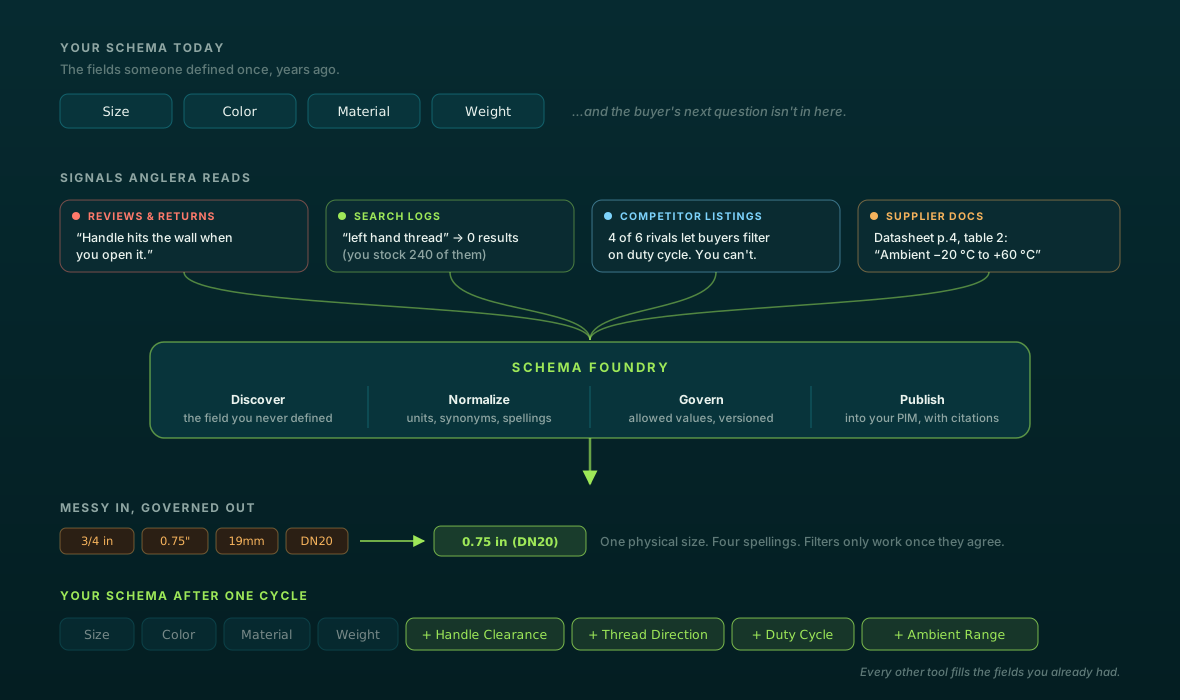
Anglera is the layer that fixes that upstream problem before either platform touches the data. It connects to your PIM via API, reads your existing SKUs, enriches every attribute and description against buyer signals — the search terms, comparison filters, and decision triggers your customers actually use — and writes the improved content back to the same PIM record. No migration required. Your system of record stays in place.
Once Anglera has run, the dynamic downstream shifts: Pimberly stores and governs genuinely buyer-ready content rather than raw supplier copy. Feedonomics syndicates content that was built to convert, not just technically compliant with channel specs. The channels Feedonomics feeds — Google Shopping, Amazon, Walmart — surface better results because the titles and attributes were written for buyers, not for the factory floor. Implementation is approximately 30 days. Whichever of these tools you choose — or both running together — Anglera enriches the content they both depend on.
Frequently asked questions
Are Feedonomics and Pimberly competing tools, or do they serve different purposes?
They serve different purposes. Pimberly is a PIM and DAM — a system of record for storing, governing, and publishing product content. Feedonomics is a feed management and syndication platform — a distribution engine that gets your existing catalog data to 300+ ad channels and marketplaces. Most teams that use both run them together: Pimberly governs the catalog, Feedonomics distributes it downstream.
Which tool should I prioritize if I can only invest in one right now?
If your product data is scattered, inconsistent, or ungoverned, solve that first. Buying a distribution tool before you have clean, governed data means syndicating the problem efficiently. Pimberly's centralization and validation give you a foundation everything else depends on. If your catalog is already well-governed and your bottleneck is channel reach, Feedonomics addresses that directly.
Does Feedonomics replace the need for a PIM like Pimberly?
No. Feedonomics does not store or govern product data — it distributes what you already have. If your catalog lives in spreadsheets or a poorly governed system, Feedonomics will route that data to channels accurately, but it will not fix the underlying quality or structure. Pimberly and Feedonomics address different layers of the stack and are designed to coexist, not compete.
How does Anglera work alongside Feedonomics and Pimberly?
Anglera enriches the product content that both tools depend on. It connects to your PIM — Pimberly or any other — reads every SKU, enriches attributes and copy against buyer signals, and writes the results back to the PIM. Pimberly then governs and publishes buyer-ready content; Feedonomics syndicates content built to perform in search and on marketplaces. Anglera takes approximately 30 days to implement and requires no platform migration or rip-and-replace.
What does buyer-signal enrichment mean and why does it matter for feed performance?
Instead of reformatting supplier copy, buyer-signal enrichment analyzes how real buyers actually search for, compare, and purchase products in your category — then rewrites titles, fills missing attributes, and builds descriptions that match that intent. When Feedonomics syndicates that content to Google Shopping or Amazon, the products surface for the terms buyers use and convert at higher rates. When Pimberly stores and publishes that content to your channels, the completeness scores and attribute quality reflect what buyers need, not just what suppliers sent.