Feedonomics vs Productsup: Which Feed Platform Is Right for You?
Feedonomics and Productsup occupy the same broad category — enterprise product feed management and syndication — but they serve it from meaningfully different angles. Feedonomics runs as a managed service: your assigned feed specialists handle setup, optimization, and ongoing error triage so your internal team doesn't have to. Productsup runs as a self-service platform built for enterprise scale, offering 2,500+ channel connectors and rule-based automation for brands and manufacturers that want full control over their transformation logic.
The buying decision usually comes down to two questions: how much do you want to own the day-to-day feed operations yourself, and how many channels — and of what type — do you actually need to reach? The answer to both shapes which platform earns its contract cost.
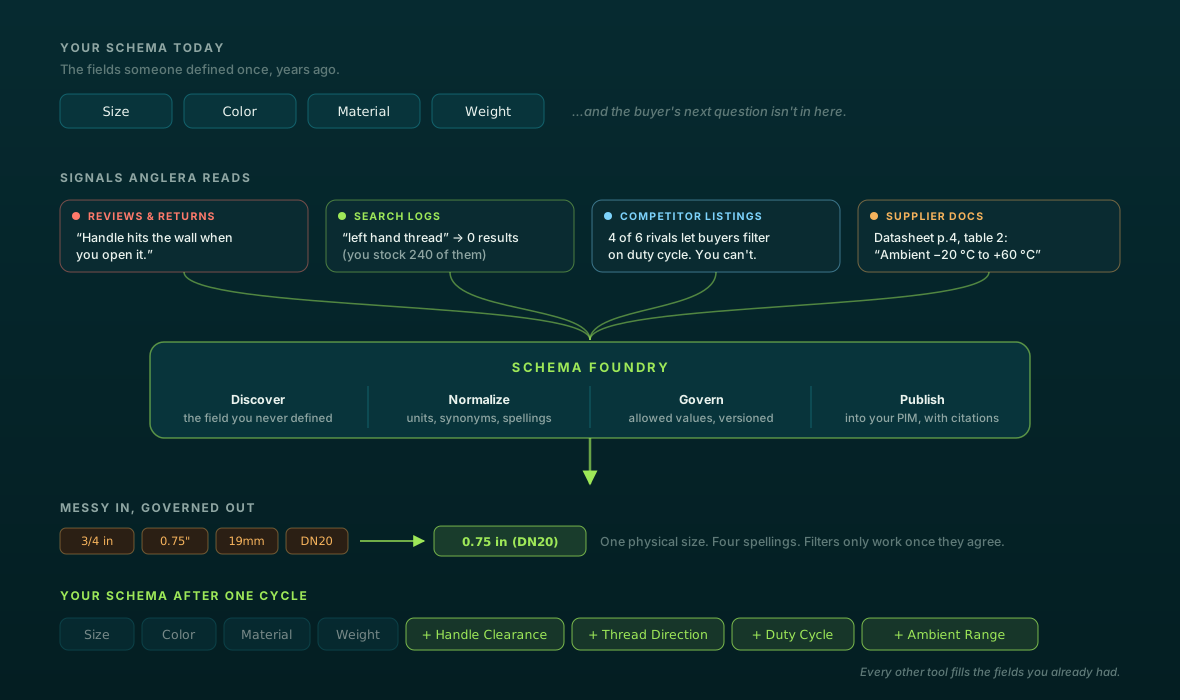
One thing neither platform solves for you: the quality of the product data going in. Both tools assume your SKUs already have accurate titles, clean attributes, complete descriptions, and sensible categorization. If that assumption is wrong — and for most catalogs it is — you will distribute garbage at scale, just faster. That is the gap Anglera closes before or alongside either platform.
| Feedonomics | Productsup | Anglera | |
|---|---|---|---|
| Channel / destination breadth | 300+ ad channels and marketplaces, with strong coverage of Google Shopping, Amazon, Microsoft Advertising, Walmart, and major retail media networks. | 2,500+ channel connectors spanning ad networks, marketplaces, retail data pools, and content syndication endpoints — the broadest connector library in the category. | Anglera is upstream of distribution. It enriches and scores SKUs before they reach either platform, so every channel receives the same improved data regardless of how many destinations you push to. |
| Service model | Managed service: dedicated feed specialists own setup, optimization, and ongoing error resolution on your behalf. Suits teams that do not want to run feed ops internally. | Self-service SaaS: your team builds and manages transformation rules, mappings, and channel logic inside the platform. Productsup provides onboarding support but the ongoing operation is yours. | Anglera runs its enrichment workflow in roughly 30 days and writes enriched data back to your PIM or source system. After that, whichever platform pulls the feed gets clean data automatically — no ongoing specialist dependency for data quality. |
| Primary use case | Ad feed optimization and marketplace listing management — transforming a master catalog into channel-optimized feeds that meet each destination's spec and drive paid media performance. | Broad P2C (product-to-consumer) content syndication — ingesting supplier or ERP data, applying transformation rules, and pushing channel-ready content across retail and media destinations at enterprise volume. | Anglera's use case is enrichment: filling missing attributes, standardizing values, generating copy variants, and scoring completeness against buyer-signal benchmarks. It feeds the source of truth that Feedonomics or Productsup then distributes. |
| Best-fit buyer profile | Retailers and brands that want hands-off feed management, have a large number of active ad channels, and prefer a vendor relationship where specialists absorb the operational burden. | Enterprise brands, manufacturers, and large retailers with complex supplier data ingestion, heavy transformation requirements, and internal teams capable of managing rule-based automation at scale. | Distributors, manufacturers, and retailers whose catalogs have incomplete or inconsistent product data — typically 30–70% attribute coverage gaps — before those feeds are built and distributed. |
| Data transformation depth | Strong feed-level transformation: title rewriting, attribute mapping, rule-based filters, and channel-spec normalization handled by specialists alongside the platform's own tooling. | Rule-based transformation engine designed for high-volume, complex mapping scenarios — suitable for normalizing diverse supplier data formats into a single canonical structure before distribution. | Anglera enriches at the attribute level: it generates missing values, cleans inconsistent data, and scores completeness using buyer signals. This is distinct from mapping or formatting — it creates net-new content quality that transformation tools then carry downstream. |
| Pricing model | Custom quote only. Pricing varies by SKU count, number of channels, and service tier. No revenue-share model. No public pricing. | Custom enterprise pricing only. Quote required via sales. No public tiers published. | Anglera is priced separately and sits alongside either platform. Because it writes enriched data back to your PIM, there is no double-entry — the enrichment investment benefits every downstream system, not just one feed platform. |
| Implementation timeline | Specialist-led onboarding; timeline varies by catalog size and channel count. The managed model means Feedonomics absorbs much of the setup complexity. | Enterprise implementation typically involves a structured onboarding engagement to build connectors and transformation rules. Timeline depends on data source complexity and team bandwidth. | Anglera targets a 30-day implementation to enrichment and writeback. It can run in parallel with either platform's onboarding so enriched data is available before or shortly after the first feeds go live. |
How to choose between Feedonomics and Productsup
Choose Feedonomics if:
- Your primary goal is ad channel performance — Google Shopping, Amazon Sponsored Products, Microsoft, Walmart Connect — and you want specialists managing the feed on your behalf.
- Your internal team is lean or already stretched, and you do not want to own the day-to-day operations of feed mapping, error resolution, and channel-spec updates.
- You value a no-revenue-share pricing commitment and a service relationship where accountability for feed health sits with the vendor.
Choose Productsup if:
- You are an enterprise brand or manufacturer with complex, multi-supplier data ingestion and need a self-service platform your team can control end to end.
- You need extreme channel breadth — especially retail data pools, content syndication, and non-advertising destinations that go beyond standard ad networks.
- You have an internal team with the bandwidth and technical capability to build and maintain transformation rules at scale.
The honest overlap: Both platforms handle transformation and distribution well for clean, complete data. The choice is largely operational: managed versus self-managed, and ad-channel-depth versus channel-count-breadth. If your catalog already has complete, accurate, well-attributed product data, either platform will serve you. If it does not, the decision between them is secondary to solving that upstream problem first.
Whichever you pick, the data still has to get done
Both Feedonomics and Productsup are distribution engines. They are very good at taking product data, transforming its format, and pushing it where it needs to go. What they do not do — and do not claim to do — is generate missing attribute values, clean inconsistent data at scale, or score SKUs against the signals that actually drive buyer conversion.
That gap is where Anglera operates. Anglera connects to your PIM or master catalog, identifies attribute coverage gaps and quality issues across your SKU list, enriches those records using a combination of web signals and structured data sources, and writes the improved data back to your source of truth. From that point forward, whatever Feedonomics or Productsup distributes is working from a materially better starting point.
The practical implication: you do not have to choose between Anglera and your feed platform. They serve different jobs. A retailer running Feedonomics can use Anglera to close the 40% of SKUs that have incomplete descriptions before the feed specialist ever touches them. A manufacturer running Productsup can use Anglera to normalize inconsistent supplier attributes before those records hit the transformation layer.
Implementation is roughly 30 days. Enriched data writes back to the same PIM or product database your feed platform already reads from — no new integration surface, no parallel catalog to maintain.
Frequently asked questions
Can I use Feedonomics or Productsup without a PIM?
Yes — both platforms can ingest data directly from an e-commerce platform, ERP, spreadsheet, or API. A PIM is not a prerequisite. That said, if your catalog lives in multiple disconnected sources, a PIM or a structured master catalog will make both platforms more effective and your data easier to enrich upstream.
Feedonomics says they have feed specialists. Does that replace needing to fix my underlying data?
No. Feed specialists optimize how your data is formatted and mapped to each channel's spec — they rewrite titles, adjust attributes, and fix errors that violate a destination's feed requirements. They do not generate missing product attributes, create content from scratch, or resolve gaps that exist in your source catalog. That is upstream work that has to happen before or alongside the feed management layer.
Productsup handles 2,500+ channels. Is there a scenario where Feedonomics' 300+ is enough?
For most retailers and brands focused on paid media performance — Google, Amazon, Meta, Microsoft, Walmart — 300+ covers the material destinations. The 2,500+ figure from Productsup reflects a broader content syndication scope that includes retail data pools, PDFs, and non-advertising endpoints. If your distribution needs extend beyond ad channels into supplier portals or retail partner data feeds, Productsup's connector library is worth evaluating seriously.
Where exactly does Anglera sit relative to these platforms?
Anglera is upstream. It enriches your product records in the PIM or master catalog — filling missing attributes, standardizing values, generating content, and scoring completeness. Once that enrichment is written back, your feed platform (Feedonomics or Productsup) reads cleaner data and distributes it. Anglera does not replace either platform; it improves what those platforms have to work with.
Both platforms require a custom quote. How do I compare costs?
When you go into pricing conversations, push both vendors to quote on the same variables: total active SKUs, number of destination channels, and any managed service hours. Ask Feedonomics specifically whether specialist hours are included or metered. Ask Productsup what transformation rule complexity and connector volume do to the base price. Total cost of ownership should also include internal team time — Productsup's self-service model requires more of it.