Feedonomics vs Sales Layer: Feed Syndication vs PIM — Which Problem Are You Actually Solving?
Feedonomics and Sales Layer are not really competing for the same job. That is the most honest thing to say upfront — and it matters, because buyers who search this comparison are often trying to solve one problem and discovering they may have two.
Feedonomics is a feed syndication and distribution platform. Its job is to take the product data you already have, transform it to meet channel specifications, and push it to 300+ ad channels and marketplaces — Google Shopping, Amazon, Walmart, Microsoft Ads, and beyond. It does not store your product data as a system of record; it moves it. The model is managed-service: Feedonomics specialists handle setup, feed optimization, and error resolution on your behalf.
Sales Layer is a cloud PIM. Its job is to be the single source of truth for your product content — centralizing attributes, digital assets, supplier data, and localized copy in one governed place, then syndicating that content to channels and retail portals. It is where the data lives and is organized, not where it is pushed through a channel-specific pipe. If you are a manufacturer, distributor, or retailer without a reliable central product data store, Sales Layer solves that problem. If you already have organized product data and need it mapped, transformed, and broadcast across paid ad channels at scale, Feedonomics solves a different one. Many mature operations need both — but choosing between them first requires being honest about which gap is currently the bottleneck.
| Feedonomics | Sales Layer | Anglera | |
|---|---|---|---|
| Primary function | Feed management and channel syndication — transforms and distributes existing product data to 300+ ad channels, marketplaces, and shopping destinations; does not serve as a product data system of record | Cloud PIM — the centralized system of record for product content, digital assets, and supplier data; governs, validates, and syndicates that content to channels and retailer portals | Enrichment layer — connects to your PIM or catalog, enriches every SKU against buyer signals, and writes buyer-ready content back to the source of truth before either tool distributes it |
| Where it sits in the stack | Downstream of your PIM or catalog — reads product data, maps it to channel schemas, and pushes to destinations; does not write enriched content back to the source | The source of truth itself — sits at the center of the product data stack; upstream of syndication, downstream of supplier onboarding | Between raw supplier data and the PIM — enriches content at the source so that whatever Sales Layer stores (and Feedonomics later distributes) is already buyer-ready |
| Channel reach and syndication model | 300+ ad channels and marketplaces; managed-service model with specialists handling feed rules, error resolution, and ongoing optimization per channel | Multi-channel syndication to marketplaces and retailer portals as a built-in feature; self-service with support; channel breadth is narrower than a dedicated feed syndication platform | Does not syndicate — enriches the product content that Sales Layer governs and Feedonomics distributes; works upstream of both |
| Content enrichment capability | Reformats and maps existing fields to channel specifications; feed optimization focuses on structure and mapping, not on rewriting or generating buyer-signal-driven content | Validation rules flag completeness gaps; bulk-edit tools let your team fix them manually; AI tools assist with formatting and translation; teams still research and write the core product copy | Autonomous enrichment driven by how buyers actually search, compare, and decide — fills missing attributes, rewrites titles and descriptions, scores completeness, and writes results back to the PIM without a copywriter in the loop |
| Target buyer | Retailers, brands, and agencies with existing product catalogs who need paid ad channels and marketplaces fed accurately and at scale; strongest for performance marketing and retail media use cases | Manufacturers, distributors, and retailers who need a governed, multi-channel source of truth for product content — particularly those managing supplier onboarding and B2B portal distribution alongside D2C channels | Any B2B distributor, retailer, or manufacturer with a catalog — in or heading into either platform — who needs richer, buyer-ready product content without adding manual data work |
| Pricing | Custom quote only — varies by SKU count, channel count, and service tier; no public pricing; no revenue-share model | Starts at ~$1,000/month; tiered plans by team size and feature set (Core to Enterprise); 30-day free trial available; custom quote for most enterprise plans | Priced per SKU enriched — layers onto your existing PIM or feed investment rather than replacing it |
| Implementation | Managed onboarding led by Feedonomics specialists; setup time varies by channel count and feed complexity; new channels add setup time | ~6-week average onboarding (per Sales Layer positioning); faster than most legacy PIMs; complexity scales with catalog size and supplier onboarding scope | ~30 days from kickoff to enriched SKUs written back to the PIM; no platform migration required; works alongside an existing Sales Layer or Feedonomics deployment |
How to choose between Feedonomics and Sales Layer
Choose Feedonomics if your primary problem is distribution — you already have product data living somewhere (a PIM, an e-commerce platform, or a spreadsheet-driven catalog) and your bottleneck is getting that data to the right ad channels and marketplaces in the right format, at scale, without managing feed rules yourself. Feedonomics' 300+ channel reach and managed-service model are genuinely differentiated for performance marketing, retail media, and marketplace operations where channel-specific feed optimization and error resolution are the daily operational challenge. If you are spending meaningful time on broken Google Shopping feeds, Amazon listing errors, or Walmart content rejections, Feedonomics' specialists take that off your plate.
Choose Sales Layer if your primary problem is upstream — you do not have a reliable, centralized source of truth for your product data. If product attributes live in supplier spreadsheets, ERP exports, and disconnected tools with no governed master record, Sales Layer solves that foundational problem first. Its B2B-oriented feature set — Supplier Portal, multi-channel syndication, digital asset management, and validation workflows — suits manufacturers and distributors who need to bring order to a messy catalog before worrying about channel-specific optimization. The 6-week onboarding and ~$1,000/month starting price make it accessible without an enterprise-scale budget or a months-long implementation project.
A few signals that clarify the choice:
- If you already run a PIM (Akeneo, Salsify, Informatica, or Sales Layer itself) and your pain is channel distribution, Feedonomics is the natural addition.
- If you have no single source of truth for product data and your team is managing content in spreadsheets or ERP exports, Sales Layer addresses the foundational gap.
- If you need both — a governed PIM and a high-volume channel syndication engine — the two tools are complementary rather than competitive; Sales Layer manages the data, Feedonomics moves it.
- If upfront cost transparency matters, Sales Layer's published starting price gives you a real number to plan against; Feedonomics requires a discovery call before any pricing is visible.
Whichever you pick, the data still has to get done
Neither Feedonomics nor Sales Layer makes your product content buyer-ready — that work is assumed to have already happened.
Feedonomics takes whatever content exists in your catalog and maps it to channel schemas as accurately as possible. If your titles are written for procurement rather than search, your attributes are incomplete, or your descriptions fail to answer the questions buyers actually ask, Feedonomics distributes those problems faithfully across 300+ destinations. Better channel reach amplifies the content quality you walk in with — for better or worse.
Sales Layer gives you a governed, centralized place to store and organize product content. Its validation rules catch format errors and completeness gaps — but they flag the problem; your team still has to research, write, and fill the gap. Supplier Portals shift data entry responsibility to suppliers, but suppliers write for their own catalog, not for how your buyers search, compare, and decide.
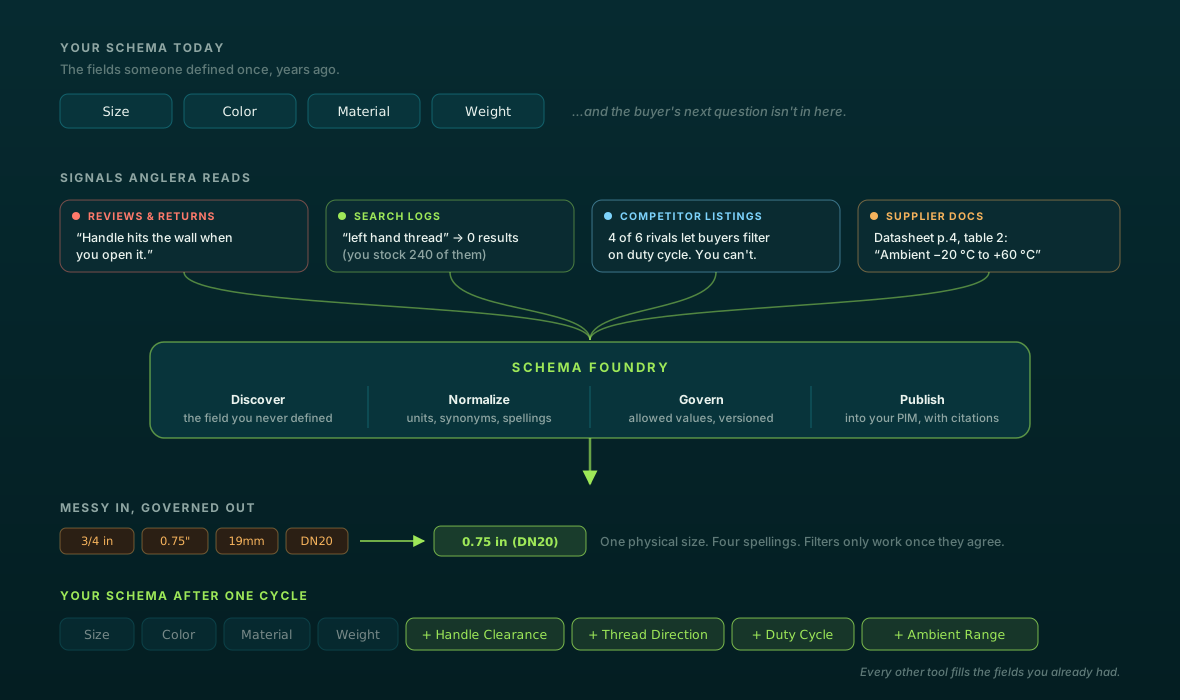
Anglera is the layer that does the enrichment work neither platform handles. It connects to your Sales Layer instance (or whichever PIM you run) via API, reads every SKU, enriches attributes and copy against real buyer signals — how customers in your category actually search, filter, and choose — and writes the improved content back to the same PIM record. Your source of truth stays in place and gets better. The content Sales Layer then governs and Feedonomics then distributes is buyer-ready from the start, not just well-formatted or well-organized. Implementation is ~30 days with no platform migration required, and it works alongside whichever combination of these tools you choose.
Frequently asked questions
Are Feedonomics and Sales Layer competitors?
Not really. Feedonomics is a feed syndication platform — its job is to take existing product data and distribute it to 300+ ad channels and marketplaces. Sales Layer is a PIM — its job is to be the central system of record for product content. They solve different problems and are more often complementary than competing: Sales Layer manages the data, Feedonomics distributes it. A buyer choosing between them usually needs to figure out which problem is the actual bottleneck first.
Can Sales Layer replace Feedonomics for channel distribution?
Sales Layer includes multi-channel syndication to marketplaces and retailer portals as a built-in feature, so for moderate distribution needs it may reduce or eliminate the need for a dedicated feed syndication tool. However, Feedonomics' channel breadth (300+ destinations), performance marketing focus, and managed-service specialists are difficult to match for companies running large-scale paid ad operations across Google Shopping, Amazon, Walmart, and Microsoft. If paid ad channel feed management is a core daily operation, Sales Layer's syndication is unlikely to fully replace Feedonomics.
Does Feedonomics improve product content quality?
No. Feedonomics reformats and maps existing product data to meet channel specifications — title length, attribute structure, required fields — but it does not rewrite copy, generate missing attributes, or optimize content based on how buyers search. If your product data is thin or poorly written going in, Feedonomics distributes it accurately but does not improve it. Content quality improvement happens upstream, before syndication.
How does Anglera work with Sales Layer or Feedonomics?
Anglera connects to Sales Layer via API, reads your existing SKUs, enriches every attribute and description against buyer signals — how your customers actually search, compare, and filter — and writes the improved content back to the Sales Layer record. No migration is required. Once Sales Layer holds enriched, buyer-ready content, Feedonomics (or any other distribution tool) gets better source data automatically, without any change to the feed setup. Anglera implementation takes ~30 days.
What is the pricing difference between Feedonomics and Sales Layer?
Sales Layer publishes a starting price of ~$1,000/month with a 30-day free trial, making it easier to budget before a sales conversation. Feedonomics does not publish pricing — costs vary by SKU count, channel count, and service tier and require a direct quote. For buyers who need transparency before committing evaluation time, Sales Layer's published starting point is an advantage.