Feedonomics vs Stibo Systems: Two Different Layers, One Product Data Problem
Feedonomics and Stibo Systems are rarely true competitors. They live at opposite ends of the product data stack, and a buyer choosing between them usually has a more fundamental question to answer first: do you have a data governance problem, or a data distribution problem?
Stibo Systems makes STEP, an enterprise Master Data Management and PIM platform. It is the authoritative system of record — built for large organizations that need to centralize, govern, and trust their product, supplier, and customer data before it flows anywhere. A Gartner Magic Quadrant Leader for MDM, STEP handles complex data relationships, workflow approvals, and multi-domain data management at enterprise scale. If your data is siloed, inconsistent, or ungoverned, STEP is the foundation layer that fixes that problem upstream.
Feedonomics, owned by BigCommerce, operates downstream. It takes product data you already have and transforms, optimizes, and syndicates it across 300+ ad channels and marketplaces — Google Shopping, Amazon, Microsoft, Walmart, and beyond. Its model is managed-service: feed specialists handle setup, error resolution, and ongoing optimization on your behalf. If your data is already structured and your problem is channel reach and paid-channel performance, Feedonomics works on that layer. The catch both tools share is the same: neither enriches product content. Stibo governs what you load into it; Feedonomics distributes what you hand it. The quality of the underlying data is assumed.
| Feedonomics | Stibo Systems | Anglera | |
|---|---|---|---|
| Primary job | Feed management and syndication — transforms and distributes product data to 300+ ad channels and marketplaces; specialists handle ongoing optimization and error resolution on the client's behalf | Enterprise Master Data Management and PIM — STEP is the authoritative system of record for product, supplier, and customer data; governs, models, and distributes master data at scale across domains | Enrichment layer — reads from whichever system holds your master data, enriches every SKU against buyer signals, and writes results back; not a syndication platform or MDM |
| Where it sits in the data stack | Downstream — works with data you already have and sends it out; does not serve as a system of record or governance layer | Upstream — the foundational system of record; data flows out from STEP to downstream channels and partners after governance | Between the system of record and the distribution layer — enriches content after it is governed and before it is distributed, improving what both Stibo and Feedonomics work with |
| Data enrichment and content quality | Optimizes and transforms existing feed data for channel-specific requirements (titles, descriptions, category mappings per channel); does not create or deeply enrich source product content | Manages and governs whatever data is loaded into STEP; enrichment quality depends entirely on what goes in; no autonomous content generation | Generates buyer-signal-driven content — descriptions, attributes, and titles built around how buyers actually search, compare, and decide — and writes results back to the source record |
| Channel and syndication reach | Core strength: 300+ ad channels and marketplaces with managed specialists driving setup and optimization; purpose-built for paid-channel distribution at scale | STEP includes syndication capabilities, but the primary value is governance, not channel breadth; most large deployments use connectors or integrators for downstream distribution | Does not distribute to channels — enriches the product content that Feedonomics or Stibo then syndicates, so every feed and every channel receives richer data |
| Implementation model and timeline | Managed-service model — Feedonomics specialists handle setup and ongoing management, which shortens initial ramp; feed go-live within weeks for most engagements | Complex enterprise implementation — typically measured in months; commonly requires a systems integrator alongside the vendor; implementation scope scales with data domain complexity | ~30 days from kickoff to enriched SKUs written back to the PIM; no platform migration and no system integrator required |
| Pricing model | Custom quote based on SKU count, channel count, and service tier; no public pricing; no revenue-share model | Custom enterprise subscription scoped by users, data volume, and modules; no public pricing; total cost includes implementation and often a systems integrator engagement | Priced per SKU enriched — layers onto existing platform investments rather than replacing them |
| Who uses it day to day | Ecommerce and performance marketing teams at retailers and brands — the people who run paid-channel campaigns and need products visible across search and marketplace placements | Enterprise data governance teams, MDM architects, and IT leadership at large manufacturers, retailers, or distributors managing multi-domain master data environments | Product data managers and ecommerce operations teams who need richer content in the system of record without adding headcount to write and maintain it manually |
How to choose between Feedonomics and Stibo Systems
Choose Feedonomics if you already have structured, reasonably clean product data and your primary problem is distribution — getting products visible across the maximum number of paid channels and marketplaces with minimal internal overhead. Feedonomics suits retailers and brands that run heavy performance marketing programs on Google Shopping, Amazon, Walmart, and Microsoft, and want feed specialists to handle channel-specific optimizations, error resolution, and ongoing maintenance. The managed-service model is a real advantage for teams that do not want to build in-house feed expertise. If you have 300 channels to cover and need someone who knows each channel's quirks, Feedonomics is built for that.
Choose Stibo Systems if you are a large enterprise with a foundational data problem — siloed, inconsistent, or ungoverned master data spread across product, supplier, and customer domains that no single system currently owns. STEP is the right answer when you need an authoritative system of record with governance workflows, complex data modeling, and multi-domain MDM before anything useful can flow downstream. Stibo is a fit for organizations with the IT budget, the implementation runway, and the organizational mandate to tackle master data governance seriously. It is not a lightweight tool — budget for months of implementation and a systems integrator.
A few signals that clarify which problem you actually have:
- If your data exists and is reasonably clean but is not reaching the right channels at the right quality for each channel's requirements, that is a Feedonomics problem.
- If your data is inconsistent across systems, nobody trusts the numbers, and downstream teams argue about which source is correct, that is a Stibo problem.
- Large enterprises sometimes need both: STEP as the governed system of record, Feedonomics as the downstream distribution layer. They are not substitutes; they sit at different layers.
- If you are mid-market or if a months-long MDM implementation is not feasible, Stibo Systems is likely oversized for your situation. Look at lighter PIM options before committing to enterprise MDM.
Whichever you pick, the data still has to get done
Both Feedonomics and Stibo Systems assume the product data itself is already buyer-ready. Stibo governs and distributes what you load into STEP — the quality of the content going in determines the quality of what flows out. Feedonomics optimizes feed formatting and channel mapping for what you hand it — but it does not rewrite thin descriptions, fill missing attributes, or improve copy that was written for a supplier catalog rather than a buyer searching Google.
In practice, product data arrives from suppliers as raw specs: factory-floor language, missing dimensions, inconsistent attribute naming, and descriptions that tell a procurement team what a product is without telling a buyer why to choose it. Neither STEP nor Feedonomics fixes that gap. Someone has to research, write, and enrich every SKU — and at scale, that work is either a manual backlog or it does not happen.
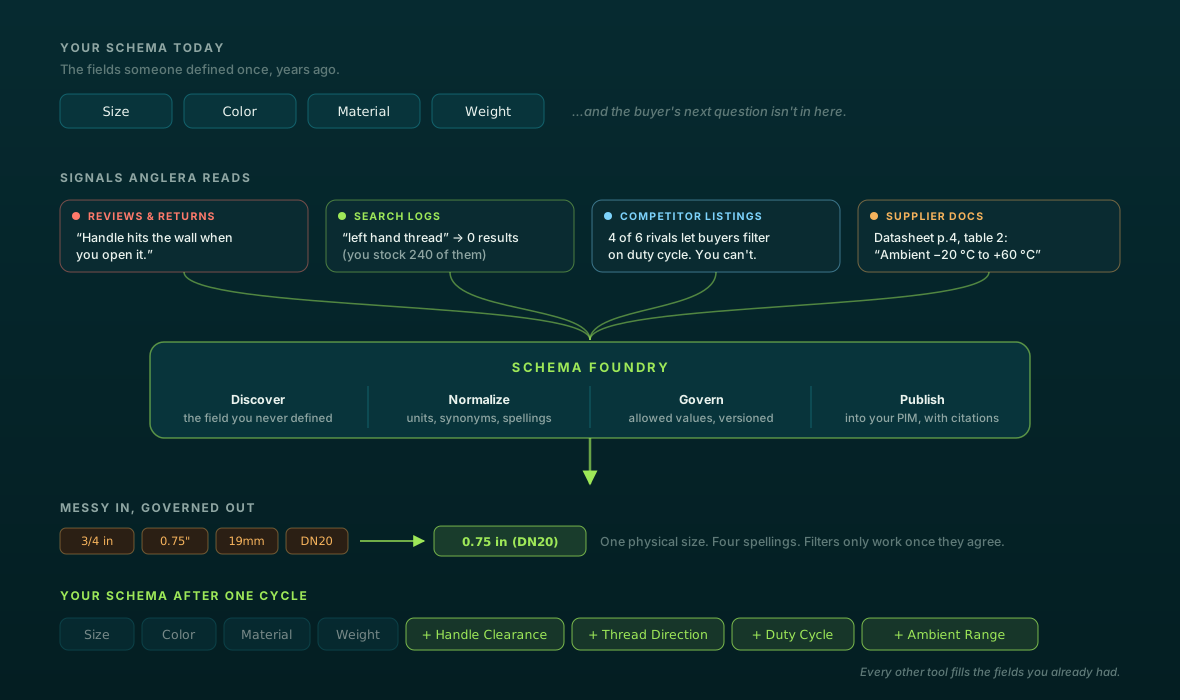
Anglera is the layer that does that work. It connects to your system of record via API — whether that is STEP, a lighter PIM, or a product database upstream of Feedonomics — pulls your existing SKUs, runs enrichment against buyer signals (how your customers actually search, compare, and filter), and writes the improved attributes, titles, and descriptions back to the source record. The master data in STEP gets better content, not just better governance. The feeds Feedonomics distributes carry richer, buyer-optimized copy into every channel. Anglera does not replace either platform; it fills the gap both platforms leave open. Implementation is approximately 30 days with no platform migration required.
Frequently asked questions
Are Feedonomics and Stibo Systems competitors?
Not in any meaningful way. They solve different problems at different layers of the product data stack. Stibo Systems STEP is an upstream MDM and PIM platform — the governed system of record for master data. Feedonomics is a downstream feed management and syndication platform — it takes data you already have and distributes it to 300+ ad channels and marketplaces. A large enterprise might use both: STEP to govern the data and Feedonomics to distribute it. Buyers confused between the two often have a more fundamental question to answer about which layer is actually broken.
Does Feedonomics clean or enrich product data, or does it just distribute it?
Feedonomics optimizes and transforms product data for channel-specific requirements — mapping categories, adjusting title formats, and resolving feed errors for each destination channel. It does not deeply enrich source content: it does not generate descriptions, fill missing attributes, or rewrite copy based on buyer search behavior. The quality of what you feed into Feedonomics determines the quality of what goes out.
How long does a Stibo Systems STEP implementation typically take?
Stibo Systems implementations are typically measured in months, not weeks. The timeline varies by data domain complexity, the number of integration points, and the scope of governance workflows required. Most large deployments involve a systems integrator alongside the Stibo team, which adds both time and cost. Budget for a serious implementation project before expecting data to flow reliably through STEP.
Is Stibo Systems right for mid-market companies, or is it enterprise-only?
Stibo Systems is built for large enterprises managing complex, multi-domain master data at scale. The implementation complexity, custom pricing, and systems-integrator requirement make it a poor fit for most mid-market companies. If your catalog is manageable and your data problems are less about multi-domain MDM governance and more about product content quality or channel reach, there are lighter-weight PIM options that will serve you better without the enterprise implementation overhead.
Where does Anglera fit if I already use Feedonomics or Stibo Systems?
Anglera works upstream of both. If you use Feedonomics, Anglera enriches your product content at the source before it reaches Feedonomics — so the feeds that get distributed to 300+ channels carry richer, buyer-optimized copy. If you use Stibo Systems, Anglera connects to STEP via API, enriches your SKUs against buyer signals, and writes the improved attributes and descriptions back to the master record — so the content STEP governs and distributes is buyer-ready from the start. Implementation is approximately 30 days and requires no platform migration.