Feedonomics vs Syndigo: Which Platform Fits Your Product Data Problem?
Feedonomics and Syndigo both move product data to external destinations. That is roughly where the similarity ends.
Feedonomics is a managed-service feed platform. Its job is to take your product data, transform it, optimize it for each channel's requirements, and distribute it across 300+ ad channels and marketplaces — Google Shopping, Amazon, Microsoft Advertising, Walmart, and beyond. The work is handled by feed specialists, not left to your team. If your core problem is performance marketing feed management — keeping listings live, error-free, and optimized across dozens of paid channels — Feedonomics is purpose-built for that.
Syndigo is a Product Experience Cloud (PXM). Its job is to act as the content supply chain hub for brands and manufacturers distributing product content to retail trading partners and GDSN recipients. With 2,500+ recipient connections and compliance logic covering 10,000 data validations and 23,000 unique retailer requirements, Syndigo's strength is ensuring the right content reaches the right retail endpoint in the right format. If your core problem is getting validated, retailer-compliant product content to a broad network of retail accounts — not performance marketing feeds — Syndigo is the more natural fit.
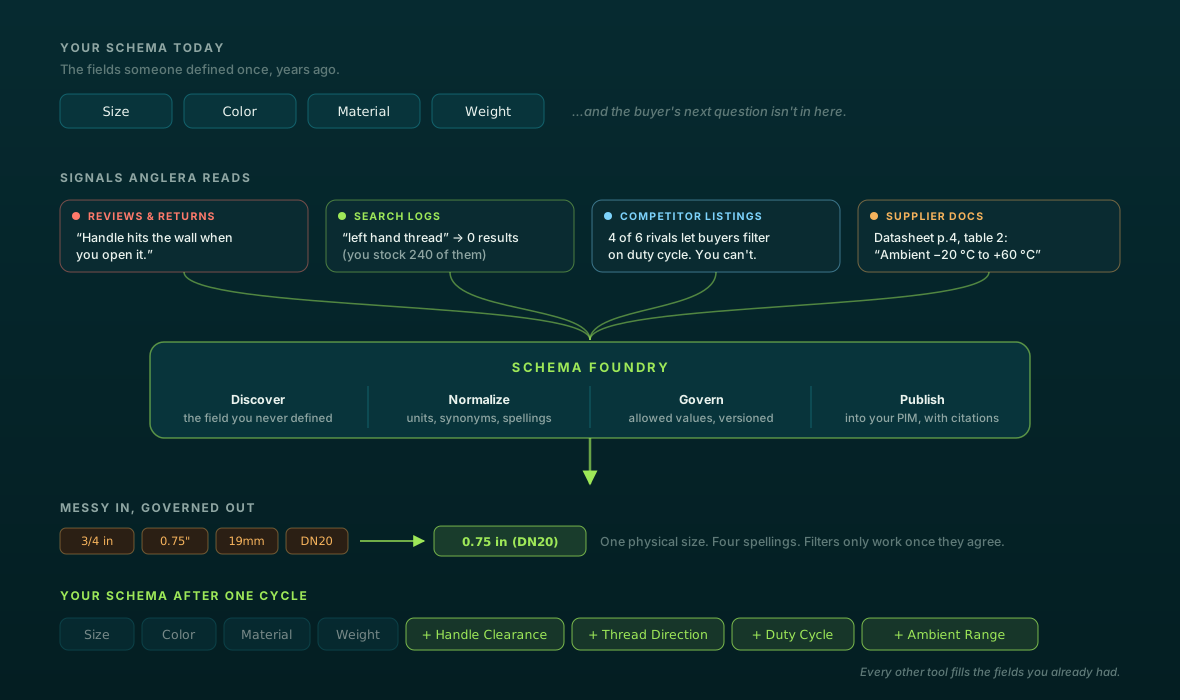
Neither platform solves the upstream problem they share: the product data going in is rarely buyer-ready. Feedonomics optimizes how existing data is formatted and routed; Syndigo validates how existing content maps to retailer schemas. Neither enriches the underlying attributes and copy against how buyers actually search, compare, and decide.
| Feedonomics | Syndigo | Anglera | |
|---|---|---|---|
| Primary purpose | Feed management and performance marketing syndication — transforms, optimizes, and distributes product data across 300+ ad channels and marketplaces; managed-service model with feed specialists handling setup and ongoing error resolution | Product content supply chain — stores, validates, and distributes product content to 2,500+ retail and GDSN recipients globally; combines PIM, DAM, MDM, and syndication in a single platform | Enrichment layer — not a feed manager or syndication platform; reads product data from whatever system of record you run, enriches every SKU against buyer signals, and writes results back before distribution |
| Channel and network reach | 300+ paid ad channels and marketplaces: Google Shopping, Amazon, Microsoft, Walmart, Meta, Pinterest, and similar performance marketing destinations | 2,500+ retail trading partners and GDSN recipients globally; particularly strong for brands distributing to grocery, mass, and specialty retail accounts with strict content compliance requirements | Does not syndicate or manage channels — enriches the product content that Feedonomics or Syndigo then distributes |
| Service and operations model | Managed service: dedicated feed specialists handle implementation, ongoing optimization, and error triage on your behalf; not a self-service SaaS tool | Platform-driven: your team manages content workflows within the Syndigo hub; compliance rules, validation logic, and retailer requirement mapping are built into the platform rather than delivered through a service team | Operates autonomously — enriches SKUs without requiring a copywriter, feed specialist, or ongoing manual review loop |
| Data validation and compliance | Feed-level optimization: maps attributes to each channel's schema, resolves feed errors, enforces character limits, and improves listing quality for paid placements; does not validate against retailer trading-partner requirements | 10,000 data validations and coverage of 23,000 unique retailer requirements; GDSN compliance built in; strongest in the industry for ensuring content meets the specific schemas required by grocery, mass, and specialty retail buyers | Enriches content quality upstream — fills gaps, improves attribute completeness, and aligns copy to buyer intent before validation or feed optimization runs |
| Enrichment capability | Transforms and optimizes existing feed data for each channel's requirements; does not generate or enrich product attributes and descriptions from scratch | Content authoring and completeness scoring tools within the platform; teams write and validate content against retailer requirements; does not autonomously enrich attributes against buyer signals | Autonomous enrichment driven by real buyer signals — how customers actually search, filter, and compare — not reformatted supplier copy; writes results back to the source system without manual intervention |
| Buyer profile | Retailers, brands, and agencies whose primary pain is performance marketing feed management: keeping product listings live, accurate, and optimized across Google, Amazon, Walmart, and similar paid channels | Brands and manufacturers whose primary pain is content supply chain to retail trading partners: distributing validated, retailer-compliant product content across a large network of retail accounts and GDSN recipients | B2B distributors, manufacturers, and retailers with an existing PIM or feed platform who need richer, buyer-ready product content without switching platforms |
| Pricing and total cost | Custom quote only; varies by SKU count, number of channels, and service tier; no revenue-share model; no public pricing tiers | Subscription-based, custom-quoted; varies by data volume, users, and feature tier; third-party estimates place TCO $10,000–$30,000 higher per year than smaller PIM alternatives for mid-market buyers | Priced per SKU enriched — adds to your existing platform investment rather than replacing it |
How to choose between Feedonomics and Syndigo
Choose Feedonomics if performance marketing feed management is the core problem. Your team is running paid campaigns on Google Shopping, Amazon, Microsoft, and Walmart; feeds break, go out of spec, or need continuous optimization as channel requirements change; and you want specialists — not another internal SaaS tool — to own that work. Feedonomics' managed-service model and 300+ channel reach are designed exactly for that scenario. It is not the right call if your primary need is distributing product content to retail trading partners, managing GDSN compliance, or building a governed PIM for your catalog.
Choose Syndigo if your core problem is getting validated, retailer-compliant product content to a large network of retail trading partners and GDSN recipients. You are a brand or manufacturer managing content relationships with dozens or hundreds of retail accounts, each with specific attribute requirements and content schemas. Syndigo's compliance network — 2,500+ recipients, 10,000 validations, 23,000 retailer-specific requirements — and its integrated PIM/DAM/MDM stack are built for that content supply chain challenge. It is not the right call if your primary need is paid channel feed optimization; that is Feedonomics' lane.
A few signals that clarify the choice:
- If your team is spending hours each week resolving feed errors on Google, Amazon, or Walmart, Feedonomics' specialist model directly addresses that pain.
- If you are onboarding a new retail account and need to map your product content to their specific schema and compliance rules at scale, Syndigo's retailer network is hard to match.
- If you need both — paid channel syndication and retail trading-partner content distribution — these platforms are complementary rather than competitive; some brands run both.
- If neither platform is obvious yet, the underlying question to answer first is: is my bottleneck getting products seen on paid channels, or getting approved product content into retail partner systems?
Whichever you pick, the data still has to get done
Both Feedonomics and Syndigo assume the product data they receive is already worth distributing. Feedonomics optimizes how your feed is formatted and routed to each ad channel; Syndigo validates whether your content maps correctly to each retailer's schema. What neither platform does is enrich the underlying product data — fill missing attributes, write buyer-signal-optimized descriptions, or ensure that what shoppers search for is actually present in your titles, specs, and copy.
That upstream gap is where product content consistently breaks down. Supplier data arrives as raw specs written for procurement, not for how buyers search and compare. Feedonomics can route that content across 300 channels efficiently; it will still be thin, generic, or attribute-incomplete when it gets there. Syndigo can validate that content against 23,000 retailer requirements; it will tell you what fields are missing, but it does not fill them with buyer-ready content.
Anglera is the layer that does that work before distribution starts. It connects to your existing system of record — whether that is Syndigo's PXM, a standalone PIM, or a feed data source — pulls your SKUs, enriches every attribute and description against buyer signals (how your customers actually search, filter, and decide), and writes the improved content back to the source. Feedonomics or Syndigo then distributes content that is complete and buyer-ready, not just well-formatted. Implementation takes roughly 30 days with no platform migration. The PIM or feed platform you already run stays in place; the quality of what flows through it improves.
Frequently asked questions
What is the core difference between Feedonomics and Syndigo?
Feedonomics is a managed-service feed platform built for performance marketing — optimizing and distributing product data across 300+ paid ad channels and marketplaces like Google Shopping, Amazon, and Walmart. Syndigo is a Product Experience Cloud (PXM) built for the brand-to-retailer content supply chain — managing, validating, and distributing product content to 2,500+ retail trading partners and GDSN recipients. They serve different buyers with different primary pain points.
Can Feedonomics and Syndigo be used together?
Yes. They serve different distribution paths. Feedonomics handles paid channel and marketplace feed distribution; Syndigo handles retail trading-partner content syndication and GDSN compliance. Brands or manufacturers that need both paid channel performance and retail partner content distribution can run them in parallel. The common challenge in that setup is that neither platform enriches the underlying product content — both distribute whatever data you feed them.
Does Feedonomics work for B2B distributors and manufacturers, or only retailers?
Feedonomics is designed primarily for brands, retailers, and agencies distributing product feeds to paid ad channels and marketplaces. It is less relevant for B2B distributors or manufacturers whose primary need is retail trading-partner content compliance or GDSN distribution — that is Syndigo's core use case.
How does Anglera fit alongside Feedonomics or Syndigo?
Anglera enriches your product data before it reaches the distribution layer. It connects to your existing system of record, pulls your SKUs, enriches attributes and descriptions against buyer signals, and writes the improved content back. Whatever Feedonomics then routes to paid channels, or Syndigo syndicates to retail partners, starts from a stronger content baseline. Anglera takes roughly 30 days to implement and requires no platform migration.
Does Syndigo replace a PIM, or does it work alongside one?
Syndigo includes PIM functionality as part of its Product Experience Cloud, so for many buyers it serves as the system of record as well as the distribution hub. That said, some enterprises run a separate PIM alongside Syndigo for governance or localization workflows not covered by the Syndigo data model. Whether Syndigo replaces or supplements your existing PIM depends on catalog complexity and how much of the full PXM stack you actually need.