Informatica PIM vs Pimberly: Which Is Right for Your Business?
Informatica Product 360 and Pimberly both carry the PIM label. That is roughly where the overlap ends.
Informatica Product 360 is an enterprise PIM rooted in Master Data Management. If your organization needs governance across product, customer, supplier, and location data in a unified MDM framework — and you have the dedicated data governance teams and IT infrastructure to match — Product 360 slots in as the authoritative system of record. It is a large platform investment, expensive and implementation-heavy, and most defensible when you genuinely need its full MDM scope, not just a place to centralize product content.
Pimberly is a modern cloud SaaS PIM and DAM built for mid-market e-commerce and retail teams that need to move catalog content to market quickly. It handles large SKU counts, digital asset management, validation rules, and multi-channel publishing in a single platform — without the IT footprint of an enterprise MDM deployment. The approximately $30,000/year entry point and SaaS delivery model reflect a different value proposition: operational speed and simplicity for commercial teams managing channel complexity, not a master data architecture project.
Both platforms assume the product data going into them is already buyer-ready. It rarely is.
| Informatica PIM | Pimberly | Anglera | |
|---|---|---|---|
| Platform scope | Full enterprise MDM + PIM stack — governs product data alongside other master data domains (customer, supplier, location) as the authoritative hub in a large enterprise data architecture | PIM + DAM focused on e-commerce and retail product content workflows — purpose-built for channel publishing and digital asset management with no broader MDM ambitions | Enrichment layer only — reads from whichever PIM stores your catalog, enriches every SKU against buyer signals, and writes results back; not a PIM, not a governance platform |
| Target buyer | Large enterprises with existing Informatica infrastructure, dedicated data governance teams, and cross-domain MDM requirements — common in manufacturing, distribution, and regulated industries | Mid-market e-commerce and retail teams managing large SKU counts across multiple sales channels; designed for commercial and catalog teams that need content live quickly without a major IT program | B2B distributors, retailers, and manufacturers with any PIM who need richer, buyer-ready product content without switching platforms |
| DAM and digital assets | Data governance and asset management capabilities exist within the broader Informatica platform; not marketed as a standalone DAM strength; typically paired with separate DAM tools in enterprise deployments | Native DAM built into the platform — digital assets live alongside product data in the same system, with workflows linking the two; meaningful for teams managing large volumes of product images, videos, and documents | Does not manage digital assets — enriches the product data attributes, descriptions, and copy that the PIM stores alongside those assets |
| AI and enrichment | Positions as an "Agentic AI PIM" — AI agents enrich, validate, and manage product data inside the platform, built on Informatica's CLAIRE AI engine; enrichment operates against internal governance rules and supplier data already loaded in the system | Validation rules and workflow automation for data completeness; AI-assisted content features at the channel level; less prominent AI enrichment positioning relative to enterprise competitors | Autonomous enrichment driven by buyer signals — how real buyers search, compare, and decide — not reformatted supplier copy or internal schema rules; writes results back to the PIM without a copywriter in the loop |
| Channel publishing | Distributes through integrations with the enterprise data stack — ERP, e-commerce, downstream MDM consumers; strengths are in governed, regulated, and enterprise distribution contexts rather than direct multi-channel retail publishing | Automated channel publishing workflows to multiple e-commerce and retail channels; a core operational strength for retailers and online brands managing simultaneous content delivery to many destination channels | Does not publish to channels — enriches the content that Informatica or Pimberly then distributes; works upstream of both platforms |
| Pricing | Not publicly listed; Standard, Professional, and Enterprise tiers; quote-only and widely cited as expensive; total cost of ownership includes licensing, implementation services, and ongoing professional services | Starts at approximately $30,000/year; custom pricing by SKU volume and channels; not publicly listed as fixed tiers | Priced per SKU enriched — layers onto your existing PIM investment rather than replacing it |
| Implementation timeline | Major enterprise IT project; MDM scope typically adds months or quarters to deployment; phased rollouts are common given the governance architecture, data model configuration, and enterprise integration work involved | Faster SaaS deployment than enterprise MDM; mid-market customers can typically go from kickoff to live content in weeks to a few months depending on catalog size and channel configuration | ~30 days from kickoff to enriched SKUs written back to the PIM; no platform migration required |
How to choose between Informatica PIM and Pimberly
Choose Informatica Product 360 if you are a large enterprise that needs unified Master Data Management across product, customer, supplier, and location data — and you have the data governance maturity, IT resources, and existing Informatica infrastructure to operate at that scale. Product 360 earns its total cost of ownership when the requirement is authoritative, governed product data as one domain in a broader enterprise MDM architecture: complex regulatory environments, multi-domain master data, and deep integration with ERP and enterprise data stacks. If your organization has a dedicated MDM team and a genuine cross-domain governance mandate, Informatica makes sense. If you are evaluating PIM as a standalone business need without the broader MDM requirement, Product 360 is likely over-engineered and over-priced for that scope.
Choose Pimberly if you are a mid-market e-commerce or retail business managing large SKU volumes across multiple channels and you need a modern, cloud SaaS PIM with native DAM in a single platform. Pimberly's strength is operational: faster to deploy than enterprise MDM, more accessible to commercial and marketing teams, and built around the multi-channel publishing workflows that retail and e-commerce teams run daily. At approximately $30,000/year to start, it occupies a meaningfully different price tier than Informatica without sacrificing the PIM and DAM capabilities most mid-market teams actually need. If your primary pain point is SKU count, channel complexity, and asset management — not cross-domain enterprise data governance — Pimberly fits that scope more cleanly.
A few signals that clarify the choice:
- If you have an existing Informatica enterprise deployment and need PIM integrated into that MDM architecture, Product 360 is the natural extension.
- If you are a mid-market retailer or e-commerce business without enterprise MDM requirements, Pimberly's SaaS model and faster implementation path are strong practical advantages.
- If budget is a significant constraint and MDM-grade governance is not on your requirements list, Pimberly's lower entry price and SaaS delivery are meaningful differentiators.
- Both require a direct sales conversation before you see a real number — build evaluation time accordingly.
Whichever you pick, the data still has to get done
Both Informatica Product 360 and Pimberly assume your product data arrives enriched — complete attributes, buyer-ready descriptions, titles that match how customers actually search. In practice, product data comes from suppliers as raw specs, inconsistent formats, and copy written for a price list or factory data sheet, not for a product detail page or a digital shelf.
Informatica gives you governed, authoritative control over that content at enterprise scale. Pimberly gives you a fast, well-organized place to manage and publish it across channels. Neither platform automatically makes the content itself better — that work still falls on your catalog or merchandising team, one SKU at a time.
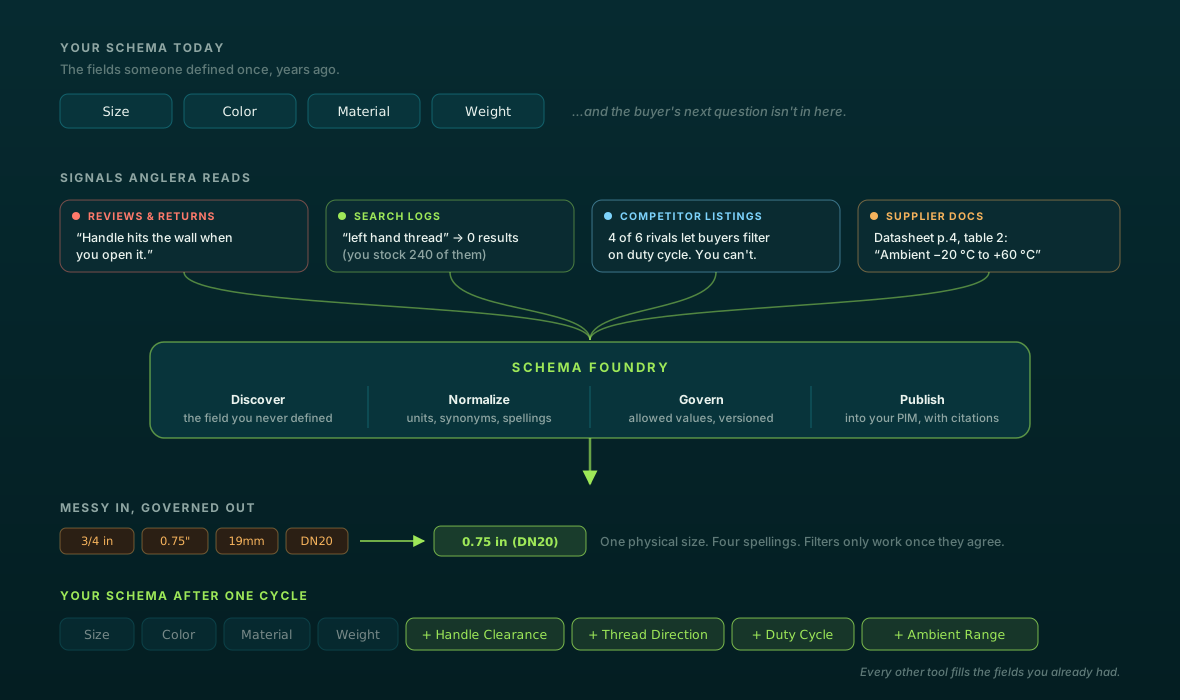
Anglera is the layer that does that work. It connects to your Informatica or Pimberly instance via API, reads your existing SKUs, enriches every attribute and description against buyer signals — how your customers actually search, compare, and filter — and writes the improved content back to the same PIM record. Your system of record stays in place. Enrichment quality lifts across the catalog. The content your PIM then governs and distributes is buyer-ready from the start, not just well-organized. Implementation is ~30 days with no platform migration required.
Frequently asked questions
What is the main difference between Informatica PIM and Pimberly?
Informatica Product 360 is an enterprise MDM + PIM platform that governs product data as part of a broader master data architecture covering customer, supplier, and location domains. It is built for large enterprises with dedicated data governance teams and existing Informatica infrastructure. Pimberly is a cloud SaaS PIM and DAM built for mid-market e-commerce and retail teams managing large SKU counts across multiple channels, with a focus on operational speed and multi-channel publishing. They serve different buyer profiles and scale assumptions, and are not really direct substitutes for most organizations.
Is Informatica PIM worth the investment if I only need PIM, not full MDM?
Probably not. Informatica Product 360's value proposition is strongest when you need MDM-grade governance across multiple master data domains and already operate within the Informatica ecosystem. If your requirement is strictly PIM — centralizing and publishing product data across channels — you are paying for enterprise MDM architecture you will not fully use. Mid-market alternatives like Pimberly start at approximately $30,000/year and cover the PIM and DAM use case without the MDM overhead or the enterprise IT project that comes with it.
Does Pimberly include digital asset management?
Yes. Pimberly includes native DAM functionality alongside the PIM — digital assets live in the same platform as your product data, with workflows that connect the two. For mid-market teams managing large volumes of product images, videos, and documents alongside SKU data, this built-in integration removes the need for a separate DAM tool and eliminates data silos between product records and their associated assets.
How does Anglera work with Informatica or Pimberly?
Anglera connects to your PIM via API, reads your existing SKUs, runs enrichment against buyer signals — how your customers search, compare, and decide — and writes the improved attributes and copy back to the same PIM record. No migration or platform change is required. Anglera works alongside whichever platform you choose in approximately 30 days. Your system of record stays in place; the content quality improves across the catalog.
Which platform is faster to implement?
Pimberly is significantly faster to deploy in most cases. As a cloud SaaS platform, mid-market customers can typically move from kickoff to live content in weeks to a few months. Informatica Product 360 is a major enterprise IT project — the MDM scope, data model configuration, governance architecture, and enterprise integration work typically extend the deployment timeline to months or quarters. If speed to value is a priority and enterprise MDM scope is not required, Pimberly has a clear implementation advantage.