Informatica PIM vs Productsup: Governance vs. Distribution
Informatica PIM (Product 360) and Productsup rarely compete for the same job. Informatica is a master data management and PIM platform — the enterprise system of record for companies that need rigorous governance, workflow approval chains, and a single authoritative source of product truth across a complex data stack. Productsup is a product content syndication and feed management platform — built to ingest supplier data, apply transformation rules, and push channel-ready feeds to 2,500+ destinations including Amazon, Google, Meta, and retail data pools.\n\nThe reason buyers compare them is usually one of two situations: a large enterprise is deciding whether Informatica's MDM-grade governance is worth the investment when a distribution-first platform like Productsup could anchor a simpler setup, or a company has been pitched both and is trying to understand where each fits. In both cases, the honest frame is that these platforms are designed for different problems — governance versus distribution — and many mature enterprises end up running both in sequence.\n\nWhat neither platform resolves is the quality of the product content itself. Informatica governs and structures data; Productsup transforms and distributes it. Neither automatically makes your product descriptions buyer-ready, fills in missing specifications against how buyers search, or generates copy that converts. That work happens upstream of both — and it either falls on your team or gets automated by a dedicated enrichment layer.
| Informatica PIM | Productsup | Anglera | |
|---|---|---|---|
| Primary function | Enterprise PIM + MDM — the authoritative system of record for product master data, with governance workflows, data quality rules, and integration across the enterprise data stack; positioned as an "Agentic AI PIM" for all-in-one MDM+PIM+AI governance | Product content syndication and feed management — ingests product data, applies transformation rules, and distributes channel-ready feeds to 2,500+ destinations including Amazon, Google, Meta, and retail data pools; positioned as the P2C (product-to-consumer) backbone | Enrichment layer — not a PIM, not a syndication platform; reads from whichever system holds your SKUs, enriches every product against buyer signals, and writes results back before governance or distribution happens |
| Data governance and MDM | Full master data management capabilities — attribute hierarchies, approval workflows, data stewardship, cross-domain MDM (product, supplier, customer), and enterprise data quality governance at scale | Governance is limited to transformation rules for channel output — format compliance, feed validation, and field mapping per destination; not a system of record and not designed for multi-domain MDM | PIM-agnostic — adapts to whichever schema and governance model the PIM defines; no data model changes required |
| Channel reach and syndication | Enterprise integrations across ERP, e-commerce, and channel platforms; syndication is typically handled by downstream tools — Product 360 is the source of record, not the distribution engine | 2,500+ channel connectors covering major marketplaces, retail data pools, paid media platforms, and wholesale portals; processes over 2 trillion products per month for brands like L'Oréal, ALDI, and PUMA | Does not syndicate or distribute — enriches the content that Informatica governs or Productsup distributes; works upstream of both |
| AI and enrichment capability | "Agentic AI" enrichment claims: AI agents that validate, enrich, and manage product data inside the platform; enrichment is applied to data already inside the MDM and governed by the same approval workflows as all other content | Rule-based transformation and channel optimization — maps and reformats supplier content to meet destination requirements; AI tools assist with feed optimization but are oriented toward format compliance, not content quality | Autonomous enrichment driven by buyer signals — how real buyers search, compare, and decide — not reformatted supplier copy or schema-compliance rules; writes buyer-ready attributes and descriptions back to the system of record without a copywriter in the loop |
| Target buyer | Large enterprise manufacturers, distributors, and retailers who need MDM-grade product data governance — typically with complex multi-domain data environments, strict compliance requirements, and a large enterprise data stack already in place | Brands, manufacturers, and retailers who need to move product content to many channels quickly and accurately — particularly those managing feeds to Amazon, Google Shopping, Meta, and retail trading partners at high volume | B2B distributors, retailers, and manufacturers of any size who need buyer-ready product content without switching PIM or syndication platforms |
| Pricing and total cost | Subscription-based with Standard, Professional, and Enterprise tiers; no public pricing — quote required; consistently cited as one of the more expensive options in the market given the broader Informatica platform footprint and implementation scope | Custom enterprise pricing only; no public tiers — quote required via sales; pricing is tied to data volume, channel count, and feature scope; enterprise contracts tend to reflect the scale of the distribution network being managed | Priced per SKU enriched — layers onto your existing PIM or feed management investment rather than replacing it |
| Implementation complexity | Multi-month to multi-year enterprise implementation typical — MDM scope, data model configuration, workflow design, and integration with ERP and downstream systems add substantial project complexity before the PIM is operational | Implementation complexity scales with channel count and transformation rule depth; large enterprises with many destinations and custom field mappings typically require significant onboarding effort before feeds go live | ~30 days from kickoff to enriched SKUs written back to the system of record; no platform migration required |
How to choose between Informatica PIM and Productsup
Choose Informatica Product 360 if your core problem is enterprise data governance and master data management. You are a large manufacturer, distributor, or retailer with a complex data environment — multiple data domains (product, supplier, customer), strict quality and compliance requirements, and a need for the PIM to be the authoritative source of truth integrated across your ERP, e-commerce, and data stack. Informatica's MDM heritage, AI governance tooling, and enterprise integrations are designed for companies where the PIM is a strategic data infrastructure investment, not just a content repository. If you need Informatica's broader CLAIRE AI platform or its cross-domain MDM capabilities alongside the PIM, that suite integration is a genuine differentiator.\n\nChoose Productsup if your primary pain point is getting product content to the right places — quickly, accurately, and at scale. Productsup is purpose-built for the brand-to-consumer and brand-to-retailer distribution problem: ingesting supplier feeds, normalizing them, applying channel-specific transformation rules, and pushing optimized content to 2,500+ destinations. If your team spends significant time managing Amazon feed errors, Meta catalog rejections, or retail data pool submissions, Productsup's rule engine and connector breadth are hard to replicate. It suits companies where distribution throughput and channel compliance — not MDM governance — are the primary operational challenge.\n\nA few signals that clarify the choice:\n- If you already have an ERP or enterprise data stack and need the PIM to be governed at the same level as your other master data domains, Informatica's MDM integration is the right foundation.\n- If you manage feeds to 20+ channel destinations and your team is manually managing format errors and field mapping failures, Productsup's automation and connector depth address that pain directly.\n- If neither full MDM governance nor 2,500-channel distribution describes your actual problem, both platforms likely carry more cost and complexity than the job requires — and a mid-market PIM with a dedicated enrichment layer may serve better.\n- Both are enterprise investments with no public pricing; budget at least one full quarter for vendor evaluation, scoping, and procurement before implementation begins.
Whichever you pick, the data still has to get done
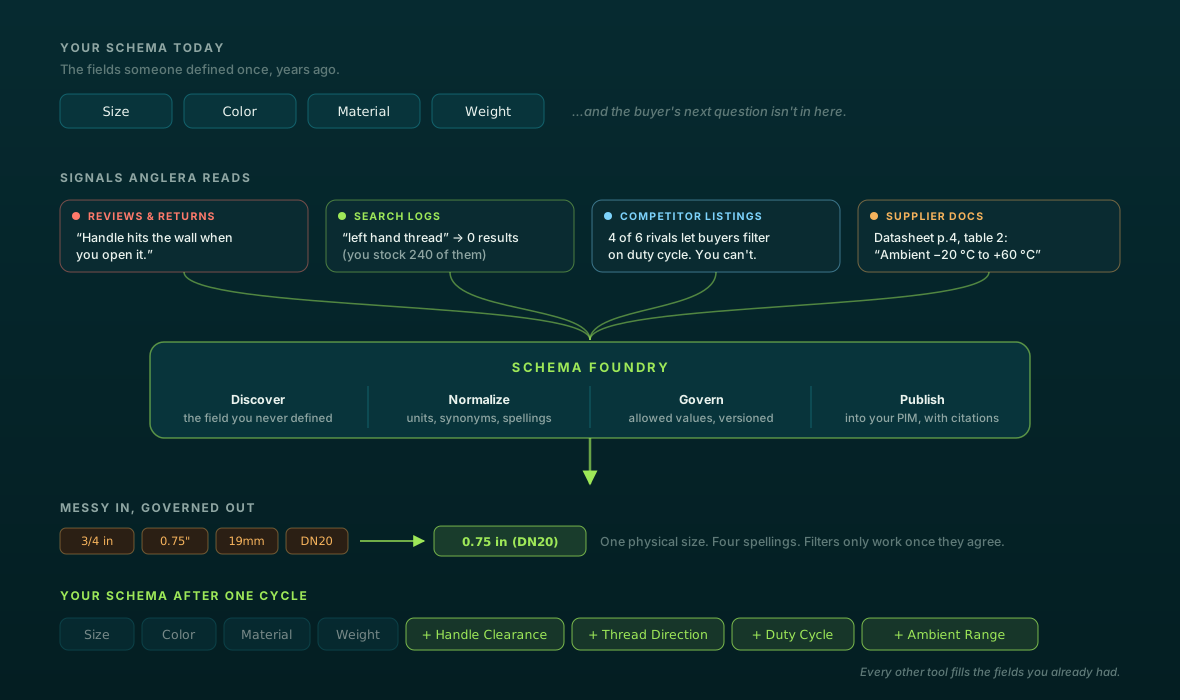
Informatica Product 360 governs your product data. Productsup distributes it. Neither platform makes the content itself buyer-ready.\n\nInformatica's AI governance validates and enriches data against the rules and schemas already defined inside the MDM — it enforces what you have configured, not what buyers are actually searching for. Productsup's transformation engine reformats data to match destination requirements — it makes sure your feed passes Amazon's schema, not that your descriptions convert buyers once they land on the page. Both platforms assume the product content going in is already complete, accurate, and written for the buyer. In practice, it rarely is. Supplier data arrives as raw specs and procurement-facing copy. Attributes are missing. Descriptions are written for the factory floor. Search terms reflect internal part numbers, not buyer language.\n\nAnglera is the enrichment layer that runs before governance or distribution. It connects via API to whichever system holds your SKUs — Informatica Product 360, Productsup, or any other PIM — reads your existing catalog, enriches every attribute and description against buyer signals (how your customers actually search, compare, and filter), scores content completeness, and writes the improved data back to the system of record. Your Informatica instance then governs buyer-ready content. Productsup then distributes buyer-ready content. The channel performance that follows reflects better inputs, not just better pipes.\n\nImplementation is approximately 30 days. No platform migration is required. Anglera works alongside whichever platform you choose — or both, if you run them in sequence.
Frequently asked questions
Are Informatica PIM and Productsup competitors or complements?
More often complements than competitors. Informatica Product 360 is a master data management and PIM platform — the system of record that governs product data inside the enterprise. Productsup is a syndication and feed management platform that takes data from that system of record and distributes it to 2,500+ channels. Many large enterprises run both in sequence. They compete for budget when a company is deciding whether to invest in MDM-grade governance (Informatica) or a distribution-first setup where Productsup anchors the workflow with a simpler data store behind it.
What is Informatica Product 360's main advantage over Productsup?
Informatica's advantage is MDM-grade data governance. Product 360 sits inside a broader master data management stack — with cross-domain data quality rules, approval workflows, data stewardship capabilities, and integration across ERP and enterprise systems. For companies where product data governance is a compliance or operational priority alongside customer and supplier data, that MDM heritage is a genuine differentiator Productsup does not offer.
What is Productsup's main advantage over Informatica PIM?
Productsup's advantage is channel reach and distribution throughput. Its 2,500+ connector library, rule-based transformation engine, and feed optimization tooling are purpose-built for the brand-to-channel workflow at enterprise scale. For companies whose primary operational pain is managing feed errors, format compliance, and content updates across Amazon, Google, Meta, and retail data pools, Productsup's distribution depth is difficult to match with a governance-first PIM like Informatica.
How does Anglera work with Informatica or Productsup?
Anglera connects to your system of record via API — Informatica Product 360, Productsup, or any other PIM or feed management platform. It reads your existing SKUs, runs enrichment against buyer signals (how your customers search, compare, and filter), and writes improved attributes, descriptions, and completeness scores back to the same record. No migration is required. Informatica then governs better-quality content; Productsup then distributes it. Implementation runs approximately 30 days.
Do Informatica and Productsup include their own enrichment tools?
Both include some form of AI-assisted content work, but with different orientations. Informatica's "Agentic AI" layer validates and enriches data against the governance rules and schemas already defined inside the MDM — it reinforces your data model rather than researching buyer intent. Productsup's transformation rules optimize data for channel format requirements — ensuring feeds pass destination schemas, not that descriptions convert buyers. Neither platform analyzes how buyers actually search and decide before generating content. Anglera's enrichment is buyer-signal-driven and writes results back to the system of record so that what both platforms work with is buyer-ready from the start.