Informatica PIM vs Sales Layer: Which Product Data Platform Is Right for Your Business?
Calling both of these "PIMs" is technically accurate but not especially useful. Informatica Product 360 is an enterprise MDM and PIM platform — a large-scale data governance engine designed to be the authoritative system of record across an organization's full data estate, not just product. Sales Layer is a cloud PIM built for speed and simplicity: mid-market manufacturers, distributors, and retailers who need a working system of record and channel syndication without a year-long IT project.\n\nThe practical gap between them is wide. Informatica Product 360 requires a data architecture team, a system integrator, and budget that sits in IT, not commerce. Its implementation timeline is measured in months or quarters, and it is routinely cited as one of the most expensive platforms in the PIM and MDM market. Sales Layer, by contrast, offers a 30-day free trial, publishes a starting price of around $1,000 a month, and markets a six-week onboarding to go-live. These are tools for fundamentally different organizational situations.\n\nBoth share a gap that neither platform fills on its own: the product data going into them. Supplier content arrives as raw spec sheets, thin descriptions, and attributes written for factory procurement rather than buyer search. Informatica governs that data against enterprise data quality rules; Sales Layer structures and syndicates it quickly to channels. Neither platform automatically researches what buyers actually search for and fills the content gaps that cost you conversions. That work still falls on someone — unless you have a dedicated enrichment layer.
| Informatica PIM | Sales Layer | Anglera | |
|---|---|---|---|
| Primary role | Enterprise MDM + PIM — a system of record for product data governance at scale, integrated into the broader enterprise data stack alongside customer, financial, and operational data domains | Cloud PIM — a fast-to-implement source of truth for product content, with built-in channel syndication and a Supplier Portal for B2B onboarding; designed for marketing and commerce teams, not IT departments | Enrichment layer — not a PIM or MDM; reads from whichever platform holds the product records, enriches every SKU against buyer signals, and writes results back; no migration required |
| Target buyer and organization scale | Large enterprise with dedicated IT and data architecture resources — typically a Fortune 1000 company running multi-domain MDM programs that include product, customer, and supplier data in the same governance environment | Mid-market manufacturer, distributor, or retailer who needs a centralized, channel-ready PIM without an IT-led deployment; suited to teams of 1–20 people managing a product catalog across multiple sales channels | B2B distributors, manufacturers, and retailers at any scale that have an existing PIM and need richer, buyer-ready product content — without switching platforms or adding headcount |
| Data governance and MDM depth | Native MDM capabilities — golden record management, cross-domain data quality rules, data stewardship workflows, and deep integration with Informatica's broader data management suite (ETL, data catalog, data quality) | PIM-layer governance only — validation rules, completeness scoring, workflow approvals, and localization within the product data domain; no MDM or cross-domain data quality features | Operates at the product content layer, not the MDM layer; adapts to whatever schema or governance model the PIM already enforces |
| Channel syndication | Enterprise system integrations via Informatica's data integration stack; not positioned primarily as a channel syndication tool — distribution relies on downstream system connections managed by IT | Built-in syndication connectors to marketplaces, retailer portals, and ecommerce platforms; channel distribution is a core feature, not an add-on — a meaningful practical advantage for teams publishing to multiple sales channels | Does not syndicate — enriches the content that the PIM then distributes; works with either platform's existing channel connections |
| Implementation speed and overhead | Typically 6–18 months for a full deployment, involving data architects, IT project teams, and often a third-party system integrator; not self-implementable at most organizations; no trial available | ~6 weeks to go live; designed for non-technical teams with self-serve onboarding; 30-day free trial available with no commitment required before purchase | ~30 days from kickoff to enriched SKUs writing back to the existing PIM; no platform migration, no IT project; connects via API to Informatica or Sales Layer |
| Pricing and total cost | No public pricing; quote-only across Standard, Professional, and Enterprise tiers; driven by users, data volume, and configuration scope; consistently cited as one of the most expensive platforms in the PIM and MDM category; budget sits in IT, not commerce | Starts at approximately $1,000/month; tiered plans scale by team size and features; custom quotes required at larger scale; significantly more accessible than enterprise MDM platforms | Priced per SKU enriched; layers onto the existing PIM investment rather than replacing it; no additional platform migration cost |
| AI and enrichment capabilities | Positioned as an "Agentic AI PIM" — AI agents validate, enrich, and manage product data inside the platform; enrichment quality depends on the supplier copy already loaded into the system; no concept of buyer-signal optimization | AI tools available on higher-tier plans for content formatting and validation assistance; agentic PIM is a positioning claim; not primarily an enrichment engine; what goes in is what gets syndicated out | Buyer-signal enrichment is the entire product — every SKU is enriched based on how buyers actually search, compare, and decide; attributes are filled, copy is rewritten, and completeness is scored by revenue impact; writes results back to either PIM |
How to choose between Informatica PIM and Sales Layer
Choose Informatica PIM if you are a large enterprise running a multi-domain master data management program and product data is one piece of a broader IT-led initiative that also covers customer data, supplier data, and operational data governance. Informatica Product 360 earns its place in organizations where product records need to be reconciled against golden records across multiple data domains, where compliance and audit trails are non-negotiable, and where you already have IT capacity and budget to support a 6–18 month deployment. If you are standardizing on Informatica's data integration stack enterprise-wide, adding Product 360 makes sense as a single-vendor extension of that investment. If product PIM is the only data problem you are solving, Informatica's scope and cost will outpace most organizations' needs.\n\nChoose Sales Layer if you are a mid-market manufacturer, distributor, or retailer who needs to centralize product content, stop managing data in spreadsheets, and start syndicating to multiple sales channels — without an IT-led deployment or a six-figure platform budget. Sales Layer's ~6-week onboarding, $1,000/month starting price, and built-in channel connectors make it a practical choice for commerce and product teams that need a working PIM this quarter, not next year. The Supplier Portal is a genuine differentiator for distributors managing a large vendor network who need suppliers to submit and maintain their own product content. If you are a Fortune 500 with a multi-domain MDM requirement, Sales Layer's governance depth will not cover it — but for the majority of mid-market B2B product data problems, it is the faster and lower-risk path.\n\nA few signals that clarify the decision:\n- If your product data problem is one piece of a larger enterprise data governance initiative with IT ownership, Informatica.\n- If you need a PIM live within a quarter, with channel syndication included, and your team does not include data architects, Sales Layer.\n- If public pricing and a free trial before commitment matter, only Sales Layer offers both.\n- If you are already running Informatica MDM across other data domains, adding Product 360 keeps the stack unified and avoids a new vendor relationship.
Whichever you pick, the data still has to get done
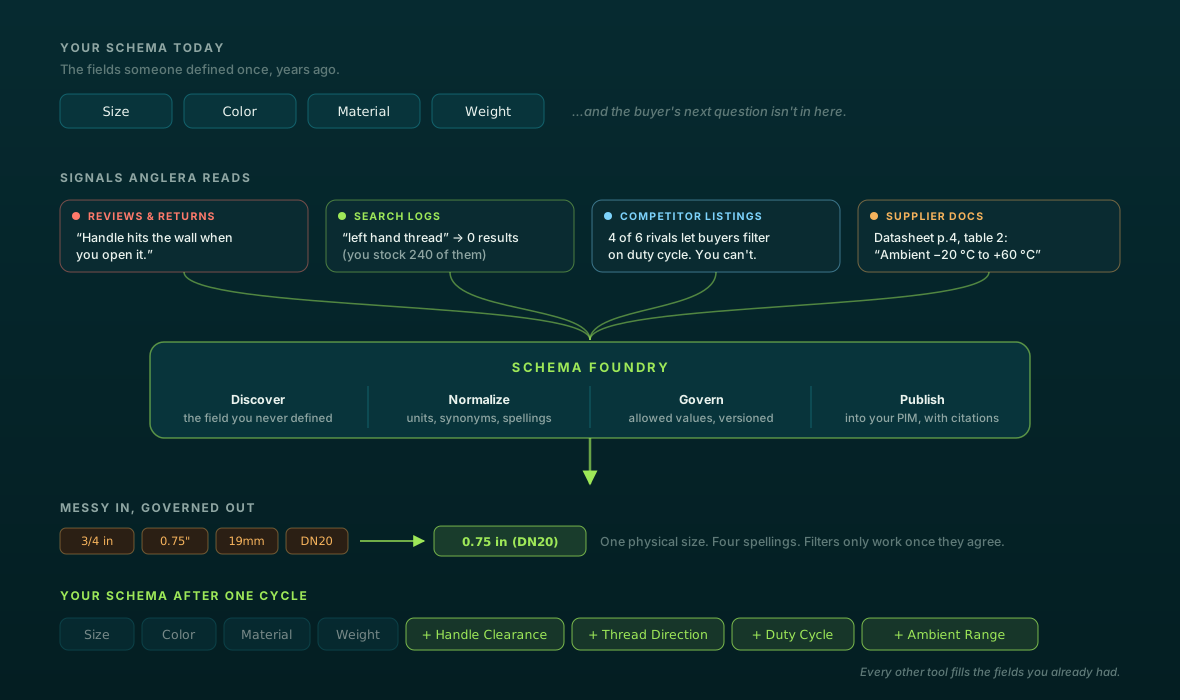
Both Informatica PIM and Sales Layer assume your product data is already good enough to govern, store, and distribute. In practice, it rarely is. Supplier content arrives as thin spec sheets, inconsistent attribute sets, and descriptions written for internal procurement rather than for the buyer who needs to find and choose a product. Informatica validates that content against enterprise data quality rules — but it does not research what a purchasing engineer actually searches for when buying a fitting. Sales Layer organizes and syndicates that content to your channels — but it publishes exactly what you put in, including every gap, inconsistency, and missing attribute.\n\nAnglera is the layer that closes those gaps before they reach the PIM. It connects to Informatica Product 360 or Sales Layer via API, reads your existing SKUs, and enriches every attribute and description against buyer signals: how the real buyers in your category actually search, filter, compare, and make purchasing decisions. Missing torque specs on a fastener SKU, vague descriptions on an electrical component, titles that match the factory nomenclature instead of the procurement search term — Anglera finds those gaps, fills them from supplier data and web sources, and writes the enriched, scored records straight back into whichever PIM you chose.\n\nYour system of record stays in place. The governance or syndication workflows you already configured continue to run. The content those workflows operate on is buyer-ready from the start. Whether you standardize on Informatica's MDM-grade governance or Sales Layer's speed and simplicity, Anglera's enrichment is what makes the records in that PIM actually perform at the moment of purchase. Implementation is approximately 30 days with no platform migration required on either side.
Frequently asked questions
What is the main difference between Informatica PIM and Sales Layer?
Informatica Product 360 is an enterprise MDM and PIM platform — a large-scale data governance system designed for organizations managing product data alongside customer, supplier, and operational data as part of a broader IT-led initiative. Sales Layer is a cloud PIM built for speed and simplicity: mid-market manufacturers, distributors, and retailers who need a centralized source of truth and channel syndication without an IT-heavy deployment. They share the same general category label but serve fundamentally different organizational situations in terms of scale, cost, and implementation complexity.
Is Sales Layer enterprise-grade, or is it only for smaller companies?
Sales Layer serves manufacturers, distributors, and retailers across a range of sizes, and its plans scale from small teams to larger enterprise accounts. However, its governance depth — particularly around multi-domain master data management, golden record creation, and cross-domain data quality rules — is more limited than Informatica's MDM-grade platform. Organizations with complex enterprise data architecture requirements across multiple data domains typically need Informatica's broader scope. For teams focused specifically on product PIM and channel syndication, Sales Layer's depth is sufficient for most mid-market and many larger use cases.
How does Anglera work alongside Informatica PIM or Sales Layer?
Anglera connects to either platform via API, reads your existing SKU records, enriches every attribute and description against buyer signals — how your customers actually search, filter, and make purchasing decisions — and writes the improved content back to the same PIM record. No platform migration is required, and the implementation takes approximately 30 days. Whichever PIM governs and distributes your data continues to do so; Anglera ensures the content inside that PIM is buyer-ready rather than a reformatted version of supplier spec sheets.
How much faster is Sales Layer to implement than Informatica PIM?
Sales Layer markets a six-week average onboarding to go-live and supports self-serve implementation for non-technical teams. Informatica Product 360 typically requires 6–18 months for a full enterprise deployment, involving data architects, IT project resources, and often a third-party system integrator. The difference reflects fundamentally different scope: Informatica's MDM-grade platform involves reconciling product data across enterprise data domains; Sales Layer focuses on product PIM and channel syndication and is designed to go live quickly.
Does Informatica PIM include channel syndication to marketplaces and retailer portals?
Channel syndication to specific marketplaces and retailer portals is not a primary differentiator of Informatica Product 360. Distribution from Informatica typically relies on downstream system integrations managed through Informatica's broader data integration tooling or third-party connectors. Sales Layer includes built-in channel connectors to marketplaces, retailer portals, and ecommerce platforms as a core feature of the platform — a practical advantage for teams whose primary requirement is getting product content to multiple sales channels quickly.