Informatica PIM vs Stibo Systems: Which Enterprise MDM Is Right for Your Business?
Informatica Product 360 and Stibo Systems STEP are both genuine enterprise MDM + PIM platforms. Both centralize, govern, and distribute product data at scale. Both are expensive by design, require significant implementation investment, and are built for organizations with complex data governance requirements — not for teams standing up a PIM for the first time.\n\nThe difference between them is one of scope and ecosystem fit. Informatica Product 360 is the product data management layer of Informatica's broader Intelligent Data Management Cloud — a platform that also covers data integration, data quality, data catalog, and cloud governance. If your organization already runs Informatica's stack, or if product data governance is one piece of a larger enterprise data initiative, Product 360 slots naturally into that ecosystem. Stibo STEP is a more standalone multi-domain MDM, purpose-built for enterprises that need to govern product, customer, supplier, and asset data in one place. It has a longer track record as a dedicated MDM platform and consistent Gartner Magic Quadrant recognition in that category.\n\nNeither platform addresses the upstream problem they share: the product data going into them is rarely buyer-ready. Supplier content arrives as raw specifications, inconsistent formats, and copy written for procurement teams — not for how buyers actually search and compare. Both tools give you sophisticated governance infrastructure; neither automatically makes your product content perform on search, comparison, or conversion. That gap is where Anglera operates.
| Informatica PIM | Stibo Systems | Anglera | |
|---|---|---|---|
| Platform scope | Product 360 is one component within Informatica's Intelligent Data Management Cloud (IDMC) — a broader suite spanning data integration, data quality, data catalog, and cloud governance; strongest for enterprises consolidating multiple data disciplines under one vendor | STEP is a dedicated, standalone multi-domain MDM platform covering product, customer, supplier, location, and asset data; purpose-built for enterprises that need deep multi-domain governance without committing to a broader data management suite | PIM- and MDM-agnostic enrichment layer — connects to Informatica Product 360 or STEP via API, enriches SKUs against buyer signals, and writes results back to whichever system is the source of truth |
| AI and enrichment capability | Marketed as an "Agentic AI PIM" — AI agents are positioned as autonomously enriching, validating, and managing product data inside the platform; enrichment operates on existing supplier content already loaded into the system | Includes ProductGen AI for content generation and AI-assisted data validation; less aggressive in AI-first positioning than Informatica; enrichment is AI-assisted but governed by internal workflow rules and data steward review | Buyer-signal enrichment — determines what content each SKU is missing based on how buyers actually search, compare, and decide; not limited to reformatting existing supplier copy; writes the result back to Informatica or STEP without a copywriter in the loop |
| Multi-domain MDM depth | MDM capabilities span customer, supplier, reference, and product domains via the IDMC platform; product MDM (Product 360) can be deployed as part of a broader enterprise data initiative with shared data quality and governance infrastructure already in place | Multi-domain MDM is the core product, not an add-on — STEP is specifically engineered to model and govern product, customer, supplier, and location data together, with configurable domain models and cross-domain relationship management as native capabilities | Focused on product enrichment only — not an MDM platform; adapts to the data model and attribute schema that Informatica or STEP defines, with no structural changes to the source system required |
| Channel syndication | Channel distribution is available via Informatica's integration ecosystem rather than as a native syndication layer; Product 360 emphasizes governance and data quality over direct channel activation | Built-in syndication capabilities within STEP; governed product data can be distributed to channel partners and trading partners as a native workflow, not solely via external integration | Does not syndicate — enriches the product content before it reaches either platform's distribution layer, so what gets pushed to channels is buyer-ready from the start |
| Implementation timeline and complexity | Multi-phase enterprise implementation typically runs 6–18 months; scoped with IT, data architects, and an SI or Informatica professional services engagement; timeline extends when the broader IDMC platform is involved alongside Product 360 | Comparable or longer timeline — STEP implementations are widely noted by practitioners for complexity; an SI partner is effectively required; data modeling, governance configuration, and data migration phases routinely push go-live well past six months | ~30 days from kickoff to enriched SKUs written back to the PIM or MDM; no platform migration required; runs alongside whichever system is already in place |
| Pricing and total cost | No public pricing; subscription-based with Standard, Professional, and Enterprise tiers scoped by users, data volume, and configuration; widely described as expensive; SI and professional services costs add substantially to year-one spend | Custom enterprise pricing; no public rates; subscription scope driven by users, modules, and data volume; SI implementation cost is a consistent additional expense that often rivals the license cost — and Stibo's implementation complexity makes that SI spend meaningful | Priced per SKU enriched — an incremental investment layered onto whichever MDM or PIM is already the system of record, not a replacement cost |
| Best fit signal | A natural choice for organizations already invested in the Informatica data stack, or for enterprises approaching product data as one piece of a broader data governance initiative that also spans data integration, data quality, and data catalog under a single vendor | Strongest for large enterprises that need deep, standalone multi-domain MDM — particularly those that want a single platform to govern product, customer, and supplier data together, with well-established Gartner MDM credentials and a dedicated multi-domain heritage | Works alongside either choice — any B2B distributor, retailer, or manufacturer with an existing MDM or PIM who needs buyer-ready product content enriched at catalog scale without switching platforms |
How to choose between Informatica PIM and Stibo Systems
Choose Informatica Product 360 if your organization is already in the Informatica ecosystem — running Informatica for ETL, data quality, or data catalog — and you want to extend that investment into product data management. Product 360 benefits from shared IDMC infrastructure: data quality rules, governance workflows, and integration connectors that are already in place across your data stack. It is also the more natural choice for enterprises framing product data governance as part of a broader enterprise data initiative that spans multiple disciplines. Informatica's "Agentic AI PIM" positioning means AI enrichment is marketed as a core platform capability, which may reduce the internal case-building required to justify AI tooling alongside the PIM.\n\nChoose Stibo STEP if your primary requirement is deep, standalone multi-domain MDM — specifically the ability to govern product, customer, supplier, and location data in one configurable platform, without committing to a broader vendor suite. STEP has a longer track record as a dedicated MDM platform and consistent recognition in Gartner's Magic Quadrant for MDM. It suits large enterprises where the governance capability itself is the primary investment, and where complex data modeling, multi-domain relationships, and native channel syndication need to be configured on a durable, standalone platform. If you want a recognized MDM leader with deep multi-domain roots and do not need Informatica's surrounding ecosystem, STEP is a strong candidate.\n\nA few signals that clarify the choice:\n- If you already run Informatica tools in your data stack, Product 360 fits that ecosystem with fewer integration seams and shared governance infrastructure.\n- If your primary requirement is multi-domain MDM governance — product + customer + supplier — and you want a Gartner-recognized standalone platform, STEP is the clearer match.\n- If native channel syndication is a core requirement, STEP's built-in distribution capabilities reduce integration scope; Informatica Product 360 relies more on the surrounding ecosystem for channel activation.\n- Both require a sales conversation before you see a real number. Build time for a multi-month vendor evaluation and an SI discovery engagement into your planning regardless of direction.
Whichever you pick, the data still has to get done
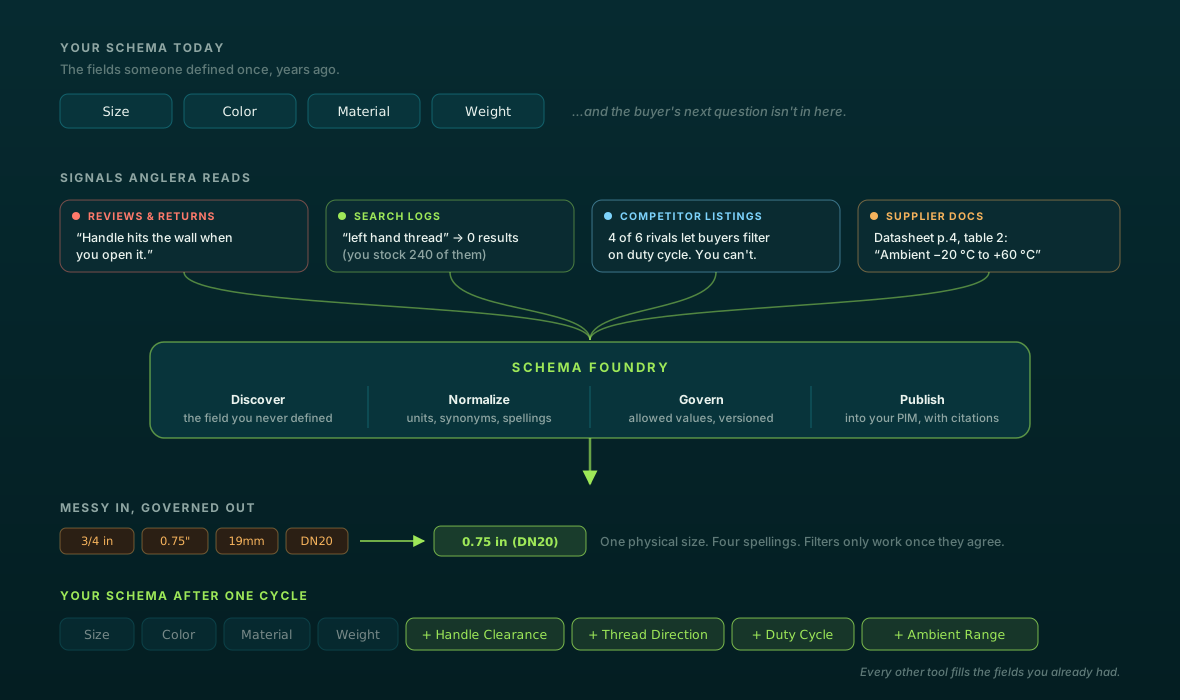
Both Informatica Product 360 and Stibo STEP assume something your catalog rarely delivers: that the product data going in is already buyer-ready. In practice, supplier content arrives as raw specifications, inconsistent attribute values, and copy written for procurement teams — not for how buyers search, compare, and filter on a digital shelf or B2B portal.\n\nBoth platforms give you an exceptionally well-governed place to store and distribute that content. Neither automatically makes the content perform. The work of researching what buyers actually search for, identifying which attributes are missing or miscategorized, writing descriptions that convert, and scoring every SKU against real buyer intent — that work still falls on internal content teams, offshore vendors, or consultants unless something else handles it. Informatica's AI agents and Stibo's ProductGen AI assist teams in reformatting and improving supplier copy that is already inside the platform; neither starts from buyer signals to determine what each SKU actually needs.\n\nAnglera is the layer that does that work. It connects to your Informatica Product 360 or Stibo STEP instance via API, reads your existing SKUs, enriches every attribute and description against buyer signals — how your customers actually search, compare, and decide — and writes the improved content back to the same record in the MDM. Your system of record stays in place. The enrichment quality lifts across the catalog. What Informatica or STEP then governs, validates, and distributes is buyer-ready from the start, not just well-organized. Implementation is ~30 days with no platform migration required.
Frequently asked questions
What is the main difference between Informatica Product 360 and Stibo STEP?
Informatica Product 360 is the product data management layer of Informatica's broader Intelligent Data Management Cloud — strongest for enterprises that also use Informatica for data integration, data quality, or data catalog, and want a single vendor across multiple data disciplines. Stibo STEP is a dedicated multi-domain MDM platform designed to govern product, customer, supplier, and asset data in one place, without requiring a broader vendor platform. Both are enterprise-grade, both require significant implementation effort, and both include AI-assisted enrichment as a capability. The primary difference is ecosystem fit: Informatica is the stronger choice if you are already in that stack; STEP is the stronger choice if you want a dedicated, standalone MDM platform with deep multi-domain roots.
Which is faster to implement — Informatica Product 360 or Stibo STEP?
Both are multi-month enterprise implementations — typically 6–18 months for a full rollout, usually with an SI or professional services engagement alongside the vendor. Stibo STEP implementations are particularly noted by practitioners for complexity and timeline length given the depth of data modeling involved, though Informatica's scope can be equally extensive when the full IDMC platform is part of the project. Neither is a quick deployment. If implementation speed is a constraint, the more relevant question is whether Anglera can enrich your existing catalog data in ~30 days in parallel with — or ahead of — a full MDM go-live.
How does Anglera work with Informatica Product 360 or Stibo STEP?
Anglera connects to your existing MDM or PIM via API, reads your current SKUs, runs buyer-signal enrichment across every product — determining what attributes are missing, which descriptions are thin, and how to fill gaps based on how buyers actually search and evaluate — then writes the improved content back to the same record in Informatica or STEP. Your MDM remains the system of record. Anglera is the enrichment layer that makes the data inside it buyer-ready. Implementation is roughly 30 days with no platform migration required on the MDM side.
Do I need a separate enrichment tool if I already have Informatica's Agentic AI or Stibo's ProductGen?
For most B2B distributors and manufacturers, yes. Both platforms include AI content generation — Informatica through its Agentic AI agents, Stibo through ProductGen — but both operate primarily on supplier content already inside the platform. They reformat and refine what is already there; they do not independently analyze how buyers search and compare to identify what content each SKU is actually missing. Anglera's enrichment starts from buyer signals: what procurement engineers search for, which filters they use, and what they compare before deciding. That is a meaningfully different input from supplier copy, and it produces content that is optimized for conversion rather than just governance completeness.
Is Stibo STEP better than Informatica for multi-domain MDM?
STEP has a longer dedicated track record as a standalone multi-domain MDM platform and Gartner Magic Quadrant recognition specifically in MDM. Informatica also covers multi-domain MDM through IDMC, but as part of a broader platform rather than as the sole focus. If multi-domain MDM — governing product, customer, and supplier data together in a single configurable platform — is your primary requirement and you do not need Informatica's surrounding data management tools, STEP's depth and heritage in that specific problem tend to resonate more with MDM practitioners. If you already run Informatica and want to extend MDM capabilities without adding a new vendor, Product 360 within IDMC is the more practical choice.