Pimberly vs Productsup: PIM vs Feed Syndication — Which Do You Actually Need?
Pimberly and Productsup do fundamentally different jobs — which means the typical "vs" framing can mislead a buyer who is trying to solve a single problem when they may actually need to solve two.
Pimberly is a PIM and DAM: the governed system of record where product data lives, validation rules enforce completeness, digital assets are managed alongside attributes, and publishing workflows route content to channels. It answers the question: where does your product data live, and who owns it? Productsup is a P2C (product-to-consumer) syndication and feed management engine: it ingests product data from whatever source you have, applies transformation rules, and pushes channel-ready feeds to 2,500+ destinations — Amazon, Google, Meta, retail data pools, and beyond. It answers the question: how does your product data get to every channel in the right format?
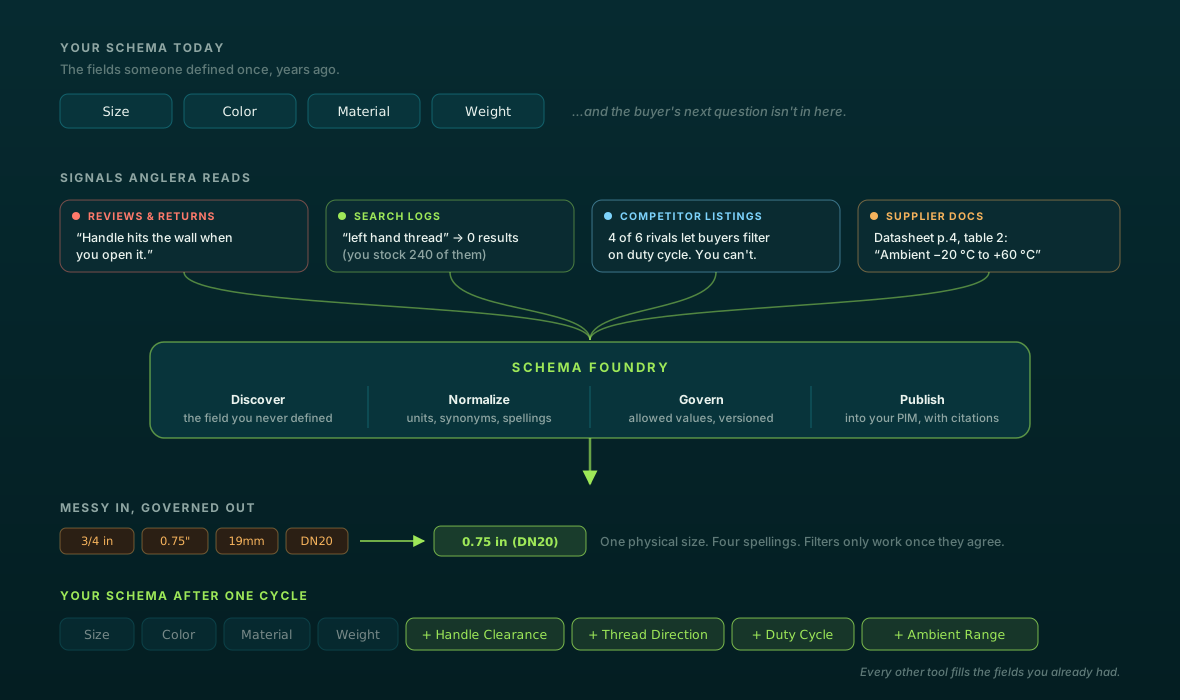
Many enterprises run both. Where the comparison gets real is when a buyer has a constrained budget and is deciding which problem to solve first — or when a mid-market team is evaluating whether a PIM with built-in channel publishing (Pimberly's model) can replace a standalone syndication layer (Productsup's model) for their specific channel footprint. Neither platform, however, solves the problem both share: the product data going into them is rarely buyer-ready. Supplier content arrives as raw specs, incomplete attributes, and copy written for the warehouse — not for how buyers actually search and decide.
| Pimberly | Productsup | Anglera | |
|---|---|---|---|
| Primary function | PIM + DAM — a governed system of record for centralizing product data and digital assets, enforcing validation, and coordinating publishing workflows across teams and channels | P2C syndication engine — ingests product data from any source, applies transformation and optimization rules, and distributes channel-ready feeds to 2,500+ destinations at enterprise scale | Enrichment layer — not a PIM or syndication platform; reads SKUs from whichever system of record you run, enriches every attribute and description against buyer signals, and writes results back before distribution |
| Channel reach & feed management | Publishing workflows to e-commerce and retail channels via native connectors; well-suited to mid-market teams with a manageable set of sales channels | 2,500+ channel connectors covering Amazon, Google, Meta, retail data pools, and marketplaces worldwide; rule-based transformations that reformat data per channel spec at high volume — processing over 2 trillion products per month | Does not syndicate or manage feeds — enriches the content that Pimberly or Productsup then distributes |
| Data governance & validation | Core PIM strength — configurable validation rules enforce attribute completeness before data leaves the system; teams govern content through defined workflows before publishing | Transformation-focused rather than governance-focused — data is reformatted and optimized for channel specs, but the underlying governance and master data management live upstream in a PIM or ERP | Complements both — Anglera fills incomplete attributes and rewrites thin copy before governance rules are applied, so validation passes instead of flagging gaps that teams then have to fix manually |
| Digital asset management | Native DAM built into the platform — images, videos, and documents are managed alongside product records and linked through the same publishing workflow | Feed and data transformation focus; not a DAM — asset management lives upstream in the PIM or a standalone DAM and Productsup handles the data layer | Data enrichment only; does not manage digital assets — works alongside whichever DAM is already in the stack |
| Typical buyer profile | Mid-market e-commerce and retail teams that need a central hub for product data and digital assets, with validation workflows and multi-channel publishing — particularly teams replacing spreadsheets or a basic ERP catalog with a proper PIM | Enterprise brands, manufacturers, and retailers that already have a data source (PIM or ERP) and need to get product content to a large, diverse set of channels reliably and at scale — L'Oréal, ALDI, and PUMA are named customers | Any team with a PIM or source of record who needs richer, buyer-ready product content without switching platforms — works alongside Pimberly, Productsup, or both |
| Pricing | Starts at approximately $30,000/year; custom pricing based on SKU volume and number of channels — no self-serve tiers publicly listed | Custom enterprise pricing only; no public tiers; quote required via sales — given the enterprise client base and platform scale, budgets typically start well above $30,000/year | Priced per SKU enriched — layers onto an existing PIM or syndication investment rather than replacing it |
| Implementation speed | Typically several months for initial rollout: data model design, attribute mapping, validation rule configuration, and DAM setup all add time before the first channel goes live | Connector configuration and transformation rule setup for each channel adds time proportional to channel count; a large enterprise rollout across many feeds can run months before all destinations are live | ~30 days from kickoff to enriched SKUs written back to the system of record — no platform migration required |
How to choose between Pimberly and Productsup
Choose Pimberly if your core problem is that you do not have a governed, centralized home for your product data. You are managing catalogs across spreadsheets, a basic ERP module, or disconnected tools, and you need a PIM with native DAM, validation workflows, and channel publishing — all in one mid-market-accessible platform. Pimberly's built-in channel connectors cover a broad enough set of destinations that mid-market teams with a manageable channel footprint may not need a standalone syndication layer at all. The $30,000/year starting point is accessible by mid-market standards.
Choose Productsup if you already have a system of record — whether a PIM like Pimberly, an ERP, or a homegrown solution — and your bottleneck is getting product data to a large number of channels in the right format, reliably, at scale. Productsup's 2,500+ connectors and transformation rule engine are built for enterprises whose channel footprint has outgrown what a PIM's native publishing can handle. If you are managing feeds to dozens of retail data pools, marketplaces, and paid channels simultaneously, Productsup's purpose-built feed management outpaces what most PIMs offer natively.
A few signals that clarify the choice:
- If you do not yet have a PIM and need to establish a system of record, start with Pimberly (or another PIM). Productsup needs a data source to distribute from — it does not replace a system of record.
- If you already have a PIM and your pain is feed reliability, channel-specific formatting, or reaching more destinations than your PIM can natively publish to, Productsup addresses that problem directly.
- If you need both a governed data hub and wide channel distribution, many enterprises run Pimberly and Productsup together — Pimberly as the source of truth, Productsup as the distribution engine.
- If channel count is modest and budget is constrained, Pimberly's native publishing workflows may cover your needs without requiring a second platform.
Whichever you pick, the data still has to get done
Whichever platform you choose — or whether you run both — there is a problem neither Pimberly nor Productsup solves upstream: the product data going into them is rarely buyer-ready when it arrives. Supplier content lands as raw specifications, inconsistent attribute formats, and copy written for procurement rather than for how shoppers actually search, compare, and decide. Pimberly gives you a well-governed place to store and validate that content. Productsup gives you a fast, reliable way to distribute it. Neither automatically makes the content better.
Anglera is the layer that does that work. It connects to your PIM via API, reads your existing SKUs, and enriches every attribute and description against buyer signals — the search terms, filters, and decision criteria your actual customers use. It then writes the improved content back to the same PIM record. Your Pimberly instance (or whichever system of record you run) governs and publishes better content. Productsup distributes content that was worth optimizing before it left. The enrichment happens once, upstream, in roughly 30 days — no platform migration, no new system of record, no changes to your publishing or syndication workflows.
Frequently asked questions
Are Pimberly and Productsup direct competitors, or complementary?
They are more complementary than competitive. Pimberly is a PIM and DAM — the system of record where product data is governed and stored. Productsup is a syndication and feed management engine — the distribution layer that gets data to channels. Many enterprises use both together: Pimberly as the source of truth, Productsup as the outbound engine. The comparison becomes a real choice when a mid-market team is deciding whether Pimberly's native channel publishing covers their needs or whether a dedicated syndication platform is warranted.
Can Pimberly replace Productsup, or vice versa?
Pimberly can replace Productsup for teams whose channel footprint is relatively contained — if you are publishing to a manageable set of e-commerce, marketplace, and retail destinations, Pimberly's native channel connectors may cover those needs. Productsup cannot replace Pimberly: it is a distribution engine that needs an upstream source of product truth to pull from. If you do not have a PIM, Productsup alone leaves you without governed master data.
What is the pricing difference between Pimberly and Productsup?
Pimberly starts at approximately $30,000/year, with pricing scaling by SKU volume and channel count — that starting point is at least publicly stated. Productsup does not publish pricing; given its enterprise customer base (L'Oréal, ALDI, PUMA) and the scale of its feed management infrastructure, budgets typically start well above the Pimberly floor. Both require a sales conversation before you see a real number.
How does Anglera work alongside Pimberly and Productsup?
Anglera connects to Pimberly (or whichever PIM is the system of record) via API, reads your existing SKUs, enriches every attribute and description against buyer signals — how your customers search, compare, and filter — and writes the improved content back to the same record in roughly 30 days. Pimberly then governs and publishes better content. If Productsup is in the stack, it distributes that better content downstream. No platform migration is required.
Do I need an enrichment tool if I already have both Pimberly and Productsup?
For most B2B distributors and manufacturers, yes. Both platforms assume the product data flowing through them is already complete, accurate, and written for how buyers evaluate products. In practice, supplier data is raw: attributes are missing, descriptions are written for procurement rather than buyers, and search-relevant copy is often absent entirely. Anglera fills those gaps upstream — before Pimberly governs and before Productsup distributes — so both platforms are working with content that is actually buyer-ready.