Pimberly vs Sales Layer: Which PIM Fits Your Business?
Pimberly and Sales Layer are both cloud PIM platforms. Both manage product data, enforce completeness rules, and push content to channels. The real question is which buyer each one was designed for — and whether that matches the problem you are actually trying to solve.
Pimberly is built for mid-market e-commerce and retail teams running large SKU catalogs across multiple sales channels. It combines PIM and DAM in a single platform, with validation rules and automated channel publishing workflows. The result is a platform that handles governance and distribution at volume — particularly suited to retailers and multi-channel operators who need a well-enforced single source of truth for both product data and digital assets.
Sales Layer positions itself as the easiest PIM to use, with a 6-week onboarding target and an explicit B2B orientation. Its Supplier Portal tooling and direct syndication capabilities target manufacturers, distributors, and retailers who need to normalize data coming in from multiple suppliers and get it back out to channels and trading partners. The "agentic PIM" framing reflects a push toward automation-first workflows inside the platform — and its tiered pricing with a public starting point and 30-day free trial makes it easier to evaluate before committing. Neither platform solves the upstream problem they share: the product data going into them is rarely buyer-ready to begin with.
| Pimberly | Sales Layer | Anglera | |
|---|---|---|---|
| Primary orientation | PIM + DAM for mid-market e-commerce and retail — governance-centric, automated channel publishing, large SKU catalogs with integrated digital asset management | PIM for manufacturers, distributors, and retailers — positioned as an agentic PIM with built-in syndication and a dedicated Supplier Portal; marketed as the easiest PIM to implement | Enrichment layer — not a PIM or syndication platform; reads from whichever system is the source of truth, enriches every SKU against buyer signals, and writes results back |
| Target buyer and vertical | Mid-market retailers and multi-channel e-commerce operators with large catalogs — teams that need product data and digital assets governed together in one platform | B2B manufacturers, distributors, and retailers managing complex supplier relationships — explicit strength where supplier onboarding and trading-partner data exchange are central operations | B2B distributors, retailers, and manufacturers across verticals who need richer, buyer-ready product content without switching PIMs |
| Supplier onboarding | Data import and validation workflows support inbound supplier data; no dedicated supplier-facing portal product surface marketed as a core differentiator | Dedicated Supplier Portal — suppliers log in, submit data, and validate it against product templates defined by the buyer; central B2B differentiator for companies managing many vendor relationships | Complements both: once supplier data is normalized inside the PIM, Anglera enriches it against buyer signals before it reaches any channel or marketplace |
| Enrichment capability | Validation rules and completeness scoring built in; AI-assisted content tools help teams fill and review attributes; human approval is part of the workflow | Completeness scoring, AI content generation, and agentic workflow automation within the PIM; validation driven by channel-specific templates; positioned as automation-first | Autonomous enrichment driven by buyer signals — how real buyers search, compare, and decide — not reformatted supplier copy; writes results back to the PIM without a copywriter in the loop |
| Pricing and total cost | From ~$30,000/year; custom pricing based on SKU volume and channels; no self-serve tiers or public price list | From ~$1,000/month (~$12,000/year); tiered plans from Core to Enterprise; 30-day free trial available; most enterprise plans require a quote | Priced per SKU enriched — layers onto your existing PIM investment rather than replacing it |
| Implementation speed | Typical rollout 3–6 months depending on channel configuration, DAM setup, validation rule design, and integration scope | 6-week onboarding target — shorter than most enterprise PIMs; trial-first approach lowers initial friction before a full commitment | ~30 days from kickoff to enriched SKUs written back to the PIM; no platform migration required |
How to choose between Pimberly and Sales Layer
Choose Pimberly if your primary challenge is managing a large SKU catalog across multiple sales channels with tight governance requirements and integrated digital asset management. Pimberly's combined PIM + DAM model, validation rules, and automated channel publishing workflows suit mid-market retailers and e-commerce teams that need a single platform to enforce data quality and push content at volume. If your team manages product assets and product data as part of the same daily workflow — and keeping them in sync across many channels is operationally expensive — Pimberly's integrated architecture reduces the number of systems in play. The ~$30,000/year entry point reflects an enterprise-calibrated investment, so it fits teams that need that level of governance and are ready to build toward it.
Choose Sales Layer if you are on the B2B side — a manufacturer, distributor, or retailer managing data from many suppliers who need it normalized and distributed to channels and trading partners quickly. Sales Layer's Supplier Portal is a genuine differentiator for companies where inbound supplier data quality is the root problem; its 6-week onboarding and tiered pricing with a 30-day free trial also create a lower-risk entry point than most enterprise PIM vendors offer. If a faster implementation timeline and more visible pricing are real constraints, Sales Layer's model is designed with those in mind.
A few signals that clarify the choice:
- If integrated digital asset management alongside product data is a core daily workflow, Pimberly's native DAM keeps both in the same platform and avoids a separate DAM integration.
- If supplier onboarding at scale — normalizing data from many external vendors against your own product templates — is the central pain point, Sales Layer's Supplier Portal is the most purpose-built tool for that job.
- If starting price and trial access matter before committing, Sales Layer's ~$1,000/month floor and free trial create a lower barrier; Pimberly's ~$30,000/year entry requires a longer sales cycle before evaluation.
- Both require a direct conversation before you see final numbers tied to your actual SKU volume and channel count.
Whichever you pick, the data still has to get done
Both Pimberly and Sales Layer assume your product data is already enriched — complete attributes, buyer-ready descriptions, titles that match how your customers actually search and filter. In practice, data arrives from suppliers as raw specs, inconsistent formats, and copy written for procurement rather than for purchase decisions. Both platforms give you a well-governed place to store and distribute that content; neither automatically makes it buyer-ready.
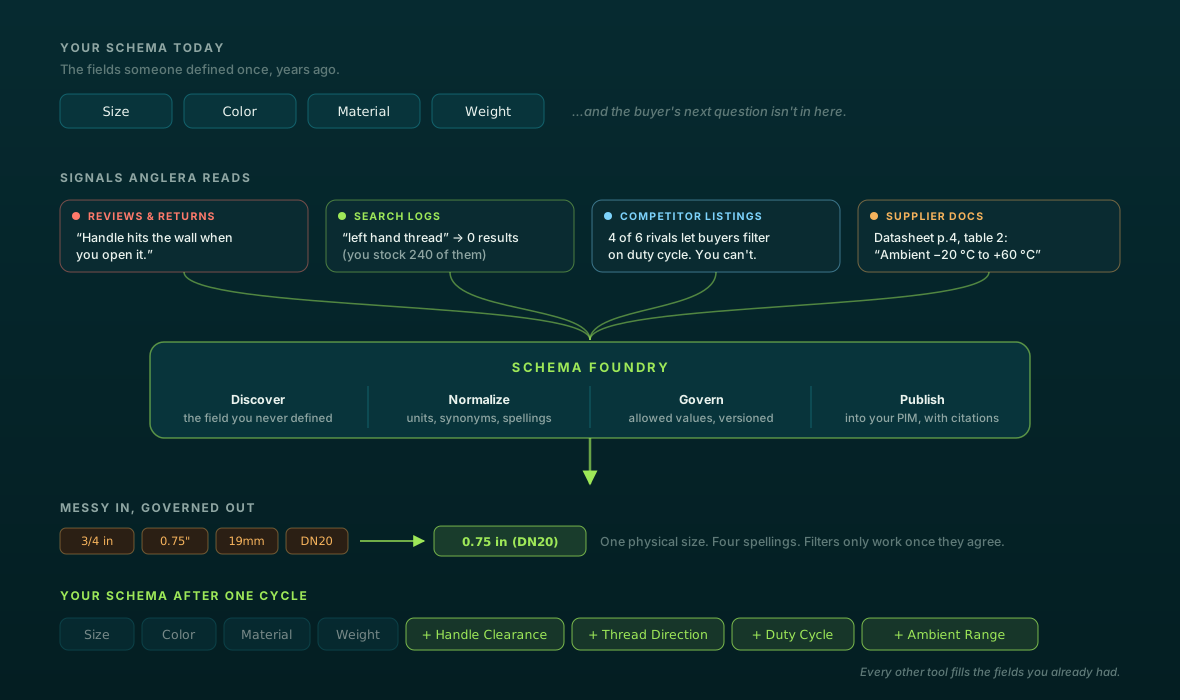
That gap — between organized and buyer-ready — is where Anglera works. It connects to your Pimberly or Sales Layer instance via API, reads your existing SKUs, enriches every attribute and description against buyer signals (how your customers actually search, compare, and decide), and writes the improved content back to the same PIM record. Your system of record stays in place. The enrichment quality lifts across the catalog. The content Pimberly or Sales Layer then validates, manages assets alongside, and distributes is built for how buyers make decisions — not just well-organized.
Whichever platform you choose, Anglera is the layer that does the enrichment work both assume already happened. Implementation is ~30 days with no platform migration required.
Frequently asked questions
What is the main difference between Pimberly and Sales Layer?
Pimberly is a PIM + DAM platform built for mid-market e-commerce and retail teams managing large catalogs across multiple channels — its design strength is governance, digital asset management, and automated channel publishing at volume. Sales Layer is a PIM built for B2B manufacturers, distributors, and retailers — its design strength is supplier onboarding via a dedicated Supplier Portal and fast implementation. Both centralize product data; the difference is vertical focus, the DAM question, and how inbound supplier data is handled.
Does Pimberly have a supplier portal?
Pimberly supports data import and validation workflows that can accommodate supplier data feeds, but a dedicated supplier-facing portal — where external vendors log in, submit product data, and validate it against templates — is not a core marketed feature. If supplier onboarding via a self-service portal is a central requirement, Sales Layer's Supplier Portal is the more purpose-built option.
Is Sales Layer a good PIM for distributors?
Yes — Sales Layer explicitly targets distributors alongside manufacturers and retailers. Its Supplier Portal helps distributors normalize incoming product data from many vendors, and its syndication capabilities push that content to channels and trading partners. Distributors with very large catalogs and complex digital asset requirements may also want to evaluate Pimberly's native DAM. The right choice depends on whether inbound supplier data management or outbound channel governance is the harder problem.
How does Anglera work with Pimberly or Sales Layer?
Anglera connects to your PIM via API, reads your existing SKUs, runs enrichment against buyer signals — how your customers actually search, compare, and filter — and writes the improved attributes and copy back to the same PIM record. No migration is required. Anglera works alongside whichever platform you choose in roughly 30 days. Your system of record stays unchanged; the content inside it becomes buyer-ready.
Do I need a separate enrichment tool if I already have Pimberly or Sales Layer?
For most B2B distributors and manufacturers, yes. Both platforms store, govern, and distribute product data, but neither automatically generates content optimized for how buyers search and decide. Both have AI-assisted tools that work on data already in the PIM — reformatting or completing supplier copy against internal schemas — but the underlying supplier data still drives the output. Anglera enriches against external buyer signals, not just internal rules, and writes results back to whichever PIM you already run.