Pimberly vs Salsify: Which Platform Is Right for Your Business?
Pimberly and Salsify both describe themselves as the system of record for product content. The difference is what each one is built to do after the data lands there.
Pimberly is a PIM-plus-DAM platform aimed at mid-market retailers and e-commerce teams managing high SKU counts across multiple sales channels. Its design priority is operational — centralizing product data and digital assets, enforcing validation rules, and automating the channel publishing workflow. If your team owns the product content end-to-end and needs a single system to govern and push it, Pimberly is built for that motion. Salsify is a Product Experience Management platform (PXM) built around brand-to-retailer syndication. Its distinctive strength is a broad pre-built network of retailer and marketplace connections, content scoring tools that surface gaps per retailer spec, and digital shelf analytics that show how published content performs. If your primary need is getting the right content to Amazon, Walmart, or other major retail accounts — and measuring it — Salsify's tooling is purpose-built for that job.
Neither platform solves the problem they share upstream: the product data going into them is rarely buyer-ready to begin with. Supplier content arrives as raw specs, inconsistent attributes, and copy written for procurement rather than for how buyers actually search and decide. Both tools give you a well-organized place to store and distribute that content; neither automatically makes it better.
| Pimberly | Salsify | Anglera | |
|---|---|---|---|
| Primary platform type | PIM + native DAM — a unified system for storing product data and digital assets, enforcing validation rules, and automating channel publishing workflows; positioned as an all-in-one operational hub for retail and e-commerce teams | Product Experience Management (PXM) — a PIM core combined with a digital shelf syndication network and content scoring tools; positioned around helping brands own the digital shelf and win more online sales | Enrichment layer — not a PIM or syndication platform; connects to whichever system you already run, enriches every SKU against buyer signals, and writes results back to the source of truth |
| Syndication & channel publishing | Automates publishing to sales channels via configurable workflow rules and channel connectors; connector coverage and setup complexity vary by retailer and channel | Pre-built connections to hundreds of retailers, marketplaces, and distributors; strongest digital-shelf syndication network of the two — purpose-built for brand-to-retailer content activation at major accounts | Does not syndicate — enriches and validates the product content before syndication fires, so what reaches each channel is complete and retail-ready from the start |
| Digital asset management | Native DAM included — store, organize, and link images, videos, and documents alongside product records without a separate tool or integration; a genuine differentiator for teams managing asset-heavy catalogs | DAM capabilities exist within the platform but are less mature; teams with high asset volumes frequently rely on an external DAM system alongside Salsify rather than replacing it | Does not manage digital assets — enriches the product data attributes, descriptions, and copy stored alongside those assets, including generating alt-text and image-based attribute extraction |
| Target buyer profile | Mid-market retailers and e-commerce teams that own the product content end-to-end — high SKU counts, multiple channels, and an internal team responsible for data governance and asset management | Brands and manufacturers syndicating outward to retail partners and marketplaces — particularly those for whom digital shelf performance (content scores, search rank, conversion) is a primary KPI | Fits either profile — distributors and manufacturers enriching incoming supplier data, or brands enriching their own catalog before it is stored in the PIM and pushed downstream |
| Pricing & total cost | Starts at approximately $30,000/year; custom pricing based on SKU volume and channel count; no publicly listed tiers — requires a sales conversation for a real number | Quote-based only; no public pricing; cost scales with user count, SKU volume, and feature tier; onboarding commonly requires a third-party consulting engagement adding approximately $16,000 or more; reviewers consistently flag it as expensive relative to alternatives | Priced per SKU enriched — layers onto the existing PIM investment rather than replacing it; ~30-day implementation with no platform migration required |
| Data enrichment & content readiness | Enforces validation rules and completeness checks; surfaces gaps in required fields; does not autonomously fill missing attributes or generate buyer-optimized copy — that work still falls to the team | Content Scores surface readiness gaps per retailer spec and measure how published content performs; does not fill those gaps automatically — teams must manually correct deficient records or engage external copywriting resources | Fills gaps autonomously — gathers data from supplier sites and public sources, generates structured attributes and buyer-signal-optimized copy, scores every SKU, and writes enriched content back to the PIM record without a copywriter in the loop |
| Implementation speed | Typically several months for full rollout depending on catalog complexity, data migration scope, and channel count; timeline varies by team size and readiness | Similar timeline; onboarding a third-party implementation consultant alongside vendor setup is the reported norm before content is flowing live to retail partners | ~30 days from kickoff to first enriched SKUs written back to the PIM; connects via API to the existing stack without displacing it |
How to choose between Pimberly and Salsify
Choose Pimberly if your team owns product content end-to-end and needs a single system to store, govern, and publish it. Pimberly's native DAM is a real advantage if you manage large asset volumes and do not want to maintain a separate system — having product data and digital assets in the same governed environment eliminates a category of integration overhead. It is best suited to mid-market retailers and e-commerce operators with high SKU counts, multiple sales channels, and an internal team that drives the data workflow rather than syndicating outward to many external retail partners.
Choose Salsify if you are a brand or manufacturer whose primary pain point is activating product content at retail accounts — Amazon, Walmart, Target, and similar partners. Salsify's pre-built retailer connections, content scoring per retailer spec, and digital shelf analytics are built for that workflow in a way Pimberly is not. The trade-off is cost and implementation complexity: Salsify requires a vendor quote, often comes with a third-party consulting engagement before content goes live, and reviewers consistently note it runs expensive relative to alternatives. If digital shelf performance and retailer content compliance are your KPIs and budget is less of a constraint, the syndication depth is hard to match.
A few signals that clarify the choice:
- If you need native DAM alongside PIM without a third tool, Pimberly wins on that dimension.
- If you are syndicating to 20 or more retail accounts and need pre-built retailer connections, Salsify's network is the deciding factor.
- If budget transparency matters in early conversations, Pimberly's approximate $30,000/year starting point gives you a real number; Salsify requires a quote and frequently runs higher once consulting is included.
- If your team is small and implementation speed matters, neither platform is fast — but Pimberly's scope is narrower, which tends to mean a less complex rollout.
Whichever you pick, the data still has to get done
Both Pimberly and Salsify assume your product data is already enriched — complete attributes, accurate specifications, descriptions written for how buyers search and compare rather than for how suppliers label parts. In practice, that assumption fails for almost every B2B distributor, retailer, and manufacturer: data arrives from suppliers as raw specs, mismatched attributes, and copy optimized for nothing in particular.
Pimberly gives you a well-governed place to store and publish that content. Salsify gives you a well-connected place to syndicate and score it. Neither platform closes the gap between what suppliers send and what buyers need to see. That is the work Anglera does.
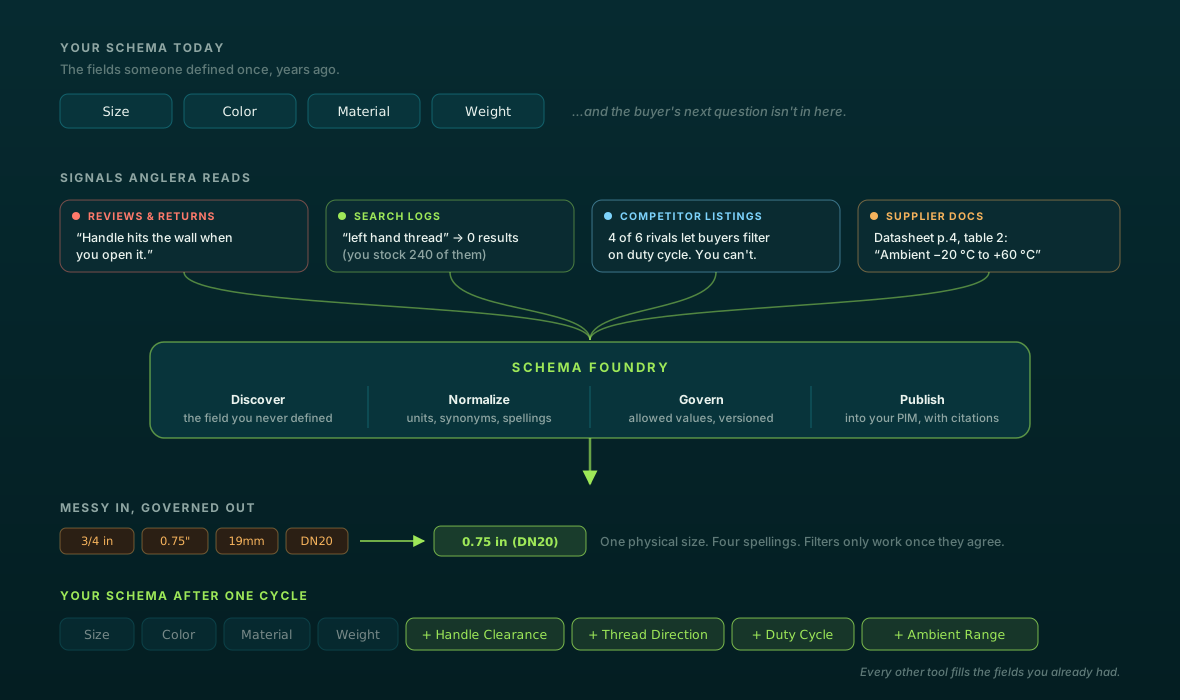
Anglera connects to your PIM or PXM via API — Pimberly or Salsify, whichever you choose. It pulls your existing SKUs, gathers additional data from supplier sites and public sources, generates structured attributes and descriptions driven by buyer signals (how your customers actually search, filter, and decide), and writes the improved content back to the same record in your system of record. Your PIM stays the source of truth. The enrichment quality lifts across the catalog. The content Pimberly then governs and publishes — or Salsify scores and syndicates — is buyer-ready from the start, not just well-organized or well-distributed. Implementation is approximately 30 days with no platform migration required.
Frequently asked questions
What is the main difference between Pimberly and Salsify?
Pimberly is a PIM-plus-DAM platform built around centralizing product data and digital assets for mid-market retail and e-commerce teams — emphasis on operational governance and channel publishing. Salsify is a PXM platform built around brand-to-retailer syndication — emphasis on digital shelf activation at major retail accounts, with content scoring per retailer spec and pre-built connections to hundreds of retailers and marketplaces. Both store product data; the difference is what each one is optimized to do with it downstream.
Does Pimberly or Salsify include data enrichment?
Neither platform automatically fills missing attributes or generates buyer-optimized content. Pimberly enforces validation rules and flags completeness gaps, but filling those gaps is manual work for the team. Salsify surfaces content scores against retailer requirements but does not resolve deficiencies automatically — teams must correct records manually or engage outside resources. Both platforms govern and distribute whatever content is already there; they do not improve it.
Which is more expensive, Pimberly or Salsify?
Pimberly starts at approximately $30,000/year, with custom pricing based on SKU volume and channel count. Salsify is quote-based only with no published pricing; reviewer feedback consistently flags it as expensive, and onboarding commonly requires a third-party consulting engagement that adds approximately $16,000 or more to the initial cost. Both require a sales conversation before you see a real number, but Pimberly's approximate starting price gives earlier budget visibility.
How does Anglera work alongside Pimberly or Salsify?
Anglera connects to your PIM via API — Pimberly or Salsify, whichever you run — reads your existing SKUs, enriches every attribute and description against buyer signals, and writes the improved content back to the same record in your system of record. No platform migration is required. Implementation is approximately 30 days. Anglera is not a PIM replacement; it is the enrichment work that happens before the PIM stores, governs, and distributes the content.
Can I use Anglera without switching my PIM?
Yes. Anglera is designed to complement your existing PIM, not replace it. Whether you are on Pimberly, Salsify, Akeneo, or another platform, Anglera connects via API, enriches your catalog, and writes results back to the system of record you already have. The PIM stays in place; the content quality improves.