Pimberly vs Stibo Systems: PIM Comparison for Product Data Teams
Pimberly and Stibo Systems both belong in the "centralize and govern your product data" category. The comparison stops being simple the moment you look at who each platform was actually built for.
Pimberly is a cloud-native SaaS PIM and DAM aimed at mid-market e-commerce and retail teams. It is designed to be stood up quickly, to enforce data validation rules across a large SKU catalog, and to push content to multiple sales channels without requiring a systems integrator. The pitch is practical: eliminate data silos, automate publishing workflows, and give your team a single source of truth they can actually maintain. Stibo Systems makes STEP, an enterprise Master Data Management platform that goes well beyond product data — it centralizes product, customer, supplier, and asset data across business domains. STEP is a Gartner Magic Quadrant Leader for MDM and is built for large enterprises that need authoritative governance across complex, multi-domain data environments. Implementation routinely runs six to eighteen months and typically involves a dedicated SI partner.
If you are a mid-market retailer or e-commerce operator with a large SKU count and a need to publish content across multiple channels quickly, you are probably not in the same conversation as a Fortune 500 enterprise evaluating a multi-domain MDM deployment. Both platforms assume your product data is complete and accurate before it arrives — and in practice, it rarely is. Supplier content comes in as raw specs written for procurement, not for how buyers search and compare online. Both Pimberly and STEP give you a governed place to store and distribute that content; neither automatically makes it buyer-ready.
| Pimberly | Stibo Systems | Anglera | |
|---|---|---|---|
| Market segment and scale | Mid-market e-commerce and retail teams — typically managing tens of thousands to hundreds of thousands of SKUs across a defined set of sales channels; designed for teams that need to move fast without a heavy implementation project | Large enterprises with complex, multi-domain master data needs — product, customer, supplier, and asset data governed across business units; commonly deployed at global manufacturers, retailers, and distributors with mature data governance programs | Works across market segments — connects to whichever PIM or MDM is the system of record, enriches every SKU against buyer signals, and writes results back; not a PIM and not scoped to enterprise-only deployments |
| Platform scope | PIM + DAM — centralizes product data and digital assets, enforces validation rules, and automates channel publishing; product-data-focused without extending to customer or supplier master data | Full MDM — STEP centralizes product, customer, supplier, and asset data across domains; built for organizations that need a single authoritative record spanning multiple entity types, not just product catalogs | Enrichment layer only — reads product data from Pimberly or STEP, enriches SKU attributes and copy against buyer signals, and writes back to the source of truth; does not compete with either platform's governance or MDM scope |
| Implementation timeline and complexity | Cloud-native SaaS; designed for faster onboarding relative to on-premise or heavy-enterprise alternatives; full implementation still takes weeks to months depending on catalog size and integration scope | Enterprise implementation typically runs six to eighteen months; a systems integrator is the expected norm for scoping, data modeling, and configuration; total cost of implementation is frequently a larger line item than the license itself | ~30 days from kickoff to enriched SKUs written back to the PIM; no platform migration or SI partner required |
| Governance and data modeling | Validation rules, workflow approvals, and channel-specific publishing logic; well-suited to catalog governance for mid-market teams without requiring deep data architecture work | STEP's data model is highly configurable — built to handle complex attribute hierarchies, multi-domain relationships, localization structures, and enterprise governance workflows at scale; Gartner Magic Quadrant Leader for MDM | PIM-agnostic — adapts to whichever schema Pimberly or STEP defines; adds enrichment quality without requiring data model changes |
| Enrichment capability | AI-assisted tools help with content consistency and attribute completion within the platform; enrichment quality depends on what supplier data was loaded in; manual review is still the expected workflow | AI features (ProductGen) assist teams in generating and validating content inside STEP; workflow-driven enrichment requires content teams, offshore vendors, or SI consultants to actually improve the copy and attributes | Autonomous enrichment driven by buyer signals — how real buyers search, compare, and decide — not reformatted supplier copy; writes results back to the PIM without a copywriter in the loop |
| Pricing | Starts at approximately $30,000/year; custom pricing based on SKU volume and channels — no publicly listed fixed tiers | Custom enterprise pricing only; subscription-based, scoped by users, data volume, and modules; no public pricing; SI and implementation costs add substantially to the total investment | Priced per SKU enriched — layers onto your existing PIM or MDM investment rather than replacing it |
| DAM and digital asset management | Native DAM included — digital assets managed alongside product data in the same platform; a meaningful differentiator for teams running combined product-plus-asset workflows | Asset data management is part of STEP's MDM scope, but deep DAM functionality is typically handled through integrations or complementary platforms for media-heavy organizations | Does not manage digital assets — enriches the product data attributes, descriptions, and copy stored alongside assets in Pimberly or STEP |
How to choose between Pimberly and Stibo Systems
Choose Pimberly if you are a mid-market retailer or e-commerce operator managing a large SKU catalog across multiple channels and you need a cloud-native PIM and DAM that your team can stand up and operate without a multi-year implementation project. Pimberly is built for speed-to-value in a product-data-plus-assets workflow: validation rules, workflow automation, and channel publishing are its core value. If your primary problem is data silos and slow, manual publishing across sales channels — and you are not running a multi-domain enterprise MDM program — Pimberly fits the bill and at a price point that does not require a board-level budget approval.
Choose Stibo Systems STEP if you are a large enterprise with a genuine multi-domain master data problem — product, customer, supplier, and asset data that needs to be governed, modeled, and distributed across business units at scale. STEP's MDM depth, governance workflows, and data modeling capabilities are purpose-built for organizations where product data governance is one part of a broader master data strategy. If you have complex attribute hierarchies, multi-locale requirements, supplier data onboarding at enterprise scale, and the internal resources or SI partner to support a proper implementation, STEP's Gartner recognition and enterprise depth make it a defensible choice.
A few signals that clarify the decision:
- If you need a PIM and DAM running in weeks, not months, and your team does not have an SI on retainer, Pimberly's cloud-native model is the realistic path.
- If your data governance problem spans more than product data — customer records, supplier entities, asset metadata — and you are in a large enterprise environment, STEP's multi-domain MDM scope is hard to replicate with a mid-market PIM.
- If budget is a constraint and you need a fixed starting price before a sales conversation, Pimberly's approximately $30,000/year floor gives you something to model; STEP requires a full discovery process before any number is on the table.
- If you are in manufacturing or distribution at enterprise scale and you already have STEP deployed, replacing it is almost certainly not the answer — the question is what you layer on top to improve content quality.
Whichever you pick, the data still has to get done
Pimberly and Stibo Systems STEP solve different versions of the same foundational problem: where does authoritative product data live, and how does it get to the channels that need it? Both platforms do that job well within their respective market segments. Neither one solves what happens before the data arrives — or why the data that does arrive is rarely buyer-ready.
Supplier content comes in as raw specs written for procurement teams, factories, and purchase orders. Attributes are incomplete. Descriptions are copy-pasted from a catalog PDF. Titles do not match how buyers search. Both Pimberly and STEP give you a governed, well-organized place to store and distribute that content. Neither platform interrogates buyer behavior to determine what the content should actually say.
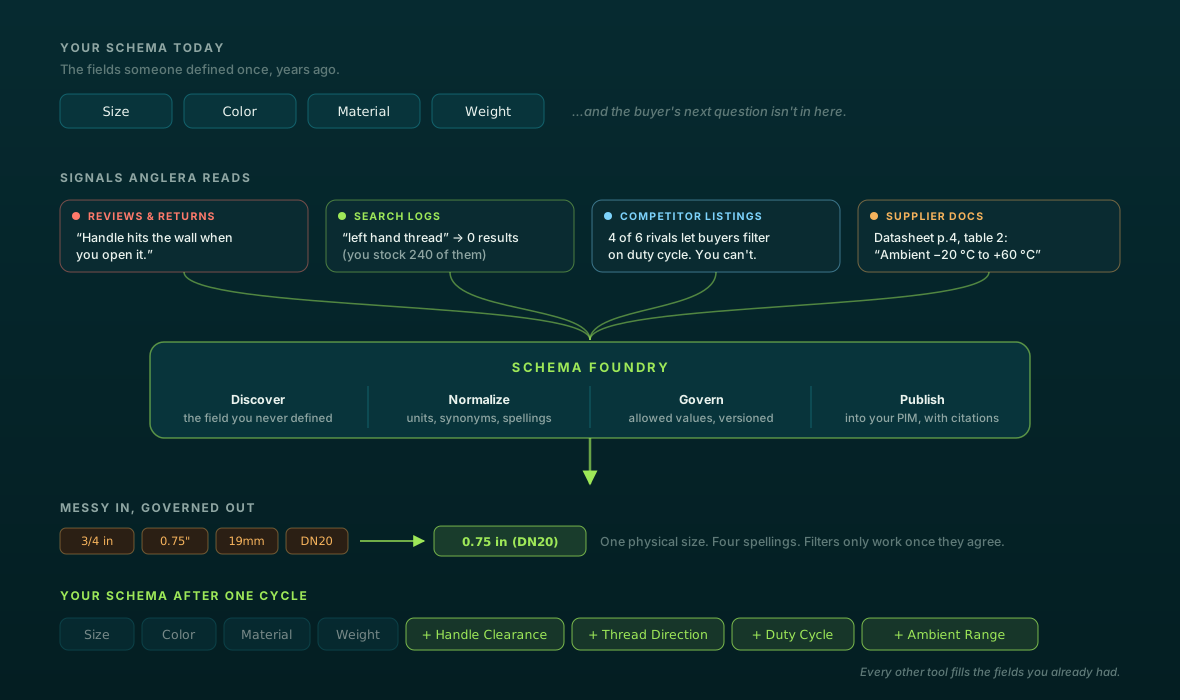
That is the work Anglera does. It connects to your Pimberly or STEP instance via API, reads your existing SKUs, enriches every attribute and description against buyer signals — how your customers actually search, compare, and filter — and writes the improved content back to the same PIM or MDM record. Your system of record stays in place. The implementation is roughly 30 days. The content Pimberly or STEP then governs and distributes is buyer-ready from the start, not just well-organized. Whichever platform you choose, Anglera handles the enrichment work both platforms assume already happened.
Frequently asked questions
What is the main difference between Pimberly and Stibo Systems STEP?
Pimberly is a cloud-native SaaS PIM and DAM built for mid-market e-commerce and retail teams that need to centralize product data and publish it across multiple channels quickly. Stibo Systems STEP is an enterprise Master Data Management platform that goes beyond product data to govern customer, supplier, and asset data across business domains — used by large enterprises with complex, multi-domain master data requirements. The two platforms serve fundamentally different market segments and organizational scales.
Is Stibo Systems STEP too complex for a mid-market business?
For most mid-market businesses, yes. STEP implementations typically run six to eighteen months and require a systems integrator for scoping, data modeling, and configuration. The total investment — license plus implementation — is designed for enterprise budgets and internal teams with dedicated data governance resources. Mid-market retailers and e-commerce operators generally find cloud-native platforms like Pimberly or Akeneo a better fit for their scale and timeline requirements.
Does Pimberly compete with Stibo Systems, or are they for different buyers?
They address the same category — centralized product data management — but in practice they serve different buyers. Pimberly competes most directly with mid-market cloud PIMs like Akeneo Growth, Plytix, and Catsy. Stibo Systems STEP competes at the enterprise MDM level alongside Informatica, Profisee, and SAP MDG. A buyer seriously evaluating both is likely either growing into enterprise requirements or benchmarking a mid-market option against an enterprise shortlist.
How does Anglera work with Pimberly or Stibo Systems STEP?
Anglera connects to your PIM or MDM via API, reads your existing SKUs, runs enrichment against buyer signals — how your customers search, compare, and filter — and writes the improved attributes and copy back to the same record in Pimberly or STEP. No platform migration is required. Implementation is roughly 30 days. Your system of record stays unchanged; the product content inside it becomes buyer-ready.
Do I still need an enrichment tool if I already have Pimberly or Stibo Systems?
For most B2B distributors, retailers, and manufacturers, yes. Both platforms store and distribute product data, but neither automatically generates buyer-signal-optimized content. Both have AI-assisted tools that help teams work faster on data already inside the platform — but the starting point is still raw supplier content, and someone or something still has to make it buyer-ready. Anglera automates that work and writes results back to whichever platform you already run, so your PIM or MDM stores content that was enriched against real buyer behavior, not just organized.