Pimberly vs Syndigo: Which Platform Is Right for Your Product Data?
Pimberly and Syndigo are both product data platforms, but they are solving different problems. Pimberly is a cloud PIM and DAM built for mid-market e-commerce and retail teams that need a single source of truth for governing and publishing product content across their own sales channels. Syndigo — now including the 1WorldSync network — is an end-to-end Product Experience Cloud (PXM) built for brands and manufacturers that need to push compliant product content outward to thousands of retail partners, GDSN nodes, and distributors at global scale. The architectures, pricing, and best-fit use cases are materially different.
The decision usually comes down to one question: is your primary pain point internal data governance and channel publishing, or external content distribution to retail partners? If it is the former, Pimberly is likely a cleaner fit at a lower price point. If it is the latter — and especially if GDSN certification, retailer-specific compliance rules, or a large trading-partner network matter — Syndigo's scale justifies its premium. Either way, both platforms assume you arrive with complete, accurate product data. That assumption is where Anglera comes in.
| Pimberly | Syndigo | Anglera | |
|---|---|---|---|
| Primary function | PIM + DAM for centralizing product records and digital assets; automates publishing workflows to owned and partner channels via API connectors. | PXM platform combining PIM, DAM, MDM, and a proprietary syndication network — one hub to store, validate, and distribute content to 2,500+ retail and GDSN endpoints. | Sits upstream of both: generates missing attributes, cleans raw supplier data, and writes enriched, publish-ready records back to the PIM — it does not store or distribute product data. |
| Syndication and retailer network | Publishes via configurable API connectors and feed exports. No built-in syndication network to major retailers or GDSN; integration scope depends on what connectors are configured. | Direct connections to 2,500+ retail endpoints and GDSN nodes globally. One of the largest content networks in the world following the 1WorldSync acquisition — a genuine competitive moat for brands that need broad retailer reach. | Not a syndication layer. Enriches the product attributes and copy upstream so that whatever leaves the platform meets retailer spec on the first submission rather than bouncing back for corrections. |
| Content validation and compliance | Configurable validation rules and workflow gates enforce data quality before publish. Teams define their own rules; depth of coverage scales with configuration effort. | 10,000+ pre-built data validations and 23,000 unique retailer requirements baked in. Flags non-compliance before submission — reducing rejection cycles with major retail partners. | Enriches and corrects attribute data before it reaches either platform's validation layer. Fewer validation failures, faster first-pass acceptance rates. |
| DAM capabilities | Native DAM included. Centralizes digital assets alongside product records; supports asset versioning, metadata tagging, and rights management within the same platform. | DAM included in the suite, covering asset storage and distribution as part of the broader content supply chain. Asset management is integrated with the retailer delivery workflow. | Sources, resizes, and quality-checks product images during enrichment; delivers assets ready to attach to the product record in whichever DAM layer the platform provides. |
| Data governance and MDM | PIM-centric governance — strong for managing product hierarchies, attributes, and channel-specific variations. MDM is not a core feature; better suited to product data than enterprise master data broadly. | Includes an MDM layer alongside PIM, supporting broader master data management across product, location, and party data. Useful for enterprises that need data governance beyond the product catalog. | Enriches attribute-level data quality regardless of which governance layer sits above it. Not an MDM replacement. |
| Best-fit buyer | Mid-market e-commerce and retail operators managing large SKU counts across owned channels and a manageable set of trading partners. Teams that want strong workflow, DAM, and publishing automation without the complexity of an enterprise syndication network. | Brands, manufacturers, and CPG companies that must push compliant product content to major retailers, distributors, and GDSN recipients at scale. The network and compliance coverage are the product — buyers who do not need that reach are paying for capabilities they will not use. | Fits any team — Pimberly or Syndigo customer — whose incoming supplier or product data is incomplete, inconsistently formatted, or missing attributes needed to pass retailer validation. |
| Pricing and TCO | Starts at approximately $30,000/year; custom pricing based on SKU volume and channels. Generally the lower-cost option between the two for mid-market catalog sizes. | Custom-quoted. Third-party estimates place TCO $10,000–$30,000 higher per year than smaller PIM alternatives for comparable mid-market deployments. The premium reflects network breadth and compliance depth. | Separate enrichment subscription priced by SKU volume. Adds to overall platform cost but replaces manual data-cleaning headcount or agency spend that most teams are already carrying. |
How to choose between Pimberly and Syndigo
Choose Pimberly if your team is primarily an e-commerce or retail operator managing product content across your own channels and a defined set of partners. You need disciplined PIM governance, a native DAM, and reliable publishing workflows — and you are not in the business of pushing content into a GDSN or submitting to hundreds of major retailers through a compliance network. Pimberly delivers more bang-per-dollar for that use case, with a lower starting price and a faster implementation footprint.
Choose Syndigo if your business model requires distributing compliant product content to major retail chains, GDSN nodes, or a large trading-partner ecosystem. The 2,500+ recipient network, 10,000+ pre-built validations, and retailer-specific compliance rules are not features you configure — they are the product. If that distribution problem is your core pain, Syndigo's network is a legitimate moat and the higher TCO buys you meaningful time-to-shelf reduction and rejection-rate improvement with major retail partners. If you do not need that network, you are paying for a capability you will not use.
A note on implementation: Neither platform is a weekend project. Pimberly's SaaS model is generally faster to stand up, but catalog complexity and channel count drive scope. Syndigo's MDM and GDSN requirements add meaningful onboarding time for large networks. Budget implementation effort accordingly in either case.
Whichever you pick, the data still has to get done
Both Pimberly and Syndigo are built on a shared assumption: that the product data coming into the platform is already complete, accurate, and attribute-rich. In practice, it almost never is. Supplier feeds arrive with missing specs, thin descriptions, inconsistent units, and low-quality or absent images. Teams spend weeks — sometimes months — cleaning that data manually before the PIM or syndication workflow can do its job.
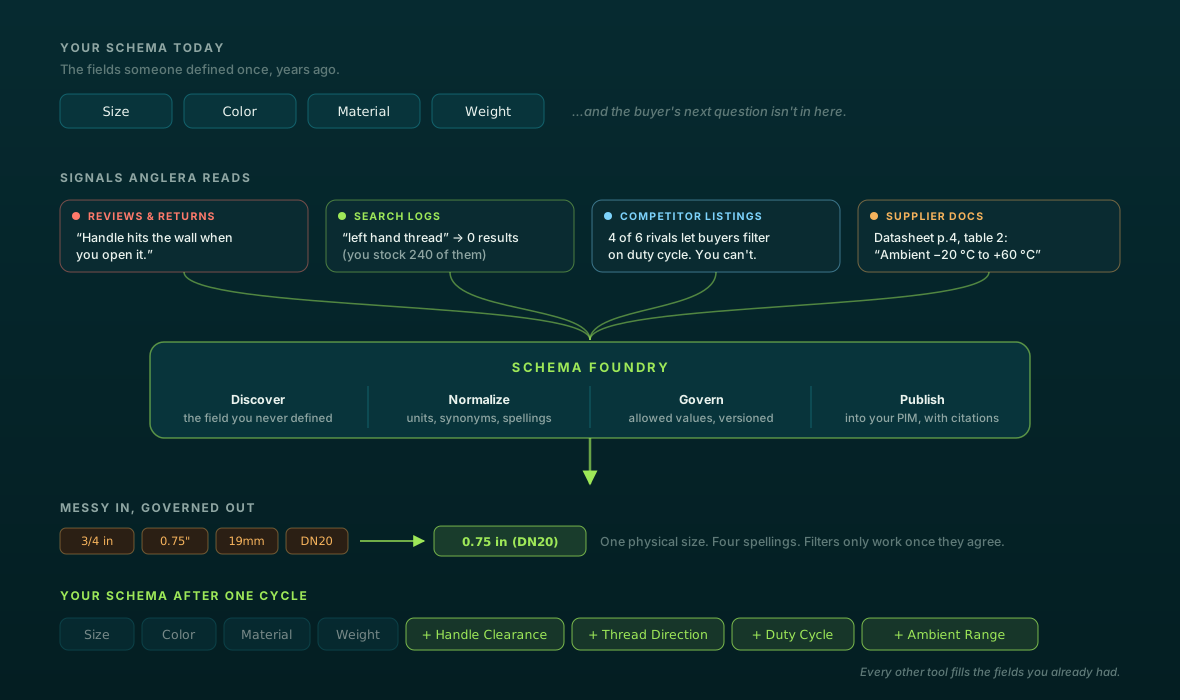
Anglera sits upstream of that workflow. It connects to your raw supplier data or existing catalog, generates missing attributes using buyer signal intelligence, rewrites thin or off-brand copy, sources and scores product images, and writes the enriched, completed records back to the PIM as the system of record. From that point, Pimberly governs and publishes it, or Syndigo validates and distributes it — whichever platform you chose.
Anglera does not compete with either platform. It does the enrichment work that both platforms assume already happened. Implementation runs approximately 30 days. There is no PIM migration, no syndication displacement, no change to the downstream workflow — just cleaner data going in, higher first-pass acceptance rates coming out, and less manual effort in between.
Frequently asked questions
Can Pimberly handle GDSN content distribution?
Pimberly is a PIM and DAM platform focused on internal data governance and multi-channel publishing via APIs and connectors. It does not include a native GDSN network. If GDSN certification and direct retailer submission to global endpoints are core requirements, Syndigo's built-in network is a meaningful advantage that Pimberly does not replicate through configuration alone.
Does Syndigo replace a standalone PIM?
Syndigo includes PIM and MDM functionality, so for many brands it can serve as the system of record for product data. Whether it replaces a separate PIM depends on the complexity of your internal data governance and workflow needs. Some organizations find Syndigo's PIM layer sufficient; others run it alongside a more configurable internal PIM for complex catalog hierarchies or highly customized publishing workflows.
What does Anglera actually do that Pimberly or Syndigo cannot?
Both platforms are built to store, validate, and distribute product data — they are designed to work with data that is already good. Anglera handles the upstream step that neither platform covers: generating attributes from raw supplier specs, rewriting thin or inaccurate descriptions, sourcing and scoring product images, and flagging completeness gaps before the record reaches the PIM. It then writes the enriched data back to the platform so the governance or syndication layer receives something it can actually publish without manual intervention.
How does Syndigo's acquisition of 1WorldSync affect buyers evaluating it today?
The merger consolidated two of the largest GDSN and content syndication networks, giving Syndigo broader retailer coverage, deeper GDSN compliance capabilities, and a larger pool of pre-validated trading-partner requirements. For brands that need GDSN certification or content distribution at wide retailer reach, the combined network is a genuine competitive differentiator. Buyers who do not need that network breadth should evaluate whether they are paying a premium for capabilities their use case does not require.
Is Pimberly suitable for large enterprise catalogs with high SKU counts?
Pimberly is designed to handle high-volume catalogs and targets mid-market and growing enterprise customers. It performs well for teams managing large SKU counts across owned and partner channels. Very large enterprises with complex MDM requirements, heavy GDSN compliance obligations, or the need to push content to hundreds of major retail partners may find Syndigo's broader data governance and compliance layer a better long-term fit — but for the majority of mid-market retail and e-commerce teams, Pimberly's scope is sufficient and its price point is materially lower.