Productsup vs Sales Layer: Which Platform Belongs in Your Product Data Stack?
Productsup and Sales Layer are not direct competitors in the way most comparison pages assume. Productsup is a syndication and feed management engine — its job is to take product data that already exists and push it, at scale, to 2,500-plus channels. Sales Layer is a PIM — its job is to be the single source of truth where that product data lives, is validated, and is governed. The tools can coexist in the same stack. When buyers put them side by side, they are usually asking one of two questions: "Do I need a PIM or just better channel distribution?" or "Can one of these replace something I already have?"
The honest answer depends almost entirely on where your product data problem actually starts. If your data is structurally sound and your bottleneck is getting it to more channels faster, Productsup is the conversation to have. If your data is scattered, inconsistently attributed, or supplier-submitted in ten different formats, the channel distribution problem is downstream of a data governance problem — and Sales Layer addresses that upstream.
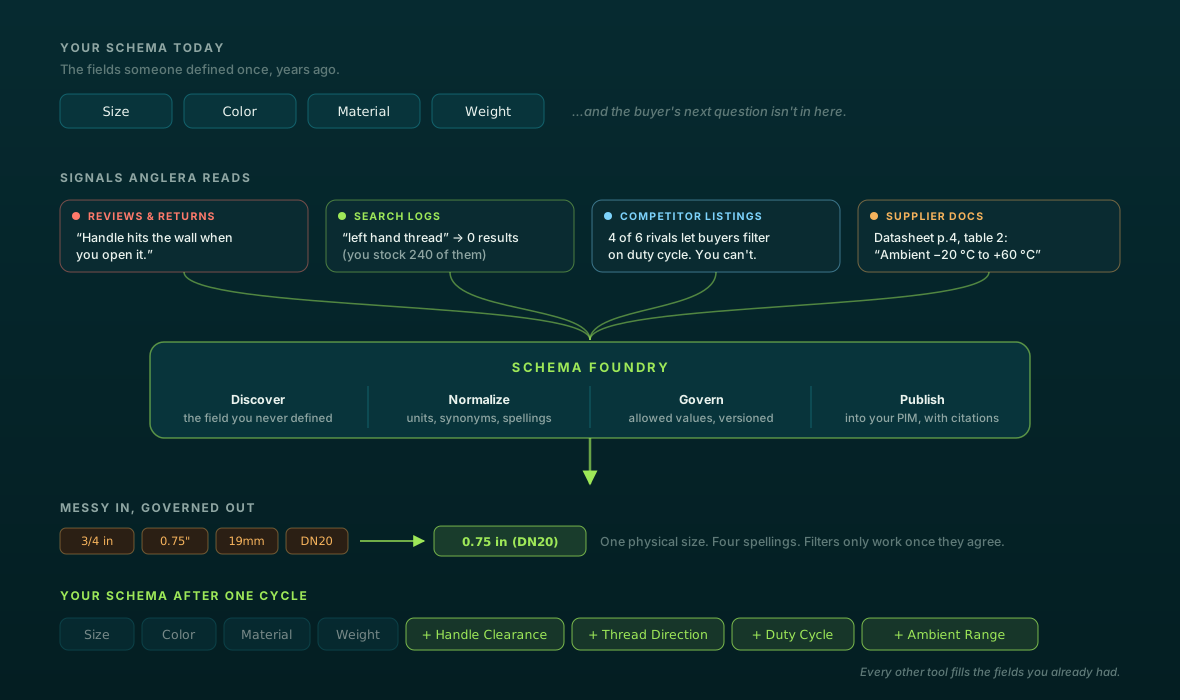
What neither platform is built to do is enrich product data: pulling missing attributes from supplier specs and web sources, generating channel-compliant copy, and scoring every SKU against the actual requirements of the channels it needs to reach. That work is assumed to have already happened. In most catalogs, it has not.
| Productsup | Sales Layer | Anglera | |
|---|---|---|---|
| Primary function | Syndication and feed management engine — ingests product data from existing systems and distributes it across 2,500+ channels, marketplaces, and retailer portals via rule-based transformation. | Cloud PIM — centralizes and governs product data as a single source of truth, with structured validation, digital asset management, and multi-channel syndication built in. | Enrichment layer — gathers missing attributes, cleans inconsistent values, generates channel-compliant copy, scores SKUs against buyer signals, and writes results back to the source of truth. |
| Channel coverage | 2,500+ pre-built connectors covering Amazon, Google Shopping, Meta, retail data pools (Syndigo, 1WorldSync), and major global marketplaces. Processing over 2 trillion products per month at enterprise scale. | Multi-channel syndication included — focused on retailer portals, marketplace feeds, and B2B distributor channels. Channel breadth is narrower than a dedicated syndication platform. | Channel-agnostic. Enriches product attributes to each channel's specific attribute spec so feeds pass validation on the first submission — regardless of which syndication tool is doing the pushing. |
| Supplier onboarding | Not a supplier portal. Productsup ingests data from existing sources via connectors and APIs — vendor onboarding is handled outside the platform. | Dedicated Supplier Portal is a core differentiator. Manufacturers and distributors can onboard vendors through a structured submission workflow that normalizes incoming data into the central catalog. | Works on supplier-submitted data after it lands — filling attribute gaps, normalizing units and terminology, flagging quality issues — so messy incoming content does not propagate downstream. |
| Data quality and enrichment | Rule-based transformation and field mapping. Powerful for reshaping and routing data that already exists; not designed to create or source missing attributes. | Completeness scoring and validation rules surface gaps. The platform identifies what is missing but does not fill it — that remains a manual or third-party task. | Core capability. Pulls from multiple sources to populate missing attributes, generates copy that meets retailer style guides, scores content completeness against live buyer requirements, and writes enriched data back to the PIM. |
| Implementation speed | Enterprise deployment with a timeline that varies by data complexity, number of channels, and transformation requirements. Full rollouts typically take several months. | Marketed as a 6-week onboarding — one of the faster PIM implementations available. A 30-day free trial lets teams validate fit before committing. | ~30-day implementation to first enriched SKU. Works alongside the existing PIM and syndication stack rather than replacing anything. |
| Pricing entry point | Custom enterprise pricing only. No public tiers, no self-serve trial. A sales conversation is required to get a number. | Starts at approximately $1,000 per month. Tiered plans scale by team size and feature set (Core through Enterprise). Custom quotes required above base tiers. | Contact for pricing. Scoped to catalog size and enrichment depth. |
| Ideal company profile | Enterprise brands, manufacturers, and retailers with high SKU volume, complex channel requirements, and an existing data foundation that needs distribution automation. Clients include L'Oréal, ALDI, and PUMA. | Manufacturers and distributors who need to build or consolidate their product data foundation, manage supplier submissions, and reach B2B and retail channels from a single governed source. | Any company using either platform whose incoming product data is incomplete, inconsistently attributed, or failing channel validation — regardless of catalog size. |
How to choose between Productsup and Sales Layer
Choose Productsup if your primary problem is distribution, not governance. If you have a PIM (or clean, well-structured product data) and your bottleneck is reliably pushing that content to a growing list of channels — Amazon, retailer data pools, Google Shopping, Meta — at volume and speed, Productsup's connector depth and enterprise feed automation are purpose-built for that job. It is the stronger choice for brands with complex transformation requirements across many simultaneous channels.
Choose Sales Layer if you do not yet have a functioning single source of truth, or your current PIM is slowing teams down. Sales Layer's B2B-first design, fast 6-week onboarding, and Supplier Portal make it a practical starting point for manufacturers and distributors who need to consolidate scattered product data before worrying about distribution. The 30-day free trial makes it lower-risk to evaluate.
Consider running both if your stack needs to do both jobs at scale: Sales Layer holding the master record and governing supplier submissions, with Productsup handling the channel distribution layer downstream. They are not redundant — they address different stages of the product data lifecycle.
Neither is the right choice if your underlying product data is incomplete, poorly attributed, or inconsistent at the SKU level. Distributing bad data faster (Productsup) or storing bad data more neatly (Sales Layer) does not solve the content quality problem. That problem needs to be addressed before — or alongside — either platform.
Whichever you pick, the data still has to get done
Both Productsup and Sales Layer assume your product data arrives ready to use. Productsup's transformation rules can map fields and reshape structure, but they cannot invent a missing load capacity, generate a compliant product description, or score a SKU against a retailer's attribute requirements. Sales Layer's completeness scores tell you what is missing — closing those gaps is your team's responsibility.
Anglera does the closing. It works upstream of whichever platform you choose: pulling attribute data from supplier specs, manufacturer sites, and web sources; generating copy that meets retailer and marketplace style guides; scoring every SKU against the buyer-signal requirements of the channels it needs to reach; and writing the enriched results directly back to your PIM. By the time your data flows into Productsup's feed engine or Sales Layer's syndication layer, it is actually channel-ready.
Anglera is not a PIM and not a syndication tool. It does not replace either platform — it does the enrichment work both platforms assume already happened. Implementation is roughly 30 days, and it connects to your existing stack without requiring you to change your source of truth or your channel strategy. Whichever side of this comparison you land on, the enrichment problem exists either way.
Frequently asked questions
Is Productsup a PIM?
No. Productsup is a syndication and feed management platform. It ingests product data from your existing systems and distributes it to channels — it does not serve as your master product record. If you need a system of record for product data, evaluate a PIM like Sales Layer first, then layer Productsup on top for distribution.
Does Sales Layer replace Productsup?
For companies with moderate channel complexity, Sales Layer's built-in syndication may be sufficient. For enterprise-scale feed management across 2,500-plus channels — with advanced transformation logic, high-volume automation, and connectors to retail data pools — Productsup's depth is hard to replicate inside a PIM. The two tools serve different parts of the stack and can coexist.
Can Sales Layer handle supplier onboarding?
Yes, and it is a genuine differentiator. Sales Layer's Supplier Portal lets manufacturers and distributors invite vendors to submit product data through a structured workflow. Incoming submissions are normalized into the central catalog, reducing the manual effort of standardizing supplier content at ingestion.
Where does Anglera fit if I already use one of these platforms?
Anglera works on the data before it moves through either tool. Feed rejections, low content scores, and channel validation failures are almost always caused by upstream problems — missing attributes, inconsistent values, copy that does not meet retailer specs. Anglera addresses those problems at the source, so your PIM and syndication layer both operate on clean, complete input.
How is Anglera different from the enrichment features inside these platforms?
Both platforms include some enrichment-adjacent functionality — completeness scoring in Sales Layer, transformation rules in Productsup. These are useful for routing and validating data that already exists. Anglera's entire purpose is enrichment: sourcing missing attributes, generating compliant copy, scoring against live buyer requirements, and writing results back to the PIM. It goes substantially deeper than what is built into syndication or PIM tools as a side capability.