Productsup vs Salsify: Which Platform Fits Your Stack?
Productsup and Salsify approach product data from opposite directions. Productsup is a distribution engine — it takes the data you already have and pushes it, transformed and reformatted, to 2,500+ channels. Salsify is a system of record — it stores, authors, and scores your product content, then syndicates it to retailers and marketplaces. Both platforms assume your product content is accurate, complete, and ready before they do their best work. That assumption is where most teams run into trouble.
For manufacturers and brands with mature content operations, that distinction drives the decision. If your bottleneck is getting data to the right channel format at scale, Productsup is built for that. If your bottleneck is owning a single source of truth and activating it across the digital shelf, Salsify is the closer fit. Large organizations sometimes end up running both: Salsify as the content system of record, feeding Productsup for high-volume channel distribution.
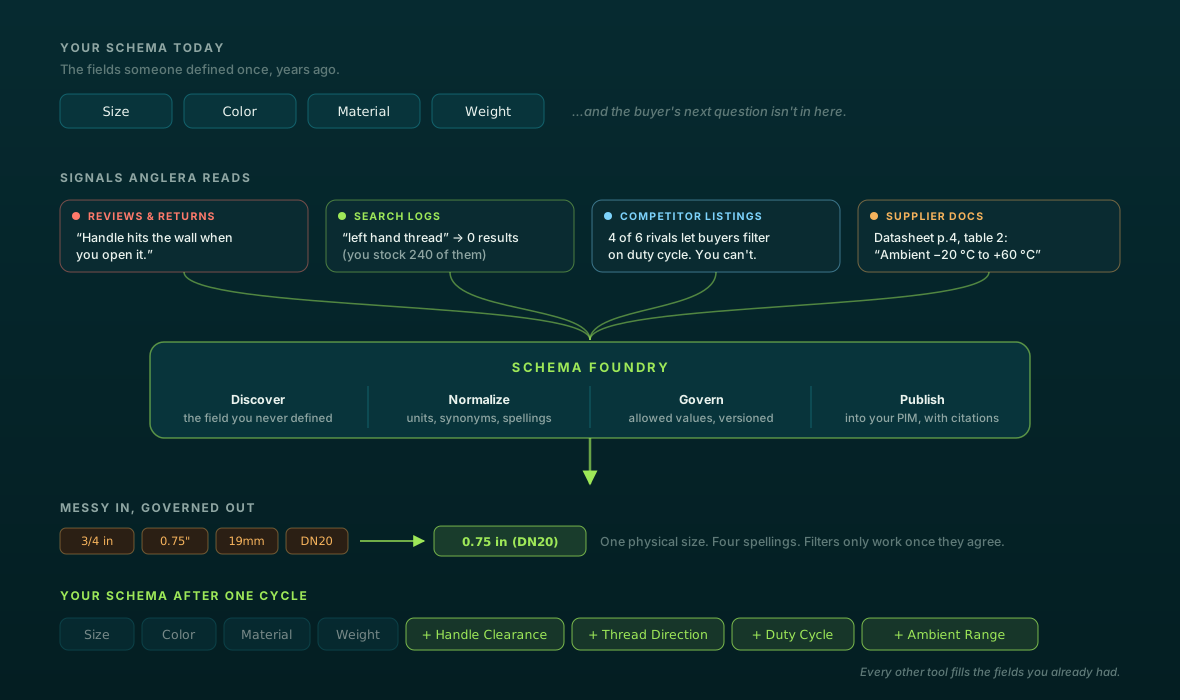
What neither platform handles is the upstream problem — incomplete attributes, unstandardized values, missing copy, and product records that have never been scored against what buyers actually search for. That gap is what Anglera addresses, and it exists regardless of which platform you choose.
| Productsup | Salsify | Anglera | |
|---|---|---|---|
| Primary function | Feed transformation and multichannel syndication. Ingests data from any source, applies mapping and transformation rules, and distributes to 2,500+ channels including Amazon, Google, Meta, and retail data pools. | PIM/PXM system of record. Centralizes product content, supports structured authoring workflows and collaboration, and syndicates to retail and marketplace partners. | Sits upstream of both. Enriches and completes product records before they enter either platform's workflow — so the data going in is as strong as possible. |
| Channel reach | 2,500+ pre-built channel connectors. Built for breadth and volume — brands like L'Oréal, ALDI, and PUMA use it to stay in sync across a large and shifting channel mix. | Syndication network focused on the digital shelf: major retailers, grocery, home improvement, and direct marketplace connections. Narrower than Productsup's connector library but tailored to brand-to-retail workflows. | Channel-agnostic. Enriches the underlying data; whichever platform distributes it benefits from more complete and accurate inputs. |
| Content authoring and data quality | Rule-based transformation and attribute mapping. Strong at format normalization and channel-specific reformatting. Not a content authoring tool — assumes the content was already written before it arrives. | Structured authoring workflows, digital shelf readiness scoring, and collaboration tools for brand teams to build, maintain, and improve content over time. | Auto-generates missing attributes, standardizes inconsistent values, and scores every SKU against buyer signals. Writes the enriched records back to your source of truth before authoring or syndication begins. |
| PIM / system of record | No native PIM. Functions as a transformation layer — it needs a data source (ERP, PIM, or flat files) feeding into it. Organizations evaluating Productsup typically already have or need a separate PIM. | Yes. Acts as the centralized product content repository for brands and distributors who want one platform to store, author, score, and syndicate rather than stitching together a PIM and a separate tool. | Not a PIM. Reads from and writes back to whatever system of record you designate — Salsify, another PIM, or your ERP — without replacing any of it. |
| Implementation and onboarding | Enterprise implementation; timeline depends on channel count and data complexity. No public pricing or onboarding benchmarks published. | Complex onboarding. Reviewers report an additional ~$16k cost for required third-party consulting on top of the subscription. Noted steep ramp time before the platform is fully operational. | Approximately 30-day implementation. Connects to your existing stack without replacing anything already in place. |
| Pricing model | Custom enterprise pricing only. No public tiers. A sales conversation and quote are required before any cost picture becomes clear. | Quote-based only. Costs are tied to user count, SKU volume, and feature tier. Reviewers consistently describe it as expensive relative to alternatives at similar scale. | Usage-based pricing aligned to SKU volume and enrichment scope. Contact for details. |
| AI and enrichment capabilities | Rule-based automation for feed transformation and attribute mapping. Reliable at format normalization and conditional logic. Not designed for content generation or gap-filling. | Digital shelf readiness scoring and some AI-assisted authoring features within the platform. Primarily supports human-authored content rather than generating it automatically. | Core capability. AI-powered enrichment gathers, cleans, and generates product content — scored against actual buyer signals — then syncs it back to the source of truth automatically. |
How to choose between Productsup and Salsify
Choose Productsup if your core problem is distribution at scale. If you have product data that is reasonably complete and your team is spending time manually reformatting feeds, managing channel-specific attribute mappings, or keeping thousands of SKUs in sync across Amazon, Google, retail data pools, and your own channels simultaneously — Productsup is built for exactly that. It suits large brands and manufacturers with established content operations who need a reliable, rules-driven distribution engine. The 2,500+ connector library is a genuine differentiator if you're operating across a wide and complex channel mix. Budget for an enterprise implementation conversation; there is no self-serve path in.
Choose Salsify if your core problem is owning the content in the first place. If your brand teams are working in spreadsheets, you lack a single source of truth for product content, and digital shelf performance is inconsistent and unmeasured across retail partners — Salsify's PIM and PXM capabilities address that directly. It's better suited to brands and distributors who want one platform to store, author, score, and syndicate rather than integrating a standalone PIM with a separate distribution tool. Go in with eyes open on cost: the platform is quote-based, implementation typically requires paid consulting on top of the subscription, and reviewers flag it as a premium-priced option. The payoff is a genuinely centralized content operation once it's running.
If you're considering both: that's a legitimate stack for large enterprises. Salsify as the system of record feeding Productsup for high-volume distribution gives you the best of each platform's core strength. It also means two enterprise contracts, two implementation efforts, and no native enrichment between them — which is worth factoring into the total cost picture.
Whichever you pick, the data still has to get done
Both Productsup and Salsify are downstream platforms. Productsup distributes content; Salsify organizes and publishes it. Neither enriches it.
Anglera operates one step earlier. Before your data enters Salsify's authoring workflow or Productsup's transformation rules, Anglera finds what is missing, fills gaps using buyer signal intelligence, standardizes inconsistent values, and writes the improved records back to your source of truth. That means cleaner inputs entering whichever platform you run — and better outputs reaching the channels and retailers that matter.
If you are running Salsify, Anglera enriches the records that live in your PIM before your team opens an authoring workflow or before any readiness score is calculated. If you are running Productsup, Anglera ensures the data feeding your transformation rules is complete enough to produce channel listings that actually convert rather than thin, attribute-sparse entries. In either case, Anglera's approximately 30-day implementation adds the enrichment layer both platforms assume you already have.
Frequently asked questions
Is Productsup a PIM?
No. Productsup is a feed transformation and syndication platform. It ingests data from a source — your ERP, a PIM like Salsify, or flat files — applies transformation rules, and distributes it to channels. If you need a system of record for product content, you need a PIM alongside it.
Does Salsify replace the need for a separate feed management tool?
Partially. Salsify's syndication network covers major retail and marketplace partners, and for many brands that's sufficient. If you need connectors to a very large number of channels simultaneously or more complex, conditional feed transformation rules, some teams add a dedicated syndication layer on top.
What is the difference between a PIM and a syndication platform?
A PIM is a system of record — it stores and organizes your product content centrally. A syndication platform takes that content and transforms or distributes it to channels. Salsify does both; Productsup focuses on the syndication and transformation side and needs a data source to pull from.
Where does Anglera fit if I already have both a PIM and a syndication tool?
Anglera fills the gap neither tool addresses: incomplete attributes, missing copy, non-standardized values, and content that has not been scored against buyer signals. It enriches the data in your PIM before it flows downstream to syndication — so both platforms perform better because their inputs are better.
How long does Anglera take to implement alongside an existing stack?
Approximately 30 days. Anglera connects to your existing stack — whether that is Salsify, Productsup, an ERP, or another PIM — without replacing any of it.