Productsup vs Stibo Systems: Channel Distribution vs. Master Data Governance
Productsup and Stibo Systems sit at opposite ends of the product data pipeline. Productsup is a channel distribution and feed management engine — its job starts when your product data is already structured and ends when that data reaches your target endpoints. Stibo Systems STEP is an enterprise MDM and PIM — its job is to be the authoritative source of record for product, customer, supplier, and asset data, with governance workflows and data modeling as core capabilities. They are not interchangeable tools solving the same problem.\n\nThe buyer choosing between them is usually in one of two situations: they have a system of record and need better channel reach (lean toward Productsup), or they lack a reliable source of truth for master data and need to build one before anything else can work cleanly (lean toward Stibo). Some large enterprises run both — STEP as the governed source of record, Productsup as the downstream distribution engine pushing feeds to Amazon, Google, Meta, and retail data pools.\n\nWhat neither platform does automatically is enrich the product data itself. Productsup transforms and routes whatever it receives. STEP governs and structures it. Neither fills in missing specifications, rewrites supplier copy for how buyers actually search, or scores catalog completeness against real buyer intent. That gap is upstream of both tools — and it is usually where catalog quality breaks down first.
| Productsup | Stibo Systems | Anglera | |
|---|---|---|---|
| Primary function | Feed management and channel syndication — ingests product data, applies transformation and optimization rules, and distributes channel-ready content to 2,500+ endpoints including Amazon, Google, Meta, and retail data pools; processes over 2 trillion products per month | Enterprise MDM and PIM — the authoritative system of record for product, customer, supplier, and asset data; governance workflows, configurable data models, and multi-domain mastering built into the platform; Gartner Magic Quadrant Leader for MDM | Enrichment layer — reads from the system of record (STEP or another PIM), enriches every SKU against buyer signals, and writes results back; not a PIM, MDM, or syndication platform |
| Data governance and modeling | Rule-based data transformation and feed optimization for channel distribution; not designed as a governance or data modeling platform — assumes clean, structured product data is already coming in from an upstream source | Core strength — multi-domain data governance with configurable data models, approval workflows, data quality scoring, and role-based access control spanning product, customer, supplier, and location domains | PIM-agnostic — adapts to whichever schema Stibo or the upstream system defines; no data model changes required to layer in enrichment |
| Channel reach and syndication | 2,500+ pre-built channel connectors covering marketplaces, search, social, and retail data pools; the broadest connector library in the category, with enterprise clients like L'Oréal, ALDI, and PUMA | Syndication capabilities built into STEP, but narrower than a dedicated feed management platform; more commonly used to distribute to downstream systems and trading partners than to drive high-volume marketplace feeds across hundreds of endpoints | Does not syndicate — enriches the content that Productsup or Stibo distributes downstream; works upstream of both |
| MDM scope | Product-data-focused; a channel distribution tool, not a multi-domain MDM; does not govern customer, supplier, or location master data alongside product data | Multi-domain MDM — manages product, customer, supplier, and location data in a single platform; suited to large enterprises running complex, multi-domain data environments where a single source of truth spans more than just the product catalog | Product-SKU-focused — enriches product attributes, descriptions, and structured data that the MDM stores and the channel platform then distributes |
| Implementation timeline and complexity | Faster to stand up for specific feed management use cases; individual channel integrations can be configured in weeks; full enterprise rollout with all connectors and transformation rules configured takes longer; no publicly stated timeline | Multi-month to multi-year implementations common at enterprise scale; complex data modeling, governance configuration, and domain setup frequently require a systems integrator engagement; subscription scoped by users, data volume, and modules | ~30 days from kickoff to enriched SKUs written back to the system of record; no platform migration required |
| Pricing and total cost | Custom enterprise pricing only; no public tiers; quote required via sales; scaled by data volume and channel scope | Custom enterprise subscription; scoped by users, data volume, and modules; systems integrator costs add substantially to total implementation spend; no public pricing | Priced per SKU enriched — layers onto your existing platform investment rather than replacing it |
| Best-fit buyer | Brands, manufacturers, and retailers that have reasonably clean, structured product data and need to distribute it efficiently across a large number of digital channels at enterprise scale — particularly where Amazon, Google, Meta, and retail data pools are all active targets | Large enterprises that need a trusted, multi-domain master data platform — particularly those with complex product hierarchies, multi-domain governance requirements, or data quality standards where STEP's MDM depth is the core requirement | Any B2B distributor, retailer, or manufacturer with a PIM or MDM in place who needs richer, buyer-ready product content without switching platforms |
How to choose between Productsup and Stibo Systems
Choose Productsup if your primary challenge is channel distribution. You have product data in reasonable shape — structured, governed, sourced from a PIM or ERP — and the problem is getting it to a large number of digital endpoints in the right format. Productsup's 2,500+ pre-built connectors and rule-based feed transformation are built for exactly this job. If your KPIs are channel coverage, feed accuracy, and time-to-channel for new SKUs, Productsup's distribution depth is hard to match. It is the stronger choice for organizations that already have data governance handled and need the downstream distribution layer to catch up.
Choose Stibo Systems if your primary challenge is master data governance. You have product data scattered across systems — ERP exports, supplier files, legacy databases — without an authoritative source of truth, and distribution quality suffers because the data itself is not trustworthy. Stibo STEP is a Gartner Magic Quadrant Leader for MDM, built for large enterprises running complex, multi-domain data environments. If you also need to govern customer, supplier, or location data alongside product data from the same platform, STEP is the only one of the two designed for that scope. Implementation requires a significant commitment — plan for a systems integrator and a multi-month rollout.
A few signals that clarify the choice:
- If you already have a PIM or MDM in place and the problem is specifically better channel distribution, Productsup likely fits without replacing the existing system of record.
- If you do not have a reliable source of truth for product data and need to build one before anything distributes cleanly, start with STEP.
- If governing customer, supplier, or location data alongside product data in one platform is a requirement, Stibo's multi-domain MDM is the only option of the two built for it.
- Some large enterprises run both: STEP as the system of record, Productsup as the downstream distribution engine. If your architecture already points that direction, the question becomes sequencing — governance first, then distribution.
- Both are enterprise-only, quote-required products with significant implementation commitments. Build time for proper discovery conversations with both vendors before scoping a project.
Whichever you pick, the data still has to get done
Productsup transforms and routes product content to channels. Stibo Systems governs and structures it in a system of record. What neither platform does automatically is enrich the product data itself.
Productsup assumes the data coming in is ready to distribute. STEP provides the governance structure to manage it. The shared gap is upstream of both: the attributes that are incomplete, the descriptions written for procurement teams rather than for buyers, the titles that do not match how customers actually search. Filling that gap — researching what attributes buyers rely on, identifying what is missing from the catalog, writing copy that converts, scoring content quality against real buyer intent — still falls on your team by default. Or it does not happen, and the catalog ships thin.
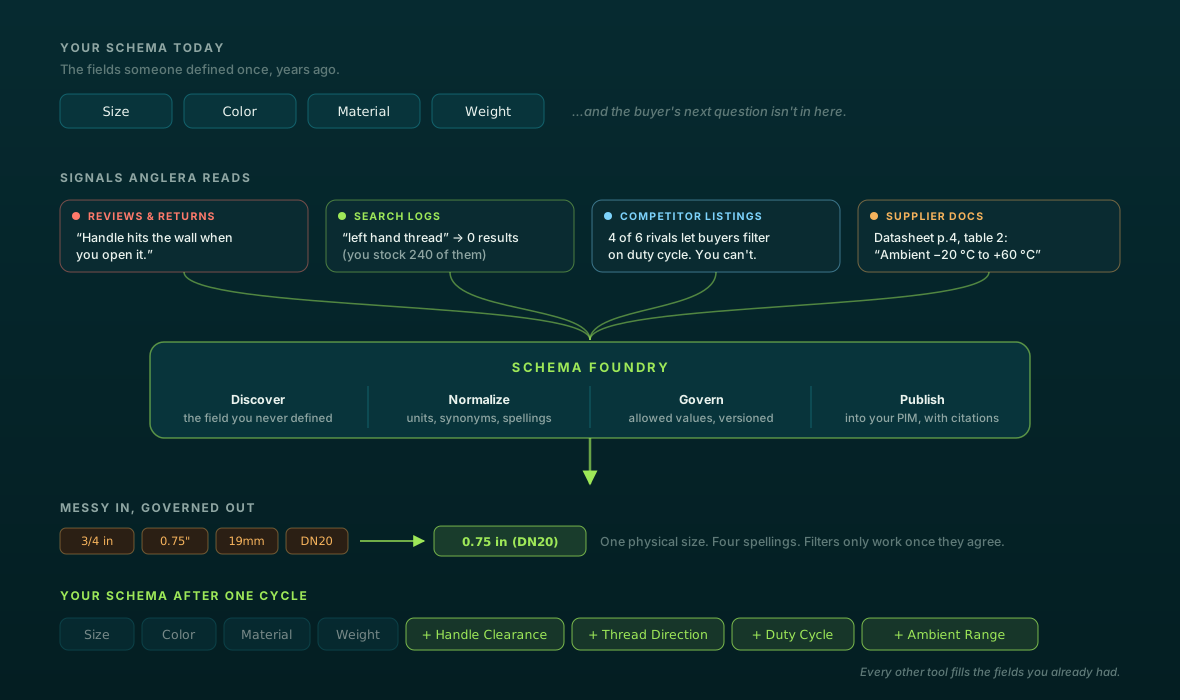
Anglera is the layer that closes that gap. It connects to your system of record — Stibo STEP, or whatever PIM is authoritative — reads your existing SKUs, enriches every attribute and description against buyer signals, and writes the improved content back to the same record. Whether Productsup then distributes that content across its 2,500+ channel connectors or STEP's built-in syndication handles distribution, the data going out is buyer-ready from the start — not just well-organized or efficiently routed. Implementation is ~30 days with no platform migration required.
Frequently asked questions
What is the main difference between Productsup and Stibo Systems?
Productsup is a channel distribution and feed management platform — it takes existing product data and pushes it efficiently to 2,500+ endpoints including Amazon, Google, Meta, and retail data pools. Stibo Systems STEP is an enterprise MDM and PIM — it is the authoritative system of record for product, customer, supplier, and location data, with governance workflows and data modeling as core capabilities. Productsup starts where the data is already clean and structured; STEP is where you go to make the data trustworthy in the first place.
Can you use Productsup without a PIM or MDM like Stibo STEP?
Yes — Productsup can ingest data from ERP exports, supplier feeds, flat files, and other sources and apply transformation rules before distributing to channels. But without a governed system of record, the quality and consistency of what goes into Productsup depends entirely on however that upstream data is managed. For complex catalogs with many SKUs, attribute families, and multiple locales, a PIM or MDM alongside Productsup is the more sustainable long-term architecture.
Does Stibo Systems replace the need for a tool like Productsup?
Not typically for high-volume multi-channel distribution. STEP has built-in syndication capabilities, but Productsup's 2,500+ pre-built channel connectors represent a deeper investment in the distribution layer specifically. Large enterprises frequently run STEP as the governed source of record and use a dedicated feed management platform downstream for last-mile channel distribution to marketplaces, search, and retail data pools.
How does Anglera work with Productsup or Stibo STEP?
Anglera connects to your system of record — Stibo STEP, another PIM, or whatever is authoritative for your product data — reads your existing SKUs, enriches attributes and descriptions against buyer signals, and writes improved content back to the same record. If Productsup then distributes that content to channels, it is distributing buyer-ready data from the start. If STEP's built-in syndication handles distribution, the same applies. Anglera works upstream of both platforms in roughly 30 days, with no platform migration required.
How long do Productsup and Stibo Systems implementations typically take?
Productsup channel integrations can be configured in weeks for specific connectors, but a full enterprise rollout across many channels with transformation rules and governance in place takes considerably longer. Stibo STEP implementations commonly run months and frequently require a systems integrator engagement — complex data modeling, multi-domain governance setup, and organizational change management all add to the timeline. Anglera runs independently of both: ~30 days from kickoff to enriched SKUs written back to the system of record.