Sales Layer vs Salsify: Which PIM Is Right for You?
Sales Layer and Salsify both centralize product content and push it to channels — but they come at the problem from different angles, serve different buyer profiles, and carry very different price tags and implementation timelines. Choosing the wrong one means re-platforming in 18 months.
Sales Layer pitches itself as the easiest PIM to deploy: a structured, B2B-oriented platform with a Supplier Portal, tiered public pricing, and a six-week onboarding promise. Salsify pitches digital shelf ownership: a Product Experience Management (PXM) platform with a broad retail syndication network, built for brands that need to win on Amazon, Home Depot, and hundreds of other channels. The overlap is real, but the center of gravity is different.
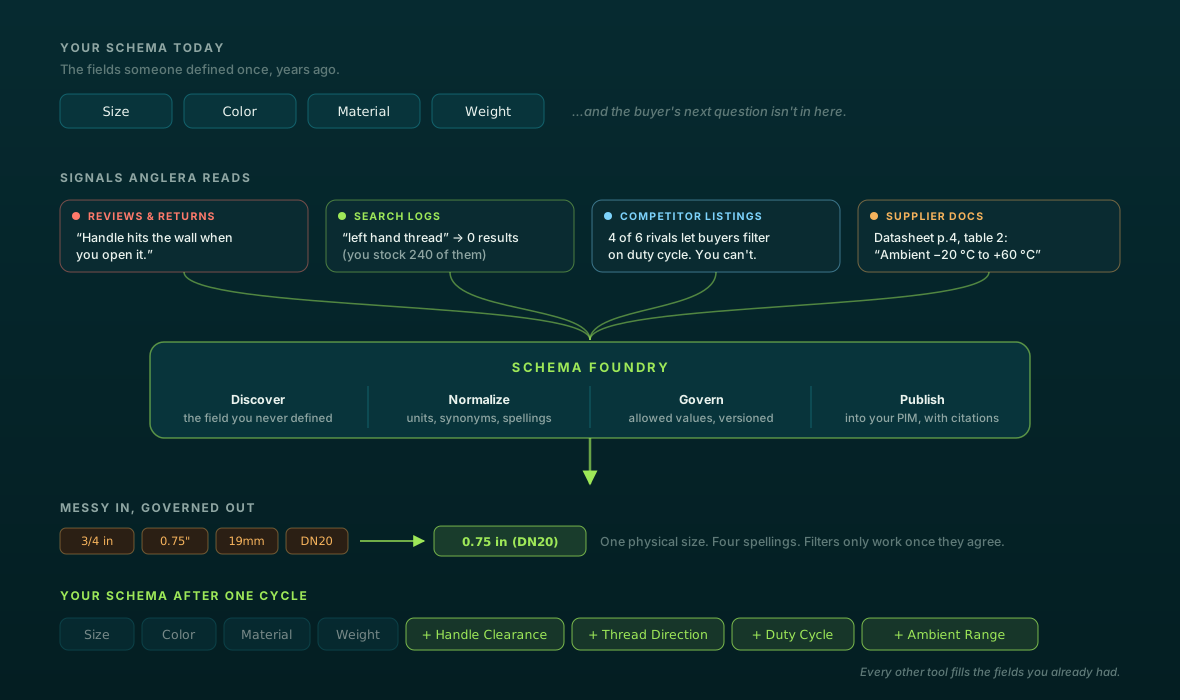
Neither platform enriches your data for you. Both assume the attributes, copy, and completeness scores that go in are already good. That is rarely true in practice — and it is exactly where Anglera plugs in, regardless of which platform you select.
| Sales Layer | Salsify | Anglera | |
|---|---|---|---|
| Core Strength | Structured PIM for manufacturers, distributors, and retailers — centralize, validate, and syndicate product data with a B2B Supplier Portal built in. | Product Experience Management focused on digital shelf activation — brand content authoring, retailer connections, and syndication at scale. | Enrichment layer: gathers missing attributes, cleans inconsistencies, scores completeness against buyer signals, and writes enriched records back to whichever PIM you run. |
| Onboarding & Time to Value | Six-week onboarding target. 30-day free trial available. Positioned as the fastest PIM to implement in its class. | Longer implementation; reviewers frequently note the need for a third-party consulting engagement, with reported onboarding costs around $16,000 on top of license fees. | ~30-day implementation. Connects to the PIM already in place — no rip-and-replace required. |
| Pricing & Transparency | Starts at approximately $1,000/month. Tiered plans (Core through Enterprise) with pricing tied to team size and features. Quote required for larger deployments. | Quote-only pricing. Costs scale with user count, SKU volume, and feature tier. Reviewers consistently flag it as expensive relative to alternatives. | Separate enrichment layer priced independently of your PIM. You pay for enrichment work done, not for seats or storage. |
| Syndication & Channel Reach | Syndicates to marketplaces, retailer portals, and digital channels. Solid breadth, with a focus on structured data distribution rather than retailer-specific content optimization. | Industry-leading syndication network. Built specifically to activate content on retailer and marketplace digital shelves — this is where Salsify has the clearest advantage. | Does not syndicate. Anglera enriches product data before it goes out the door, so whatever lands on the shelf is complete, consistent, and scored against what buyers actually search for. |
| Supplier & Vendor Collaboration | Dedicated Supplier Portal for onboarding vendors, collecting product data, and enforcing data standards at intake. A clear differentiator for distributors managing many suppliers. | Oriented toward the brand-to-retailer flow. Less emphasis on inbound supplier data collection and vendor onboarding workflows. | Enriches supplier-submitted data automatically at intake — filling attribute gaps, flagging inconsistencies, and scoring records before they touch your master catalog. |
| Data Enrichment & AI | Markets an 'agentic PIM' framing with AI-assisted validation and structuring. Enrichment beyond what suppliers provide still requires manual effort or external tools. | Offers AI-assisted content generation features. Enrichment is not the platform's core identity — digital shelf activation is. | Enrichment is the entire product. Anglera pulls missing data from authoritative sources, cleans and normalizes attributes, scores SKU completeness, and syncs enriched records back to the PIM on a schedule. |
| Best Fit Buyer | Mid-market manufacturers and distributors who need a fast, affordable PIM with strong B2B supplier collaboration and don't want a months-long consulting engagement. | Brands and retailers focused on digital shelf performance who need deep retailer network connections, robust content authoring, and are prepared to invest in a higher-cost, longer implementation. | Any team on either platform whose product data has attribute gaps, inconsistent values, or completeness scores that are holding back channel performance. |
How to choose between Sales Layer and Salsify
Choose Sales Layer if: You are a manufacturer, distributor, or retailer that needs to get a PIM running quickly without a large consulting budget. Sales Layer's six-week onboarding, tiered public pricing (starting around $1,000/month), and built-in Supplier Portal make it the stronger fit for B2B organizations managing inbound data from many vendors. The 30-day free trial lets you validate the platform against your catalog before committing. If your biggest pain is "we have no single source of truth and suppliers send us data in ten different formats," Sales Layer addresses that directly.
Choose Salsify if: Your primary problem is winning on the digital shelf — Amazon, Home Depot, Walmart.com, and hundreds of other retailer channels. Salsify's syndication network and digital shelf analytics are the deepest in the market for brand-side teams. The cost is real (quote-only, plus typical consulting onboarding costs), so this is a fit for brands with sufficient SKU volume and channel revenue to justify the investment. If your team spends significant time manually formatting content for specific retailer portals, Salsify's network effects pay off.
Where the decision gets murky: Both platforms overlap in the mid-market for brands that also manage supplier relationships. In that zone, the tiebreaker is usually: do you need the supplier-inbound workflow (Sales Layer's Supplier Portal wins) or the retailer-outbound activation (Salsify's syndication network wins)? Rarely do you need both equally.
Whichever you pick, the data still has to get done
Both Sales Layer and Salsify share a quiet assumption: that the product data flowing into them is already complete, accurate, and rich enough to perform on whatever channel it reaches. In practice, it almost never is.
Attribute gaps are the norm — missing dimensions, vague descriptions, inconsistent category taxonomies, supplier-provided copy that does not match what buyers search for. Neither platform was built to fix that. Both were built to store and move data that is already good.
Anglera is the layer that does the work those platforms assume already happened. It connects directly to your PIM — whether that is Sales Layer, Salsify, or anything else — pulls every SKU, identifies what is missing or inconsistent, gathers authoritative attribute data from structured sources, scores completeness against real buyer signals, and writes the enriched records back to the source of truth on a schedule. Implementation takes roughly 30 days and does not require you to change your PIM, your syndication setup, or your internal workflows.
If you pick Sales Layer, Anglera enriches the data before it leaves through the Supplier Portal and syndication channels. If you pick Salsify, Anglera enriches the data before it activates on the digital shelf. The enrichment problem does not disappear when you choose a PIM — it just becomes more visible. Anglera is how you solve it.
Frequently asked questions
Can I use Anglera with Sales Layer or Salsify, or do I have to pick one?
Anglera works alongside either platform. It connects to your PIM, enriches product records, and writes them back. There is no conflict — Anglera is not a PIM or a syndication tool, so it does not replace either Sales Layer or Salsify. You continue using whichever platform you choose for storage, collaboration, and distribution.
Sales Layer says it already has AI features. Why would I also need Anglera?
Sales Layer's AI assists with validation and structuring data you already have. Anglera gathers data you do not have — pulling missing attributes from authoritative sources, scoring completeness against what buyers search for, and filling gaps at scale. The two are complementary: Sales Layer organizes and distributes; Anglera ensures there is something worth distributing.
Salsify is expensive. Does adding Anglera on top make the cost even worse?
Anglera is priced separately and independently of your PIM license. More importantly, enriched product data tends to improve channel conversion rates and reduce the manual content work that drives up internal labor costs. The relevant question is not whether Anglera adds a line item, but whether incomplete product data is already costing you in returns, lost search placement, or suppressed listings — which it likely is.
We are a distributor with hundreds of suppliers. Which platform handles that better?
Sales Layer has a dedicated Supplier Portal built specifically for onboarding vendors and collecting structured data at scale — that is a meaningful advantage for distributors. Salsify is oriented more toward brand-to-retailer workflows. Either way, supplier-submitted data will have gaps; Anglera fills those gaps automatically at intake so your catalog does not inherit every supplier's data quality problem.
How long does it take to see results from Anglera after we go live with a PIM?
Anglera's typical implementation is around 30 days. Once connected to your PIM, it begins scoring and enriching SKUs immediately. Most teams see measurable improvement in attribute completeness within the first enrichment cycle — before the first syndication run goes to channels.