Sales Layer vs Stibo Systems: Which PIM Is Right for Your Business?
Sales Layer and Stibo Systems are both in the product data business, but they are not really competing for the same buyer. Sales Layer is a cloud PIM built for mid-market manufacturers, distributors, and retailers who need a single source of truth and fast channel syndication — up and running in about six weeks. Stibo Systems makes STEP, an enterprise Master Data Management platform that spans product, customer, supplier, and other master data domains — a Gartner Magic Quadrant Leader built for large organizations with complex governance requirements and months to implement.
Choosing between them is less about features and more about scale, scope, and how much data infrastructure you actually need. A mid-market distributor with a product catalog and a few hundred suppliers is asking a very different question than a global enterprise trying to govern master data across multiple business units and data domains. Getting that match right matters — the wrong platform costs time and money in either direction.
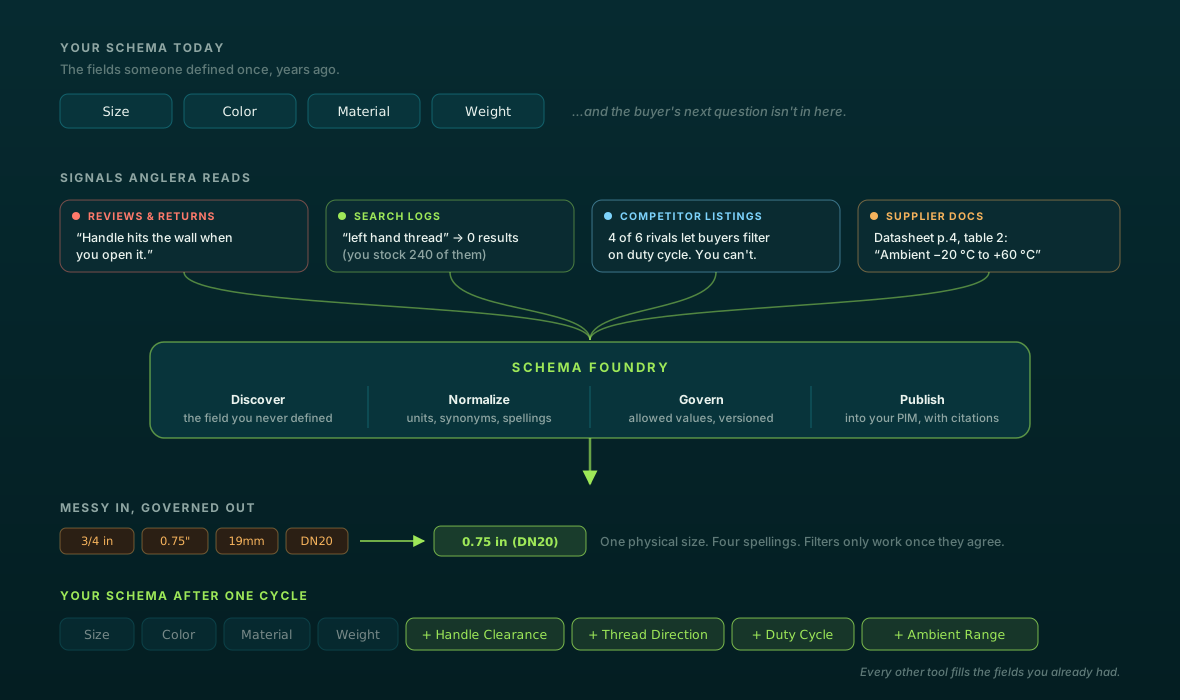
One thing both tools share: they are systems of record, not systems of enrichment. They store, validate, and distribute the product data you give them. What they do not do — and what neither markets themselves as doing — is automatically gather missing attributes, normalize specs across suppliers, or score completeness against what buyers actually search for. That gap exists whether you choose Sales Layer or STEP, and it is where Anglera operates.
| Sales Layer | Stibo Systems | Anglera | |
|---|---|---|---|
| Platform type | Cloud PIM — centralizes and distributes product content, digital assets, and supplier data. Focused exclusively on the product data domain. | Enterprise MDM + PIM (STEP) — governs product, customer, supplier, location, and other master data across multiple domains in a single governed platform. | Neither PIM nor MDM. Anglera enriches the product records that already live inside either platform, then writes the results back to the source of truth. |
| Target company size and complexity | Mid-market manufacturers, distributors, and retailers. Designed for teams that need fast time-to-value without heavy IT involvement or enterprise data modeling. | Large enterprises running complex, multi-domain data environments — often with global operations, regulated industries, or strict data lineage requirements. | Scales with either. Plugs into your existing PIM or MDM and enriches SKUs regardless of catalog size or org complexity. |
| Implementation timeline | ~6 weeks. Targets fast onboarding; a Supplier Portal helps accelerate structured data collection from vendors. | Months — and frequently requires a certified systems integrator. Scope and timeline expand with data model complexity and modules selected. | ~30 days to first enriched SKUs, independent of which platform you chose. Can run in parallel with your PIM implementation rather than waiting for it to finish. |
| Pricing model | Tiered plans starting at ~$1,000/month. 30-day free trial available. Custom quotes required for most plans above the Core tier. | Custom enterprise pricing only — scoped by users, data volume, and modules. No public pricing. Expect a significant investment; total cost of ownership includes SI fees. | Separate engagement scoped to catalog size and attribute depth, not tied to your PIM license tier or MDM module count. |
| Ease of use | Markets itself as the easiest PIM to use. UI is built for business users and merchandising teams, not IT administrators. Agentic features aim to reduce manual data entry. | Powerful but complex. Built for data stewards, architects, and governance teams managing sophisticated workflows. Steeper learning curve; formal training is typically required. | Merchandisers and catalog analysts interact with enriched data in a familiar, spreadsheet-like interface. No re-training on the underlying PIM or MDM required. |
| Supplier and partner onboarding | Dedicated Supplier Portal for collecting structured product data from vendors — a core differentiator for distributors managing many suppliers. | Partner and supplier data management is handled within STEP's broader MDM framework — robust but configured as part of the enterprise implementation, not out of the box. | Fills attribute gaps that suppliers never provided in the first place — crawling supplier sites and public sources to complete records regardless of how supplier onboarding was structured. |
| Channel syndication | Native syndication to marketplaces, retailer portals, and channels is a core capability. Built for brands and distributors pushing content outward to many destinations. | Syndication exists within STEP and is often extended with integrations and partner-specific outputs built during implementation. More configurable, less out-of-the-box. | Enriches product content before it syndicates — better input data means higher retailer acceptance rates and fewer attribute errors on the receiving end, regardless of which syndication path you use. |
How to choose between Sales Layer and Stibo Systems
Choose Sales Layer if you are a mid-market manufacturer, distributor, or retailer who needs a dedicated PIM operational in weeks, not quarters. It suits teams where business users — not data architects — will own the day-to-day workflow. The Supplier Portal makes it a natural fit for distributors managing a broad vendor base. The free trial removes most of the evaluation risk. If your primary problem is product content chaos across channels and you do not need multi-domain MDM governance, Sales Layer is likely the right fit and right size.
Choose Stibo Systems (STEP) if you are a large enterprise that requires a single governed system of record spanning multiple data domains beyond product — customer, supplier, location, and beyond. STEP belongs in your evaluation if you have compliance requirements demanding traceable data lineage, if you are already running a Gartner MDM selection process, or if your data complexity genuinely exceeds what a dedicated PIM can govern. Be realistic about the implementation investment: months of work and likely a systems integrator are part of the deal.
The trap to avoid is choosing Stibo when you have a Sales Layer problem, or choosing Sales Layer when your data complexity requires MDM governance. Neither platform is the wrong choice for the right buyer — the mismatch is the risk.
Whichever you pick, the data still has to get done
Both Sales Layer and Stibo STEP are built on a shared assumption: that the product data flowing into them is already accurate, attributed, and complete. In practice it almost never is. Suppliers send inconsistent specs. Attributes are missing or formatted differently across vendors. Descriptions are thin or written for internal use, not for buyers searching online.
That is the gap Anglera fills — and it applies regardless of which platform you chose. Anglera connects to your system of record (Sales Layer or STEP), crawls supplier sites and public sources, pulls buyer signals from search and category data, fills missing attributes, normalizes specs across your catalog, and scores every SKU for content completeness. Then it writes the enriched data back to whichever platform holds the authoritative record.
Your PIM or MDM does what it is built to do: store, govern, validate, and distribute. Anglera does what those platforms assume already happened: the enrichment work that turns raw supplier data into product content buyers can actually find and trust. Implementation takes about 30 days and runs alongside your PIM — not after it.
Frequently asked questions
Is Sales Layer or Stibo Systems better for a mid-market distributor?
Sales Layer. Its 6-week onboarding, dedicated Supplier Portal, and tiered pricing are designed for mid-market teams that need a working PIM without enterprise-scale IT overhead. Stibo STEP is built for much larger, multi-domain data programs — the implementation cost and complexity alone are typically prohibitive for a mid-market buyer.
Can Stibo Systems' STEP platform replace a standalone PIM like Sales Layer?
For a large enterprise, yes — STEP can consolidate PIM and MDM into a single governed platform. For a mid-market team focused on product content and channel syndication, STEP is generally over-engineered for the problem. A dedicated PIM like Sales Layer will get you operational faster and at a fraction of the total cost.
Where does Anglera fit if I already have Sales Layer?
Anglera enriches the product records inside Sales Layer — filling attribute gaps, normalizing specs, and scoring each SKU's content completeness against buyer signals — then writes the results back. Sales Layer handles storage, validation, and syndication. Anglera handles the enrichment work that needs to happen before those processes run cleanly.
Can Anglera work with Stibo Systems' STEP platform?
Yes. Anglera is platform-agnostic. It connects to STEP as the system of record, enriches product data using buyer signals and web sources, and pushes clean, scored attributes back through the existing integration. STEP's governance workflows and data modeling remain unchanged — Anglera operates on the product content layer within them.
What is the real difference in total implementation cost between the two?
Sales Layer targets a 6-week implementation that business teams can largely own themselves, starting at around $1,000/month. Stibo STEP implementations run months and typically require a certified systems integrator, putting total first-year costs well into six or seven figures for enterprise deployments. The right frame is not which is cheaper — it is whether your data complexity justifies the MDM investment.