Salsify vs Stibo Systems: Which Platform Fits Your Product Data Strategy?
Salsify and Stibo Systems both appear in PIM shortlists, but they are solving meaningfully different problems. Salsify is a Product Experience Management (PXM) platform built around digital shelf activation — centralizing product content for brands, distributors, and retailers so it can be authored once and syndicated to the retail accounts and marketplaces where products are bought. The center of gravity is the digital shelf: retailer scorecards, content completeness against partner requirements, and brand-consistent product pages across channels. Stibo Systems makes STEP, an enterprise Master Data Management (MDM) and PIM platform that governs product data alongside customer, supplier, location, and asset data in a unified system of record. It is a Gartner Magic Quadrant Leader for MDM, sold primarily into large enterprises running complex, multi-domain data environments where governance, audit trails, and cross-system consistency are as important as any channel output.
The practical distinction: if your primary pain is getting accurate, on-brand product content to retail partners and marketplaces — and measuring how it performs there — Salsify is purpose-built for that job. If your primary pain is governing master data across domains at enterprise scale, with a systems integrator helping configure the data model, STEP is purpose-built for that job. The two platforms rarely compete directly in a real buying decision; a mid-market distributor focused on Amazon and Walmart rarely ends up evaluating STEP, and a Fortune 500 manufacturer standing up a multi-domain MDM program rarely settles on Salsify.
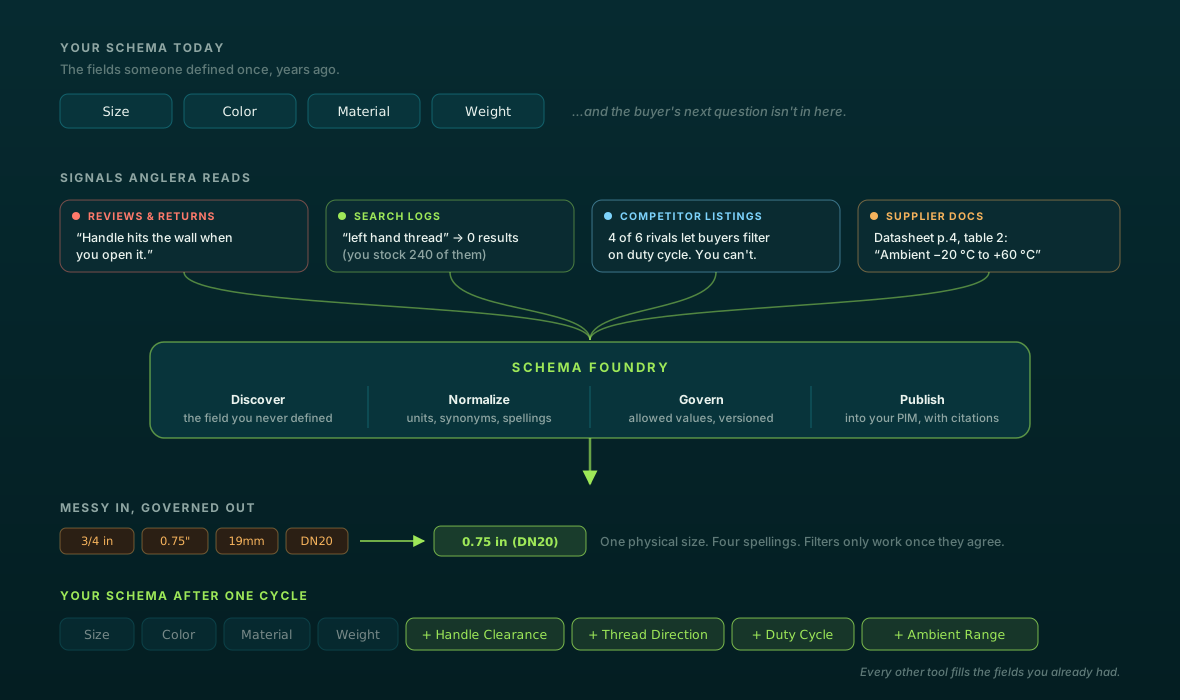
Neither platform, however, solves the upstream problem they share: product data arrives from suppliers as raw specs, inconsistent formats, and copy written for the factory floor rather than for how buyers actually search and compare. Both give you a well-governed, well-connected place to store and distribute that content. Neither automatically makes it buyer-ready. That enrichment work still happens manually — or it does not happen at all, and the catalog underperforms.
| Salsify | Stibo Systems | Anglera | |
|---|---|---|---|
| Platform type | Product Experience Management (PXM) — centralized PIM for brands, distributors, and retailers with a built-in digital shelf syndication network. Design emphasis is on authoring product content and activating it at retail accounts and marketplaces. | Enterprise Master Data Management (MDM) and PIM. STEP governs product, customer, supplier, location, and asset data under a unified data model. Gartner Magic Quadrant Leader for MDM. The core job is authoritative data governance across domains, not just product content. | Enrichment layer — not a PIM or MDM. Reads from Salsify or STEP via API, enriches every SKU against buyer signals, and writes results back to whichever system is the record of truth. |
| Data governance & MDM scope | Product-domain PIM with workflow approvals and content completeness scoring against retailer requirements. Governance is focused on product content quality — not multi-domain MDM. Customer, supplier, and financial master data live in other systems. | True multi-domain MDM. STEP governs product alongside customer, supplier, location, and digital asset data in a single platform, with audit trails, role-based governance, and configurable data stewardship workflows. The breadth of domain coverage is its primary differentiator. | Adds a data quality and enrichment layer specifically on the product data domain — filling attribute gaps, normalizing content, and scoring completeness before attributes are committed to the golden record in STEP or the Salsify product sheet. |
| Syndication & digital shelf | Strong built-in syndication network connecting directly to major retailers, marketplaces, and digital channels. Syndication is a core selling point — the platform is designed to push brand content to retail accounts at scale and to measure how it performs on the digital shelf. | STEP includes syndication capabilities and integration tooling, but syndication is more commonly used to push data to downstream enterprise systems rather than to manage direct retail content relationships. Digital shelf activation is not STEP's primary differentiator. | Does not syndicate. Enriches the attributes and copy that Salsify's network or STEP's integration layer then distributes — so what flows out to retail partners and downstream systems is buyer-ready from the start. |
| Implementation timeline & effort | Weeks to a few months for standard setups; complex catalog configurations take longer. Third-party consulting is the reported norm, adding roughly $16,000 or more to project cost before go-live. | Measured in months, often quarters. A systems integrator is almost always required for STEP. Configuring a multi-domain data model, migrating legacy data, and building governance workflows into an enterprise stack takes time by design. Large enterprises should plan for this upfront. | ~30 days from kickoff to enriched SKUs written back to the PIM. Runs on top of whichever platform is already deployed — no migration, no platform change required. |
| Pricing | Quote-based; no public pricing. Scoped by user count, SKU volume, and feature tier. Consulting at implementation adds $16,000 or more to the total cost of ownership. Reviewers consistently flag Salsify as expensive relative to alternatives. | Custom enterprise pricing. Scoped by users, data volume, and modules. As a flagship MDM platform sold into large enterprises, STEP typically ranks among the larger software investments in a data infrastructure stack. No public pricing. | Separate, SKU-volume-based subscription. Layers onto the existing platform investment rather than replacing it. |
| Enrichment capability | AI-assisted content authoring and completeness scoring against retailer requirements are built in. Helps teams improve content against partner scorecards; teams still review and approve copy. Does not autonomously research and fill missing attributes from external sources. | Data quality and matching tools are available within STEP; stewardship workflows help teams identify and resolve data gaps. These tools operate on data already in the system — they do not crawl external sources, infer missing attributes from buyer behavior, or write product copy. | Core product. Crawls supplier sites, competitor pages, and spec sheets; infers missing attributes; scores every SKU against real buyer signals; and writes enriched content back to Salsify or STEP via API. No copywriter in the loop. |
| Best fit | Brands, distributors, and mid-to-large retailers whose primary pain is authoring and syndicating product content to digital channels — particularly those managing content relationships with major retail accounts where completeness scores and digital shelf visibility drive revenue. | Large enterprises — manufacturing, retail, pharma, financial services — running complex, multi-domain data environments where a single authoritative system of record for product, customer, supplier, and other master data domains is a strategic priority alongside channel output. | Any B2B distributor, retailer, or manufacturer with an existing PIM or MDM who needs richer, buyer-ready product content without switching platforms. |
How to choose between Salsify and Stibo Systems
Choose Salsify if your primary pain is the digital shelf. You are a brand, distributor, or retailer whose core problem is getting accurate, complete, on-brand product content to Amazon, Walmart, major retail partners, and your own digital channels — and measuring how it performs once it is live. Salsify's syndication network, retailer scorecard tooling, and PXM workflow are purpose-built for that job. If your team spends significant time managing content relationships with retail accounts, Salsify's brand-to-retailer workflow tends to fit better than a general-purpose MDM platform.
Choose Stibo Systems STEP if you are a large enterprise with multi-domain data governance requirements that extend well beyond product content. STEP is the right choice when the problem is not just managing product data but governing product, customer, supplier, location, and asset data in a single authoritative system — with audit trails, stewardship workflows, and an enterprise data model that can be configured around your specific domain complexity. If your organization needs a platform that a Fortune 500 data governance team and a systems integrator can build an enterprise data strategy around, STEP is purpose-built for that scope.
A few signals that clarify the choice:
- If your team's primary metric is digital shelf content completeness and retailer scorecard performance, Salsify's native tooling is more directly useful than STEP's governance capabilities.
- If your data complexity spans multiple domains — customer master, supplier master, product master — and governance failure across any of them creates compliance or operational risk, STEP's multi-domain MDM scope addresses the problem at the right level.
- If implementation timeline matters: Salsify can be live in months; STEP implementations are measured in quarters. Build that difference into your project plan and total cost of ownership model.
- If you are a mid-market company that does not have a systems integrator relationship and needs to move quickly, Salsify is more accessible. STEP is designed for enterprise deployments with dedicated implementation teams.
- Both require a sales conversation before you see a real number — plan for a discovery process with each vendor before committing to a shortlist.
Whichever you pick, the data still has to get done
Salsify and Stibo Systems both assume your product data is already enriched — complete attributes, buyer-ready descriptions, titles written for how shoppers actually search. In practice, data arrives from suppliers as raw spec sheets, inconsistent field names, and copy written for procurement teams rather than for a product detail page. Both platforms give you a well-governed, well-connected place to store and distribute that content. Neither automatically makes it better.
Anglera is the layer that does that work. It connects to your Salsify instance or your STEP environment via API, reads your existing SKUs, enriches every attribute and description against buyer signals — how your customers actually search, compare, and filter — and writes the improved content back to the same PIM or MDM record. Your system of record stays in place. The enrichment quality lifts across the catalog. The content Salsify then syndicates to retail partners, or that STEP then distributes to downstream enterprise systems, is buyer-ready from the start rather than buyer-ready after a manual copywriting sprint.
Implementation is roughly 30 days regardless of which platform is already in production. Anglera does not require a platform migration, a new data model, or a systems integrator. Whichever platform you choose — or if you are upgrading from one to the other — Anglera runs alongside it and makes the data inside it better.
Frequently asked questions
What is the main difference between Salsify and Stibo Systems?
Salsify is a Product Experience Management (PXM) platform built around digital shelf activation — authoring product content and syndicating it to retailers and marketplaces. Stibo Systems makes STEP, an enterprise Master Data Management (MDM) and PIM platform that governs product, customer, supplier, and other master data domains in a single system. Salsify is narrower in scope and faster to implement; STEP is broader in domain coverage and designed for large-enterprise data governance programs that extend well beyond product content.
Is Stibo Systems a PIM or an MDM?
Both. STEP is first and foremost an enterprise MDM platform — Gartner recognizes it as a Magic Quadrant Leader in that category — but it includes PIM capabilities as part of the product domain. The distinction matters: if you need only PIM, STEP's scope and implementation complexity may exceed what the problem requires. If you need multi-domain MDM that also handles product data, STEP is designed for that. Salsify covers only the product domain.
Can a mid-market company realistically deploy Stibo Systems?
It is possible but uncommon. STEP's implementation model — custom enterprise pricing, months-to-quarters timelines, and an almost-always-required systems integrator — is calibrated for large enterprises with the resources and project bandwidth for that kind of deployment. Mid-market companies that need a PIM focused on product content and digital channel distribution typically find Salsify or a comparably scoped PIM a faster and more cost-efficient fit.
How does Anglera work with Salsify or Stibo Systems?
Anglera connects to your PIM or MDM via API, reads your existing SKUs, runs enrichment against buyer signals — how your customers actually search, compare, and filter — and writes the improved attributes and copy back to the same record. No platform migration is required. Anglera works alongside whichever system is already your source of truth and typically activates in roughly 30 days. Your Salsify or STEP environment stays exactly as configured; the product data inside it gets better.
Do I need a separate enrichment tool if I already have Salsify or Stibo Systems?
For most B2B distributors and manufacturers, yes. Both platforms manage and distribute product data, but neither autonomously enriches it. Salsify's AI tools help teams improve content against retailer scorecards; STEP's data quality tools help stewards resolve gaps — but in both cases, someone still has to do the research and write the content. Anglera automates that upstream work: crawling sources, filling missing attributes, scoring completeness against buyer behavior, and writing results back to the PIM. The system of record gets better content, not just better organization.