Stibo Systems vs Syndigo: Enterprise MDM or Content Network?
Stibo Systems and Syndigo both touch product data at enterprise scale. The similarity ends there.
Stibo Systems STEP is an enterprise Master Data Management platform — the authoritative system of record not just for product, but for customer, supplier, financial, and location data across every domain. Its Gartner Magic Quadrant Leader positioning is for MDM, not just PIM. The pitch is trusted master data across the enterprise, governed with workflows, data modeling, and multi-domain synchronization. Syndigo is a Product Experience Cloud: a combined PIM, DAM, content syndication, and compliance engine whose defining asset is its distribution network — 2,500+ retail and GDSN recipients inherited from the 1WorldSync acquisition, with 10,000 data validations and 23,000 retailer-specific requirements built in. Its pitch is one hub, every channel.
The comparison matters most for large brands and manufacturers with two overlapping problems: complex data governance across multiple domains and high-volume retail content distribution. Understanding which problem is primary — and whether one platform can realistically address both — is what this page is designed to help clarify.
| Stibo Systems | Syndigo | Anglera | |
|---|---|---|---|
| Primary orientation | Enterprise MDM — a multi-domain system of record for product, customer, supplier, financial, and location master data; PIM is one domain within a broader governance architecture | Product Experience Cloud (PXM) — combines PIM, DAM, syndication, and compliance tooling into a content supply chain platform; primary value is getting brand content to retail endpoints at scale | Enrichment layer — not a PIM, MDM, or syndication platform; reads from whichever system is the source of record, enriches every SKU against buyer signals, and writes results back |
| Data domain coverage | Multi-domain: product, customer, supplier, financial, and location data all governed from a single platform; suited to enterprises where product data is one of several master data problems | Product content only — deep coverage for product attributes, digital assets, and channel-specific requirements, but not designed to govern customer, financial, or supplier master data | PIM-agnostic — works on product data regardless of which platform governs it; no data model changes required on either side |
| Syndication and network reach | Syndication is available through connectors and built-in distribution capabilities, but network breadth is not the primary positioning; STEP is primarily a governance and management layer | One of the world's largest product content networks: 2,500+ retail and GDSN recipients post-1WorldSync acquisition; distribution compliance at scale is a core native capability, not an add-on | Does not syndicate — enriches the product content that Stibo or Syndigo then governs and distributes |
| Retail compliance and validation | Configurable governance workflows, data quality rules, and matching and linking logic across domains; compliance is enforced through internally defined rules rather than a pre-built retailer requirement library | 10,000 data validations and 23,000 unique retailer-specific requirements built into the platform; content is checked against actual trading partner specs before it leaves the network | Works upstream of compliance — enriches attributes and copy to be complete and buyer-ready before validation runs; reduces the failure rate going into Syndigo's validation layer |
| Enrichment capability | AI-assisted data classification, attribute extraction, and data quality scoring within the MDM; enrichment is governed through workflow and review cycles; content authoring is not a core STEP use case | Content completeness scoring, AI-assisted copy tools, and retailer readiness checks built into the platform; enrichment is checked against channel requirements; teams still author and approve final content | Autonomous enrichment driven by buyer signals — how real buyers search, compare, and filter — not reformatted supplier data or internal schema rules; writes results back to the source PIM or MDM without a copywriter in the loop |
| Implementation complexity and cost | Custom enterprise pricing; implementation typically takes months and almost always requires a certified systems integrator; scoped by users, data domains, modules, and data volume | Custom enterprise pricing; no public tiers; third-party estimates place TCO $10,000–$30,000 higher per year than smaller PIM alternatives for mid-market buyers; complex onboarding tied to network configuration and retailer setup | ~30 days from kickoff to enriched SKUs written back to the platform; no platform migration required; layers onto the existing STEP or Syndigo investment |
| Best fit | Large enterprises with multi-domain master data complexity — global manufacturers, retailers, or distributors that need a governed system of record spanning product, customer, supplier, and financial data | Brands and manufacturers whose primary pain is retail distribution and compliance at scale — particularly those syndicating to CPG, grocery, and GDSN channels requiring precise retailer content specifications | Any B2B distributor, retailer, or manufacturer on either platform who needs richer, buyer-ready product content without switching their system of record |
How to choose between Stibo Systems and Syndigo
Choose Stibo Systems if your problem is enterprise master data governance that spans more than just product. If your organization needs a single authoritative system of record across product, customer, supplier, financial, and location data — and the complexity of your data environment is multi-domain, not just multi-channel — STEP is designed for that scope. Stibo's Gartner Magic Quadrant Leader position in MDM reflects its strength in large enterprises where product data governance is one part of a broader data architecture problem. Budget and timeline accordingly: custom pricing, months-long implementations, and an SI engagement are the norm. If you are evaluating STEP specifically for PIM, weigh whether the MDM breadth adds cost without adding value for your use case.
Choose Syndigo if your primary problem is distributing compliant product content to retail and GDSN endpoints at scale. The 2,500+ recipient network, 10,000 data validations, and 23,000 retailer-specific requirements are not configuration options — they are built-in infrastructure that brands and manufacturers syndicating to major grocery, club, and mass-market retailers genuinely need. If your content team spends time manually reformatting product data to meet retailer scorecards, or if GDSN compliance is a recurring operational cost, Syndigo's purpose-built tooling for that workflow has no direct equivalent in a pure MDM platform. For mid-market buyers, factor in the TCO premium versus smaller PIM alternatives.
A few signals that clarify the choice:
- If your data governance problem spans customer data, supplier data, and financial master data alongside product — not just product — Stibo's multi-domain MDM is the right scope; a PXM platform will not cover those domains.
- If your team submits product content to 10 or more retail trading partners with distinct specification requirements, Syndigo's pre-built retailer library saves significant manual mapping work.
- If GDSN compliance is a hard requirement for your business, Syndigo's 1WorldSync network integration is a specific structural advantage.
- If budget is a constraint, note that both require a sales conversation before you see a number — and both carry implementation costs that dwarf the subscription in year one.
Whichever you pick, the data still has to get done
Both Stibo Systems and Syndigo assume your product content is already enriched before it enters the platform. Stibo's governance workflows organize, model, and distribute master data — but they do not write better attributes or research how buyers actually search. Syndigo's 10,000 data validations check whether your content meets retailer format requirements — they do not check whether the content is accurate, complete from a buyer's perspective, or written in the terms buyers use when comparing products. A product that passes Syndigo's compliance checks can still convert at a fraction of its potential if the title, description, and attributes were built around supplier language rather than buyer intent.
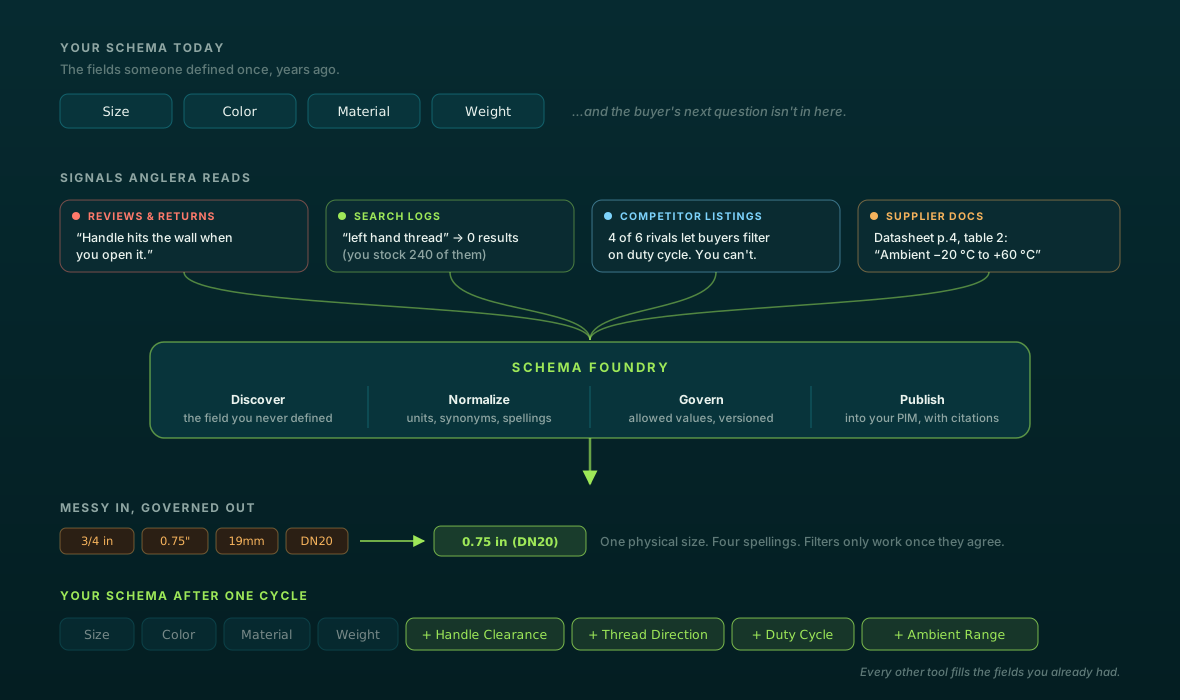
Anglera is the layer that closes that gap. It connects to your PIM or MDM via API, reads your existing SKUs, enriches every attribute and description against buyer signals — how your customers actually search, compare, and filter — and writes the improved content back to the same record. Stibo then governs and distributes enriched content. Syndigo validates and syndicates content that was buyer-ready before it hit the network. The system of record stays unchanged. Implementation is approximately 30 days with no platform migration required.
Frequently asked questions
What is the main difference between Stibo Systems and Syndigo?
Stibo Systems STEP is a multi-domain enterprise MDM platform — designed to be the system of record for product, customer, supplier, financial, and location data across the enterprise. Syndigo is a Product Experience Cloud: a PIM, DAM, and syndication platform whose defining asset is its retail content network (2,500+ recipients, 10,000 data validations, 23,000 retailer requirements). Stibo governs master data; Syndigo distributes product content at scale. They serve related but distinct problems.
Is Stibo Systems only for product data, or does it cover other data domains?
Stibo STEP covers multiple master data domains: product, customer, supplier, financial, and location data can all be governed from the same platform. This is what distinguishes it as an MDM platform rather than a pure PIM. For organizations whose data complexity is limited to product content and channel distribution, that broader scope may be more platform than the problem requires — and will likely reflect in implementation cost and timeline.
Can Syndigo serve as a full PIM, or is it primarily a syndication tool?
Syndigo includes PIM, DAM, MDM, and syndication capabilities as part of its Product Experience Cloud — it is not solely a distribution tool. That said, its primary differentiation is the breadth and compliance depth of its distribution network: 2,500+ retail and GDSN recipients with pre-built retailer specifications. Buyers who need a PIM primarily for internal content management and are not heavy retail syndicators may find Syndigo's TCO harder to justify without fully leveraging the network.
How does Anglera work with Stibo Systems or Syndigo?
Anglera connects to your PIM or MDM via API, reads your existing SKUs, enriches every attribute and description against buyer signals — how your customers search, compare, and filter — and writes the improved content back to the same record. For Stibo users, the enriched data goes back into STEP where it is governed and distributed. For Syndigo users, enriched content enters the compliance and syndication workflow buyer-ready, reducing validation failures and improving retailer scorecard performance. No platform migration is required; implementation is approximately 30 days.
Which platform is better for a brand that needs both data governance and retail distribution?
For most brands and manufacturers, this is a sequencing question rather than a binary choice. If multi-domain master data governance is the immediate priority — governing customer, supplier, and financial data alongside product — Stibo is better scoped for that problem. If retail content distribution is the immediate priority and you already have product data organized, Syndigo's network and compliance infrastructure delivers faster time-to-value for that specific use case. Some large enterprises run both: STEP as the MDM backbone and a distribution layer for retail channels. In either scenario, enrichment quality — the content going into both — determines how well the downstream platform performs.