
From tech packs and BOMs to attributes a planner can query
Tech packs and BOMs hold the truest product data in the company. Here's how to turn them into attribute columns a planning system can query.
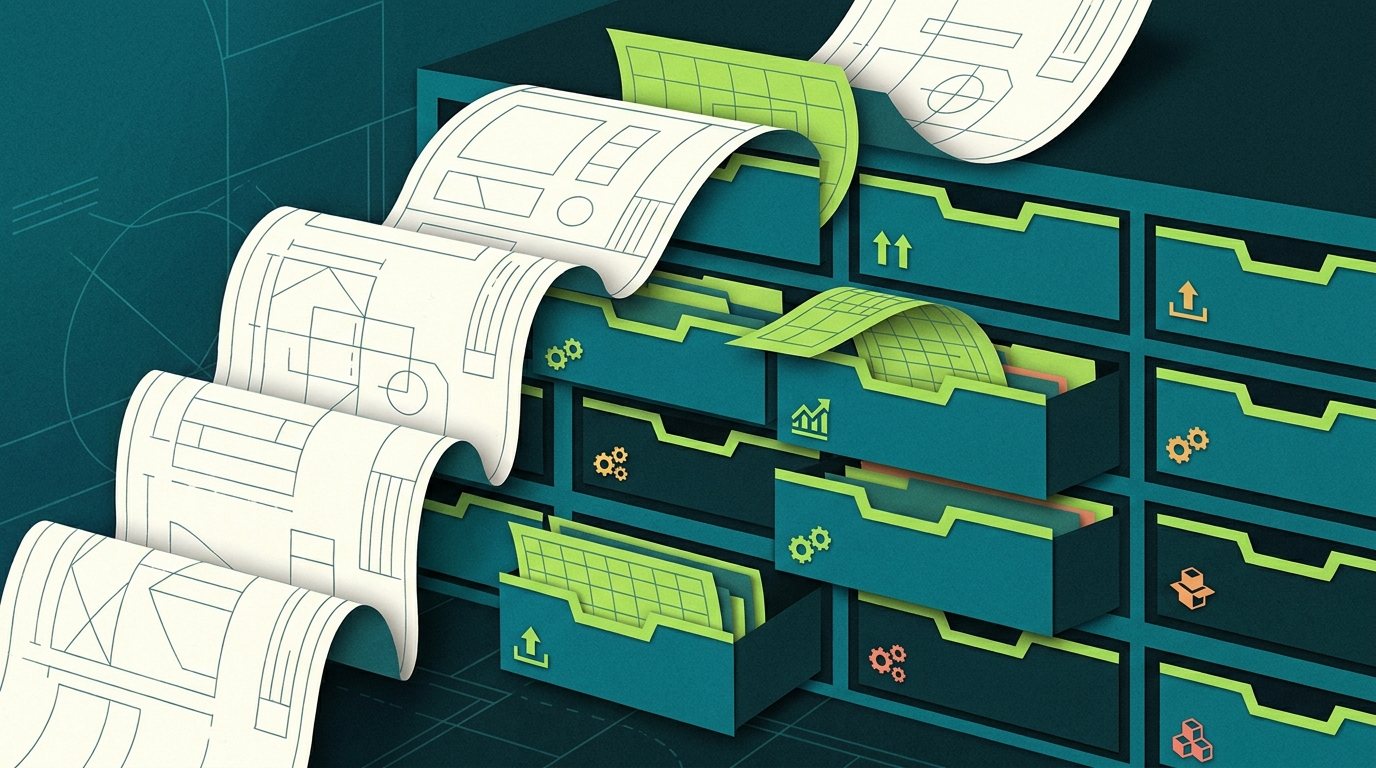
A bill of materials knows things nobody downstream bothers to ask it. Which fabric blend, in what GSM, from which mill. Whether the sole is a two-part EVA compound or a single-density unit. How many components go into a "simple" hardware kit. This is the most rigorous product description a company owns, and it usually lives as a PDF or a locked spreadsheet inside a PLM system, read by exactly the people who built the spec and nobody else.
Planning systems never see it. A demand planner working in a forecasting tool sees a SKU, a season, a channel, maybe a merchandise hierarchy three levels deep. They do not see "bonded seam construction" or "18mm buckle, zinc alloy." So when a planner forecasts a new style by finding similar past styles, they are matching on category and price point, because that's all the planning system has to match on. The tech pack that would tell them the new style is structurally closer to last year's bestseller than to the item next to it in the category tree never makes it into the comparison.
The document was never meant to travel
Tech packs and BOMs are built for a manufacturing audience: a factory, a QC team, a costing analyst. The format optimizes for a human reading top to bottom, not for a database reading a column. Materials show up in prose ("upper: full-grain leather with perforated toe box, lined in mesh"), measurements sit in a callout diagram rather than a field, and construction notes are annotations on a drawing. PTC's retail PLM team called this out directly when it introduced AI-driven tech pack automation in FlexPLM at NRF 2026, noting that turning design sketches into production-ready specs has historically been "a manual, error-prone process involving many handoffs between design and development teams." That's the PLM vendor's own read on its category, not a knock on any one brand's tooling.
The handoff problem doesn't stop at the factory. Centric Software, one of the category-defining apparel PLM platforms, describes the BOM as "a structured breakdown of all the parts, materials and other components needed to manufacture a finished product" and treats it as the fundamental blueprint a brand's teams should be working from (Centric Software, "What is a Bill of Materials"). That's correct as far as it goes. The gap is what happens next: the BOM stays a document, e-commerce copy gets written separately by a merchandiser summarizing "what it feels like," and planning inherits neither.
What extraction actually looks like
Turning a tech pack into something a planning system can query means parsing four categories of information out of unstructured documents and normalizing each into a governed attribute:
- Materials. Fabric content and blend ratios, weight (GSM or oz/yd²), finish, and treatment, pulled from spec sheets and material call-outs rather than left as a paragraph of prose.
- Construction. Seam type, closure mechanism, sole construction, lamination or bonding method — the details that predict fit, durability, and return rate, but that almost never show up in a product title.
- Dimensions. Measurements from the tech pack's point-of-measure diagram, converted into consistent units and mapped to a fixed schema (not "size chart as an image").
- Components. Every part in the BOM broken into a countable, categorizable line: hardware, trim, packaging inserts, each tagged with a material and a supplier reference where available.
None of this is guesswork. It's extraction from documents a technical designer already produced, run through document parsing plus a validation layer that checks extracted values against expected ranges and flags anything implausible for a human to confirm rather than silently accepting it.
The BOM as trust anchor
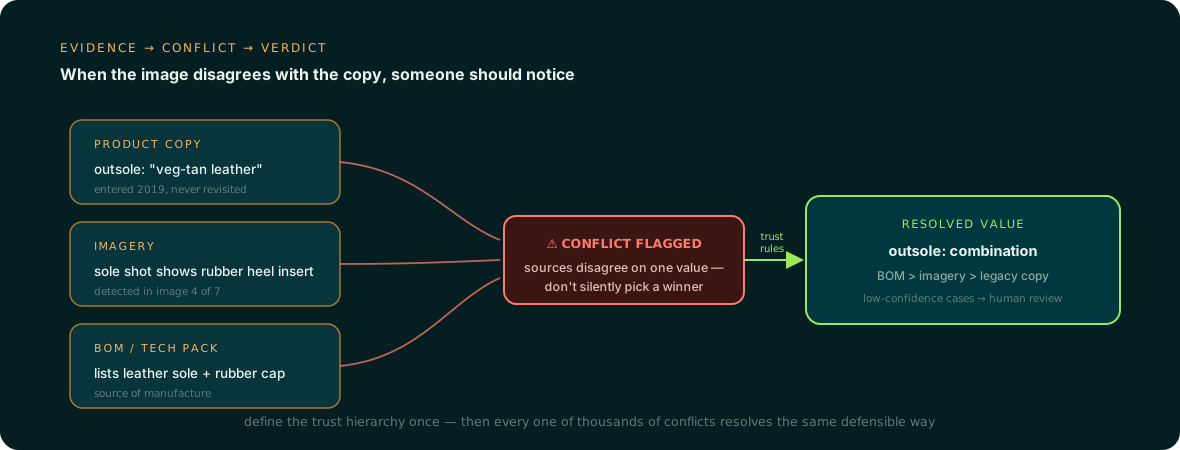
Every catalog with more than one data source eventually has a conflict. The PDP copy says "genuine leather." The BOM says "bonded leather, 70% split hide." A supplier spec sheet lists a zipper as YKK; the factory substituted a comparable part mid-run and nobody updated the record. When sources disagree about the same attribute, something has to decide which one wins, and that decision should be explicit rather than whoever edited the field most recently.
This is where a defined trust hierarchy earns its keep. The BOM, being the document the factory is contractually building to, generally outranks marketing copy and outranks a legacy ERP field hand-typed years ago and never revisited. Imagery can confirm or contradict a stated attribute (a "cotton canvas" tote that photographs like coated nylon is worth a second look) but rarely overrides a structured spec on its own. The point isn't that one source is infallible; it's that conflicts get surfaced and resolved against a rule set instead of getting silently overwritten by whichever system last touched the record.
Why planning needs this more than the PDP does
Search filters and product pages are the obvious beneficiary of clean attributes. But the more expensive failure mode is upstream, in planning. Attribute-based forecasting exists precisely because a brand cannot wait six months for sales history before deciding how much of a new style to buy. The standard technique is to find comparable past items and borrow their demand curve, or to cluster new items by shared attributes and forecast against the cluster, an approach ToolsGroup describes as using "statistically tested attributes" to feed predictive models when no direct sales history exists. Both techniques are only as precise as the attribute set behind them. If "similar" means "same category and similar price," the comparison is crude. If "similar" means "same sole construction, same material weight class, same closure mechanism," the comparison is doing real work, and that's exactly the vocabulary a tech pack already has and a planning hierarchy usually doesn't.
It's worth being honest about the limits here. Attribute-rich data improves the inputs to a forecast; it does not turn a model into a crystal ball, and no responsible vendor should claim otherwise. What it does is remove a common silent failure mode: a model quietly treating two structurally different products as comparable because the only attributes available to compare on were shallow ones.
Closing the loop
The underlying problem is drift, not any single bad field. PLM holds the engineering truth. E-commerce holds a marketing rewrite of that truth. Planning holds a third version, thinner than either, assembled from whatever made it into the ERP export. Each team edits its own copy and the three drift further apart every season.
The fix isn't picking one system as the permanent source and forcing the other two to read from it; PLM, e-commerce, and planning all need the attribute in different shapes, and none of them should be rebuilt to match another. It's maintaining one governed attribute layer, extracted from source documents and validated against a trust hierarchy, that all three can pull from and that gets re-validated whenever a new source document — a revised tech pack, an updated BOM, a supplier change — enters the system.
That's the mechanism behind Anglera: your PIM, PLM, or planning system keeps storing the data exactly as it does today. Anglera does the extraction, validation, and conflict resolution work of turning tech packs, BOMs, and spec sheets into attribute columns each system can actually query, so the number a demand plan is built on and the spec a factory is building to stop being two different stories about the same product.