
Demand forecasting in Consumer Electronics: the attribute layer your models are missing
Consumer electronics forecasts run on product attributes, not just sales history. See where thin or free-text specs quietly wreck accuracy.

A TV buyer opens next quarter's new-item file and finds forty SKUs with no sales history, a launch date six weeks out, and a spec sheet that calls one unit "OLED evo" and another "OLED, self-lit." The forecasting model doesn't know those are the same panel technology. It treats them as two unrelated new items with no comparable history, and the initial buy for both ends up wrong in opposite directions.
This is the quiet failure mode in consumer electronics planning. Nobody blames the forecast model when it's off by 30 points on a new soundbar. They blame "demand volatility" or "the category is just hard to predict." Often the real problem sits one layer down, in the attributes the model was fed before it ever ran.
Forecasting runs on rollups, and rollups run on attributes
A demand forecast is rarely built SKU by SKU from scratch. It's an aggregation: history gets grouped by category, subcategory, price band, brand tier, or feature set, a pattern gets fit to the group, and that pattern gets allocated back down to the SKU or location level. Every one of those grouping steps depends on an attribute value being correct and consistently structured. If "screen size" is stored as 55", 55 in, 55-inch, and diagonal 55 across four source systems, the rollup either fragments into four tiny buckets or silently drops units that don't match the expected format.
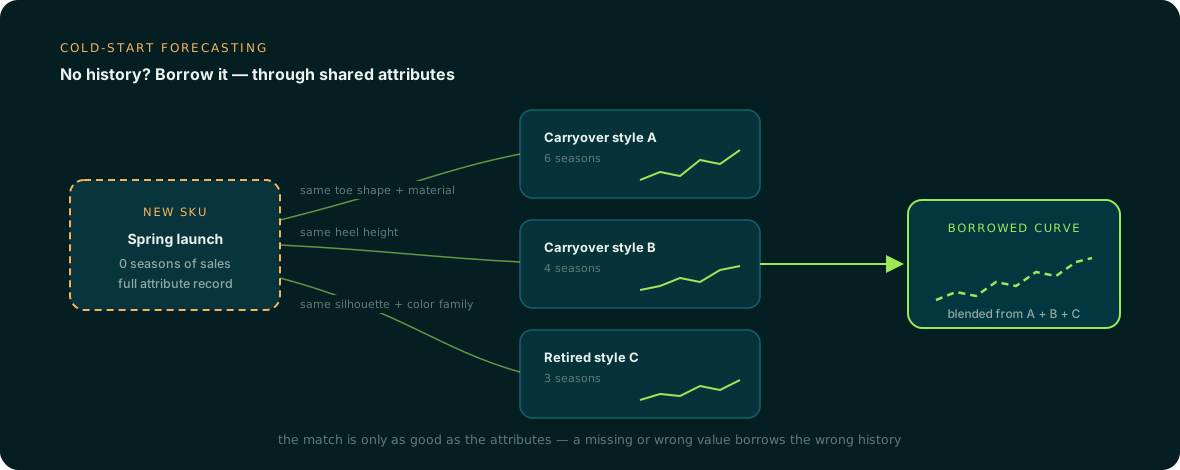
Electronics is a brutal category to run this against, because assortments turn over so fast. Global spending on consumer tech is projected near $1.29 trillion in 2025 as manufacturers keep pushing new configurations and successors (Consumer Electronics Market Report), which means a huge share of any given catalog is new-to-history at any moment. Attribute-based planning literature built for this industry describes the standard workaround directly: firms build "demand profiles...from historical sell-in and sell-through data reflecting a variety of demand and seasonal attributes," then assign a new item to the closest profile using attributes like panel type, region, and color rather than waiting for its own sales history to accumulate (Logility, on attribute-based planning for consumer electronics). That match is only as good as the attributes doing the matching.
Three attributes that quietly break electronics forecasts
Storage tier and RAM configuration. A phone or laptop line ships in three to six memory configurations at launch. If the enrichment source stores this as a free-text variant name ("Pro 256GB Midnight") instead of a structured pair of attributes (storage capacity, RAM), the model can't separate "this SKU underperforms because it's the base config" from "this SKU underperforms because midnight is an unpopular color." Every configuration gets forecast as if memory tier doesn't matter, which is exactly backwards for a category where storage tier is one of the strongest predictors of sell-through velocity and markdown risk.
Display and panel technology. OLED, mini-LED, QLED, and standard LED panels carry different price elasticity, different promotional cadence, and different seasonal lift around events like the Super Bowl or Black Friday. When panel type is buried in a marketing name instead of pulled out as a clean, standardized attribute, a planner grouping "premium TVs" for a seasonality model either lumps mini-LED in with basic LED (understating the premium tier's lift) or excludes OLED variants that were labeled inconsistently across vendors (undercounting the whole panel category's demand).
Connectivity and generation attributes. Wi-Fi 6 vs. Wi-Fi 6E, Bluetooth version, 5G band support, USB-C vs. Lightning: these look like footnotes, but they're often the actual driver of a refresh cycle's demand curve. A router or earbud line's forecast needs to know which generation each historical SKU belonged to in order to build a like-for-like comparison for the next generation. If that attribute lives only in a tech pack PDF that never made it into the PIM as a structured field, the model has no way to isolate the generation effect from noise.
The cost shows up as safety stock and markdowns, not as a forecasting error metric
New product launches are where this bites hardest. Consumer electronics forecasting has to lean on attribute-based analog matching precisely because there's no sales history yet, and industry guidance on demand forecasting for new introductions treats this as the default method rather than an edge case (AWS Prescriptive Guidance on forecasting new product introductions). When the attribute layer feeding that match is thin, wrong, or inconsistent, the model doesn't fail loudly. It fails quietly, by picking the wrong analog SKU and producing a demand curve that looks confident and is wrong.
That error then propagates two ways: understocked launches lose sell-through in the first critical weeks when a new product carries the highest margin, and overstocked launches slide into the markdown calendar early. Electronics markdown cadences are already aggressive by design, often stepping a product's price down every 30 days after launch as competitor releases and inventory position dictate. Bad initial demand signal just accelerates that slide. Returns compound it further: electronics return rates run around 11% online, driven by unclear specifications and mismatched expectations rather than fit or color the way apparel returns are (Capital One Shopping Research, average retail return rate) — and a return that gets restocked without its condition or configuration correctly re-tagged corrupts the next cycle's history too.
Attribute hygiene is a planning problem, not a merchandising nice-to-have
| Attribute state | What the forecast sees |
|---|---|
| Storage/RAM as free text in variant name | Configuration tiers blended into one undifferentiated demand curve |
| Panel type inconsistent across vendors | Premium and standard tiers over- or under-counted in seasonality models |
| Connectivity generation missing or buried in a PDF | No clean generation-over-generation comparison for new launches |
| Attributes standardized and validated | Like-item matching finds the right analog; rollups aggregate cleanly |
None of this requires ripping out the planning tool. Toolio, Blue Yonder, o9, Anaplan, and Impact Analytics all consume attributes as inputs; they don't generate the attributes themselves, and they're not built to reconcile a spec sheet against a tech pack against a legacy ERP field. That reconciliation work has to happen upstream, continuously, as new SKUs and new sources arrive.
This is the layer Anglera works on. It plugs into whatever PIM, MDM, or ERP already holds the catalog, pulls structured values for attributes like storage tier, panel technology, and connectivity generation out of tech packs, imagery, and spec sheets, and flags conflicting source values instead of silently picking one. Your PIM still stores the data and your planning tools still run the forecast. Anglera just makes sure the attributes feeding both are complete, standardized, and trustworthy enough for a rollup to mean what it says.