
How Bossard Wins Fastener Distribution Without Chasing Scale
Bossard ranks #14 on MDM's 2026 Top Distributors fasteners list. Its edge isn't branch count or vending fleets, it's engineering embedded in the part number.
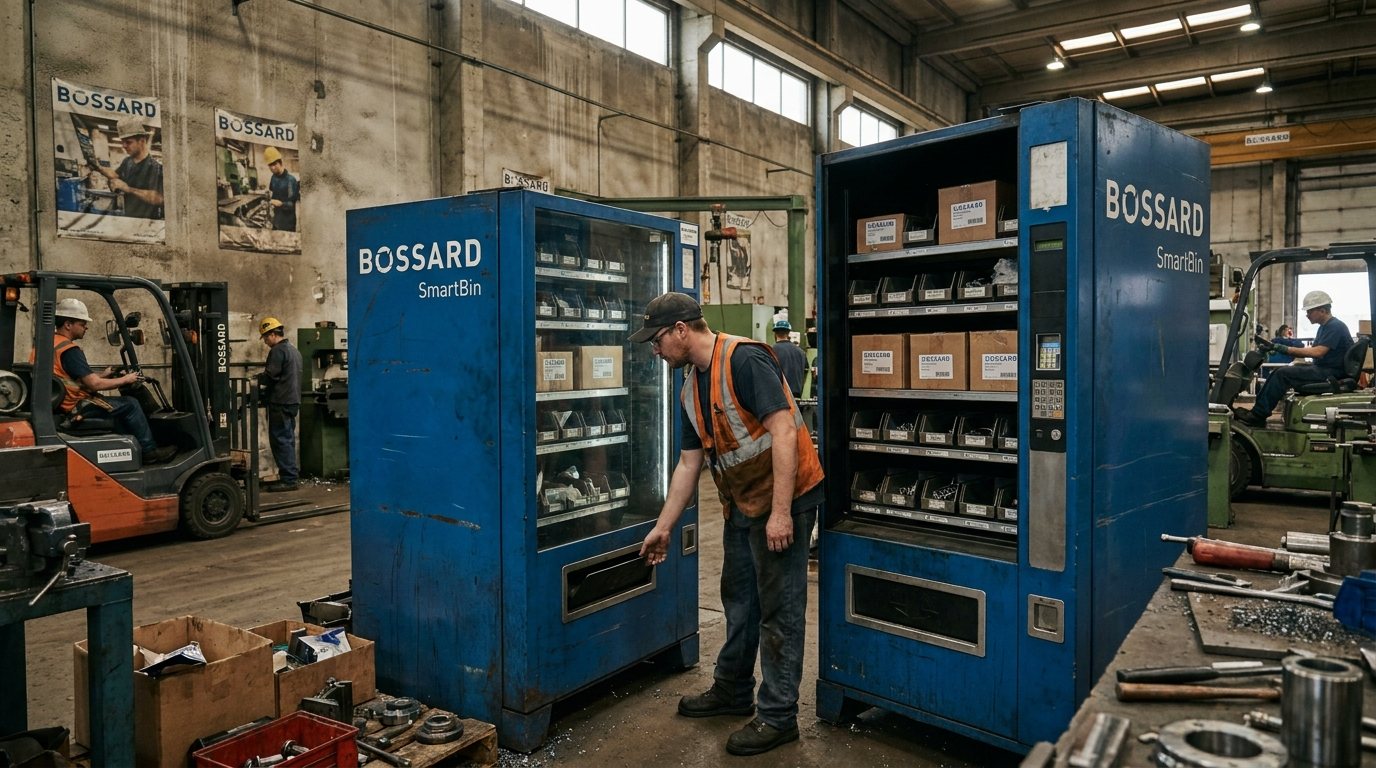
Part of Distributor Playbooks — strategy teardowns of every company on the MDM Top Distributors lists.
Bossard lands at #14 on Modern Distribution Management's 2026 Top Distributors list for fasteners, with roughly $275 million in FY2025 revenue for its North American arm. That number is a rounding error next to the parent company's roughly CHF 1.07 billion in global sales. The gap between those two figures is the whole story: Bossard runs one of the more disciplined roll-up engines in fasteners, and it has pointed almost all of it at Europe and aerospace, leaving North America to grow on engineering relationships instead of acquisitions.
A hardware store that narrowed itself into a specialist
Bossard traces back to 1831, when Franz Kaspar Bossard-Kolin opened a hardware store in Zug, Switzerland, built on capital from a silk-trading business he'd married into. For roughly a century it stayed a local operation. It didn't start trading fasteners specifically until the 1930s and 1940s, then spent the postwar decades building out from regional to national reach before expanding internationally in the 1960s, according to the company's own history as summarized on Wikipedia. It went public on the SIX Swiss Exchange in 1987.
The pivotal decision came a few years later. The early-1990s recession hit Bossard's diversified portfolio hard, and management responded by cutting the business down to one thing: fastening technology. Tools, fittings, and handicraft divisions were sold off. That narrowing is the reason a 195-year-old hardware store is now a company that talks about itself in terms of C-parts management and Industry 4.0 rather than nuts and bolts on a shelf.
The moat is the engineering, not the warehouse
Bossard America's own positioning makes the model explicit: Swiss precision, engineering services, and Smart Factory Assembly sit alongside the more than 200,000 standard and branded parts available through its eShop, sourced from a supplier base the parent company puts at 4,600 manufacturers worldwide. The pitch to a manufacturing customer isn't just "we stock the part." It's inventory and C-parts management woven into the customer's own production line, aimed at cutting time to market and total cost of ownership rather than just quoting a unit price.
That shows up in the industries Bossard chases in the Americas: aerospace, electric vehicles, data centers, robotics, semiconductors, medical devices. These are sectors where a fastener failure is a line-down event, not a shrug, and where a distributor that can co-design the fastening solution earns a different kind of relationship than one competing purely on price and delivery speed. Trade coverage from Global Fastener News has tracked this directly: Bossard's US sales growth in 2023 was explicitly tied to new customer projects at Tesla and other focus-industry accounts, not to opening more branches.
An acquisition engine that mostly skips North America
Bossard's growth-by-acquisition machine has been remarkably steady for over a decade, and remarkably concentrated in Europe and aerospace.
| Year | Acquisition | Region / focus |
|---|---|---|
| 2019 | BRUMA Schraub- und Drehtechnik | Germany, fasteners |
| 2020 | Torp Fasteners (to 100%) | Norway |
| 2021 | Jeveka B.V. | Netherlands, Benelux |
| 2022 | PennEngineering distribution business | Canada |
| 2024 | Aero Negoce International | France, aerospace logistics |
| 2024 | Dejond Fastening NV | Belgium, blind rivet nuts |
| 2025 | Ferdinand Gross Group | Germany, Eastern Europe |
Seven deals in six years, and only one of them, the 2022 PennEngineering Canadian distribution business, touches North America. Everything else has gone toward deepening Bossard's aerospace credentials and European density. Global Fastener News covered the North American deal under the headline "Bossard Looks to North America For Growth," which is notable mostly for how rarely that headline has needed writing since.
The result is a two-speed company. The European and aerospace side compounds through bolt-on M&A. The roughly $275 million Americas business compounds, when it compounds, by winning engineering-led programs organically, which also means it swings harder with the industrial cycle. Bossard's own quarterly reporting has shown that split plainly: 2023 brought US sales growth running near double digits on Tesla-linked demand even as skilled-labor shortages bit into fulfillment; by late 2024, coverage described Americas sales as declining amid "subdued" demand while Europe held steady and Asia grew; by April 2026, both the US and EU were reported growing again despite ongoing trade tensions. North America is the volatile leg of the stool.
The insight: a family name still on the door of a public company doing the rolling up
The detail worth naming directly is who's running this. Bossard has been listed on the SIX Swiss Exchange since 1987, and its fastener-distribution peers, Bufab, SFS Group, Würth, Distribution Solutions Group, are themselves aggressive consolidators. Yet the person leading Bossard's M&A strategy today, CEO Daniel Bossard, still carries the founding family's surname, 195 years after Franz Kaspar Bossard-Kolin opened that first hardware store. In a sector where private-equity-backed platforms and public conglomerates are the ones doing most of the buying, Bossard is unusual for being a public company that is still, at the top, a family name, and one that is doing the consolidating rather than being consolidated.
That combination, patient family-linked governance funding an active public-market acquisition strategy, is a large part of why Bossard can afford to let its smallest region grow slowly and organically while it builds share elsewhere. A company under quarterly activist pressure to hit a growth number in every geography every year would be far less comfortable with an Americas unit that occasionally shrinks. Bossard has stayed comfortable with it for at least three years running.
Distribution's biggest advantages rarely announce themselves. They live in the branch network nobody sees, the catalog nobody reads cover to cover, and the ownership structure nobody asks about until the numbers stop making sense without it.