
Richards Building Supply: Staying Family-Owned in a Rollup Era
How Richards Building Supply grew from one Chicago branch to 60+ locations while staying family-owned as rival distributors sold to Home Depot and QXO.
Part of Distributor Playbooks — strategy teardowns of every company on the MDM Top Distributors lists.
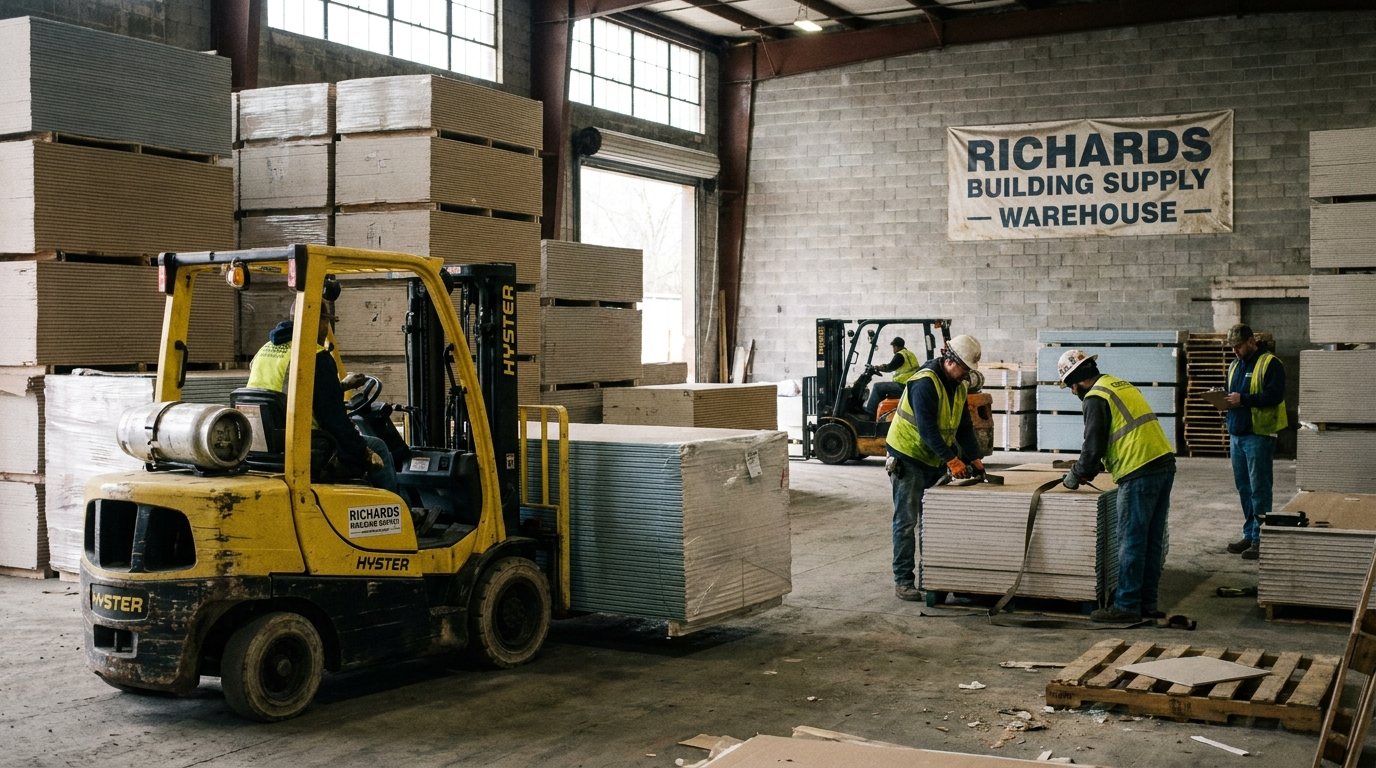
In 1978, Richard J. Guzior split off from a Chicago roofing distributor where he'd started in the shipping department and, with a business partner, opened Richards Building Supply. Forty-eight years later the company he built ranks #20 on Modern Distribution Management's 2026 Top Distributors list for building materials, with an estimated $1.0 billion in FY2025 revenue per MDM's data. What makes Richards worth studying isn't the size. It's the ownership structure that size usually erases.
The buyout that set the trajectory
Guzior and co-founder Richard Sawilchik split duties from day one: Guzior ran sales and operations, Sawilchik ran accounting and credit. That lasted eight years. In 1986, with seven children at home, Guzior bought out his partner and became sole owner, a bet that concentrated both the upside and the risk on one family. His stated logic, according to the company's own about page, was blunt: "if you're not growing, you're at risk of dying." From eight locations at the time of the buyout, Richards has expanded to more than 60 branches across 16 states, covering the West, Midwest, North, and Southeast, stocking roofing, siding, windows, doors, decking, cabinets, and rainware for exterior contractors.
The company grew almost entirely through the same playbook other family distributors use: dense branch coverage in one region, then adjacency expansion, with occasional bolt-on acquisitions rather than a rollup strategy. A 2015 purchase of Eastern Aluminum Supply pushed it further into the Northeast. The pace picked up rather than slowed as the founder aged out of daily operations, which is the opposite of what typically happens to founder-led distributors.
Succession without a sale
Most distribution founders eventually face a choice between passing the company to family or selling to a strategic or private equity buyer. Richards chose the first path deliberately. Christine Guzior, Richard's wife, became Chairman. Son Ronald M. Guzior was named CEO and President in 2019. All seven of the Guzior children hold roles inside the business today. The family also built a philanthropic arm, the Guzior Family Foundation, established in 2005, funded by the same balance sheet that funds branch expansion.
That succession model matters more than it looks like on an org chart, because of what's happening around Richards in its own vertical.
The insight: a family business in a sector being bought up around it
Roofing and exterior building materials distribution has consolidated hard in the past two years, and the buyers have not been other family businesses. Home Depot completed its $18.25 billion acquisition of SRS Distribution in June 2024, folding one of the largest specialty trade distributors into a public retail giant. Ten months later, QXO completed its roughly $11 billion acquisition of Beacon Roofing Supply at $124.35 a share, after Beacon's board spent months rejecting the offer before relenting, making QXO the largest publicly traded roofing and waterproofing distributor in the country. Two of the biggest names in the vertical that Richards competes in went from independent to institutionally owned inside a single year.
Richards did not follow. In April 2026, when it acquired United States Building Supply, a four-location Colorado distributor covering Denver, Colorado Springs, and Loveland, CEO Ronald Guzior framed the deal explicitly around ownership structure rather than scale: "This acquisition represents another win for family-owned and operated independent distributors." USBS owner Dewey Lane stayed on with the company rather than cashing out and exiting. That is a small transaction next to $11 billion and $18 billion deals, but it is a signal about what kind of buyer Richards intends to be, and what kind of seller it looks for. It is picking up other family operators who want a family successor, not a financial sponsor.
The tension worth naming plainly: staying private and family-run means Richards cannot match QXO's or Home Depot's balance sheet in a bidding war for the next mid-size regional distributor. Capital-intensive scale plays, national account contracts, and cross-market vending programs are easier to fund with public or PE money. But the same structure gives Richards something its newly-owned competitors have to work to fake: a seller on the other side of a handshake deal who trusts that the acquiring name on the building will still answer to a family, not a portfolio manager three ownership layers removed. In a vertical where the two largest independents just disappeared into bigger balance sheets, that trust is becoming a scarcer asset than capital.
Betting on the contractor relationship, not just the branch
Richards has also pushed further into the software layer of the contractor relationship than most distributors its size. It built and gives away RBS CRM, a free platform for exterior remodeling and builder contractors covering lead management, estimating, job costing, and project scheduling. That is a distributor trying to make itself sticky through the software its customers run their businesses on, not just the truck that shows up with material. It is a smaller bet than a $10 billion acquisition, but it points at the same instinct that built the company: make the customer relationship the asset, and let the balance sheet follow.
Distribution is won branch by branch, catalog line by catalog line, and relationship by relationship long before it shows up in an MDM ranking. This series looks at the operators who've made that unglamorous machinery their edge.