
One enriched catalog, every wholesale partner
Thin product data forces every wholesale partner to re-key your catalog differently. An enriched, attribute-complete dataset fixes that once.

A regional buyer opens the spec sheet a brand just sent over: a product name, a wholesale price, a case pack, and a paragraph of marketing copy. No fiber content in a structured field. No fit notes. No certifications called out anywhere a system can read them. So the buyer's merchandising team does what every merchandising team does with a thin file: they fill it in themselves, in their own words, against their own template. Multiply that by forty retail partners and the same product ends up with forty slightly different descriptions, forty different size logics, and at least a few outright errors that never make it back to the brand that made the thing.
This is the quiet cost of wholesale distribution. A brand can nail its own product data and still lose control of how the product looks everywhere it's actually sold, because the brand doesn't own the last mile of merchandising. The partner does.
Thin data doesn't stay thin, it gets rewritten
When a brand hands a retail partner a spreadsheet with gaps, the partner doesn't leave the gaps blank. Onboarding a new SKU into a retailer's system means fitting it into that retailer's category tree, mandatory fields, and image specs, and someone on the partner side has to make judgment calls about anything the brand didn't specify. One retailer decides "water-resistant" belongs in the description. Another invents an attribute for it. A third skips it entirely because nobody on their catalog team had the tech pack in front of them. None of this is malicious. It's just what happens when structured facts are missing and a human has to improvise a template deadline.
The result shows up as brand inconsistency the brand rarely sees directly, because it's scattered across other companies' storefronts. A 2025 product experience report cited by Syndigo found that incomplete data pushes a large share of shoppers toward a negative view of the brand behind it, and estimates businesses lose real revenue annually to inconsistent or incomplete product data. That's not one bad listing. That's compounding damage across every partner who had to guess.
Retailers themselves aren't the villain here, and standardizing across all of them isn't as simple as it sounds. As one industry analysis put it, product data syndication stays messy partly because a fashion retailer wants fabric composition and size charts while an electronics retailer wants battery specs and compatibility codes, and partly because brands have historically resisted normalized data out of fear it flattens their differentiation. Even the industry's attempt at a shared backbone, GS1's Global Data Synchronization Network, runs on a standard covering thousands of attributes across a network of tens of millions of registered items — and still, individual data pools layer on their own "top off" fields that don't travel between systems. Full standardization across every wholesale channel isn't coming. What's within a brand's control is the quality and completeness of the one dataset it sends out.
Treat the catalog as a syndication asset, not a one-time export
The fix isn't asking retail partners to agree on a shared schema. It's giving every partner a dataset so complete that there's nothing left to improvise. Fiber content, care instructions, fit and sizing logic, certifications, country of origin, dimensions, hazard or compliance flags — extracted once from tech packs, spec sheets, and imagery, validated against the source, and mapped into whatever structure each partner's system expects.
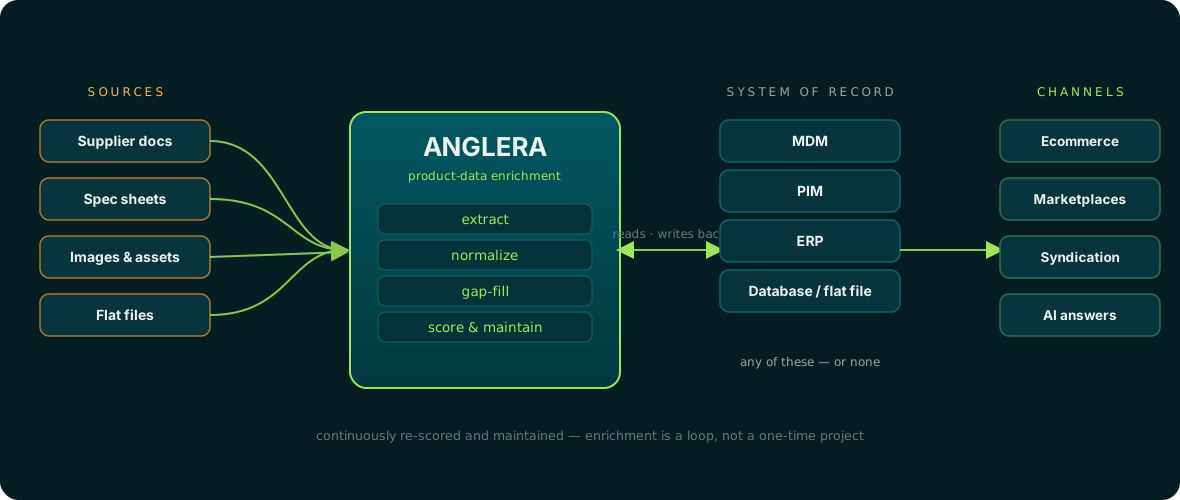
That mapping step matters more than it sounds like it should. Two retailers can both want "sleeve length," and one wants it in inches as a number, the other wants it as a size-chart row inside a text block. The underlying fact doesn't change; the shape it needs to arrive in does. Once a brand's attributes exist as clean, validated values rather than a paragraph of prose, remapping them into a new partner's template is a data operation, not a rewrite-the-copy-from-scratch project. That's the difference between a new wholesale account launching in days versus weeks, and it's also the difference between a partner's on-site filters actually working ("100% recycled nylon," "UPF 50+," "machine washable") versus silently disappearing because the field behind them was empty.
| Thin data handed to partners | Enriched, attribute-complete dataset | |
|---|---|---|
| New partner onboarding | Partner re-keys and guesses at gaps | Attributes map directly into partner's template |
| Product description on partner sites | Varies by whoever filled it in | Consistent facts, partner-specific copy layered on top |
| On-site filters (material, fit, certification) | Break or return zero results | Populate correctly because the field has a value |
| Brand control over how the product reads | Lost after the file leaves the brand | Retained at the source, re-syndicated on change |
The planning payoff: comparable sell-through, finally
There's a second reason this matters that has nothing to do with how the product looks on a partner's site. Every wholesale brand wants to compare sell-through across accounts — is the same style moving faster through outdoor specialty than through a big-box channel, and by how much. That comparison only works if the product is described the same way everywhere it's sold. If one partner tags a shoe's width as "wide" and another logs it under a completely different field, or skips it, a planner trying to roll up sell-through by width, by fabric, or by certification is aggregating apples against unlabeled fruit. The forecast doesn't fail loudly. It just quietly weights toward whichever channel happened to keep cleaner records, and nobody notices until the reorder is wrong.
An attribute set that's complete and consistent at the source is what makes cross-channel sell-through actually comparable, because every partner is reporting against the same underlying facts even if their storefronts look nothing alike.
Anglera doesn't build the retailer connections or run the syndication pipes — that's what a PIM or a distribution platform is for. What it does is make sure the data going into that pipe is complete, accurate, and consistent before it ever reaches a partner, working from tech packs, imagery, spec sheets, and whatever's already in a brand's PIM or a flat CSV export. Get that right once, at the source, and every partner downstream inherits a catalog worth building on instead of one they have to fix themselves.