All comparisons
Works with EtilizeSyndication & feeds

Anglera + Etilize

The bottom line

Keep Etilize if you sell mainstream IT/CE and need instant baseline datasheets at feed scale — no one hand-authors 20 million tech SKUs. Add Anglera to own what the pool cannot give you: coverage of the unmatched half of your item file, values normalized to your governed vocabulary with provenance, and shelf copy that is yours alone instead of the paragraph every competitor pastes.

Etilize and Anglera solve different halves of the problem — this page is about the seam between them.
The frame for this comparison

Product data is a practice, not a project.

Etilize's question is whether a matched pool record exists for this MPN and whether last night's feed delivered it in your taxonomy — the pitch is standardized, retail-ready datasheets syndicated to a network of 70,000 channel partners; Anglera's question is whether your page for that MPN says anything the other 70,000 endpoints' pages don't, and what happens to the thousands of line items in your file the pool has never heard of — work that recurs with every supplier reissue, not a feed you switch on.

01

Ground it

Mine every spec from every source.

Every value traced to a document you can open. The catalog is only as honest as what it was built from.

02

Align it

Aim the catalog at the buyer who actually buys.

Grounded data still loses if it answers questions nobody asked. Alignment is what turns specs into conversion.

03

Keep it alive

Product data is a practice, not a project.

Markets move, suppliers reissue, buyers change what they ask for. A catalog that is right in March is wrong by August unless something is watching.

Capability by capability

Where Etilize stops.

Scored against public documentation. Grouped by the three acts — so you can see which ones Etilize leaves on your desk.

01

Ground it

Mine every spec from every source.
Source mining
Where does it get specs from?
EtilizeLimited

Content teams standardize manufacturer submissions; pool SKUs only

AngleraYes

PDFs, spec tables, drawings, manuals, images, sites

Schema discovery
Does it find attributes that aren't in your schema yet?
EtilizeNo

Fixed per-category spec templates; no new attribute discovery

AngleraYes

Proposes fields your schema never had

Governed vocabulary
Does it turn messy free-text into a governed pick list?
EtilizeLimited

Normalized to their taxonomy, not your governed lists

AngleraYes

Normalizes and governs allowed values, versioned

Taxonomy & classification
Can it classify every SKU into your hierarchy?
EtilizeLimited

Standard categories; mapping to distributor taxonomies offered

AngleraYes

Auto-classifies; channel and marketplace mapping

Citations & provenance
Can you see where any given value came from?
EtilizeNo

Pool records carry no per-value source citations

AngleraYes

Every value cites its source doc and page

02

Align it

Aim the catalog at the buyer who actually buys.
Buyer personas
Is the content written for your buyer, or generically?
EtilizeNo

One standardized datasheet serves every subscriber identically

AngleraYes

B2B specifier and B2C shopper enriched differently

Review, search & social signals
Does it learn what buyers ask from the live market?
EtilizeNo

No review or search-signal loop into catalog records

AngleraYes

Reviews, search, competitor rails, social — fed back

Copy & SEO
Does it write original, channel-ready copy?
EtilizeLimited

Marketing text and SEO descriptions; identical across subscribers

AngleraYes

Original copy per persona and channel

Product imagery
Can it produce usable images for SKUs that lack them?
EtilizeLimited

Manufacturer images, rich media, 360 spins; nothing generated

AngleraYes

Generates studio-grade imagery for photoless SKUs

03

Keep it alive

Product data is a practice, not a project.
Continuous re-enrichment
What happens when the market moves after go-live?
EtilizeLimited

Daily catalog updates flow, for matched pool SKUs only

AngleraYes

Re-enriches on its own after go-live

Quality scoring
Does it score its own output and track catalog health?
EtilizeNo

No catalog-health scoring against your item file

AngleraYes

Scored against your standards; nothing publishes below bar

Write-back
Does enriched data land back in your system of record?
EtilizeYes

Customized exports and integrations load PIM, ERP, storefronts

AngleraYes

Writes back to PIM, ERP, warehouse, commerce

API, MCP & webhooks
Can your own tools and agents drive it headlessly?
EtilizeLimited

Web-service search API; docs gated, no MCP or webhooks

AngleraYes

API, webhooks, and MCP servers

Who does the work
Does it do the work, or help your team do it?
EtilizeLimited

Pool authors shared records; matching and gap SKUs stay yours

AngleraYes

Anglera owns the work; review is a guardrail

KeyYesships itLimitedlimited or gatedYour teamyour team still does itNodoesn't do itAnglera differentiator
What “buyer signals” actually means

Six signals sitting in your market right now.

“Buyer signals” is the emptiest phrase in this category, so here is the literal thing. Each of these is an observation from a live market, the gap it exposes, and the field that gets created as a result.

Search signal·site-search logs on an office-products dealer's ecommerce storefront

"high yield toner for M479fdw" recurs weekly and lands on a bare keyword-match list. The pool datasheet for each cartridge carries page yield in the spec block, but printer compatibility exists only as model names inside the description paragraph.

Compatibility is the entire purchase decision for consumables, and it is stored as prose. The buyer cannot filter by their printer, so they leave for whichever site lets them.

Field createdcompatible_printer_models (multi-value, normalized model codes) and page_yield_pages (integer), split out of description textprinter models normalized to manufacturer model codes (e.g. W2020X yields listed against M454/M479 series), yield class as Standard | High | Extra High
Competitor signal·quoted-MPN search across reseller product pages for a mainstream business laptop

Searching the MPN in quotes returns dozens of reseller pages opening with the identical marketing sentence and the identical spec table — the shared pool datasheet, verbatim, everywhere the SKU is sold.

When every page is the same, ranking and AI shopping answers are decided by domain authority, not content — and a mid-size distributor loses that fight by default. Sameness is a structural penalty only original content removes.

Field createdowned title, description, and persona-specific bullets per SKU (e.g. fleet-deployment notes for the IT buyer vs. spec highlights for the end user)copy governed by your style rules and buyer vocabulary rather than the pool's one-size template
Supplier signal·manufacturer spec PDF attached to the item-setup request for a 1500VA line-interactive UPS

The PDF carries a full runtime table — 13 minutes at half load, 4 at full — plus outlet split between battery and surge-only. The pool datasheet lists VA, watts, and outlet count; runtime and outlet split never made the template.

Buyers sizing a UPS ask "how long will it hold my 300W load" — the answer exists upstream in a document nobody parses, so it lives in support tickets instead of the product page.

Field createdruntime_min_at_half_load (integer), runtime_min_at_full_load (integer), outlets_battery_backup (integer), outlets_surge_only (integer)topology normalized to Standby | Line-interactive | Double-conversion; waveform to Pure sine | Simulated sine
Why catalogs rot

Standardization is the ceiling

Etilize earned its position by doing normalization properly: content teams take manufacturer submissions and produce one clean, structured datasheet per MPN, in a common taxonomy, localized into 30+ languages, updated daily. For a reseller standing up 50,000 tech SKUs, that is the difference between launching this quarter and hand-keying specs for a year. But the model's economics — write once, license to everyone — are also its ceiling. The same paragraph and the same spec block land on your product page and on every competitor's page for the same part number, so search engines pick one canonical and AI shopping answers cite whoever they like; content everyone has cannot be the reason anyone buys from you. Match rate is the second ceiling: the pool covers what manufacturers syndicate into it, and your item file's private-label accessories, cable assortments, kits, regional lines, and legacy spares come back unmatched — the MPN/UPC crosswalk against the pool is a standing job someone on your team owns. And the content is rented, not owned: it lives under a license from a company that has renamed the product twice since 2023, and it goes dark the day you stop paying. The pool gets you to parity. Parity is where the work starts, not where it ends.

Messy in, governed out.

Values are normalized into a governed, versioned set of allowed values — so a filter works, and keeps working after the next import.

Nominal Size
3/4 in0.75"3/4"19mm3/4 inchDN20
0.75 in (DN20)

Six suppliers, six spellings, one physical size. Filters only work once they agree.

Finish
BlkblackBLACK MATTEMatte BlkRAL 9005
Black — Matte

Free text makes a colour filter useless. A governed value makes it a facet.

Material
SS316316 StainlessStainless Steel 316A4 Stainless
Stainless Steel — 316 / A4

Same alloy, four vocabularies, plus a trade name. Buyers search all of them.

And the part nobody else does

We don't just fill the template you handed us.

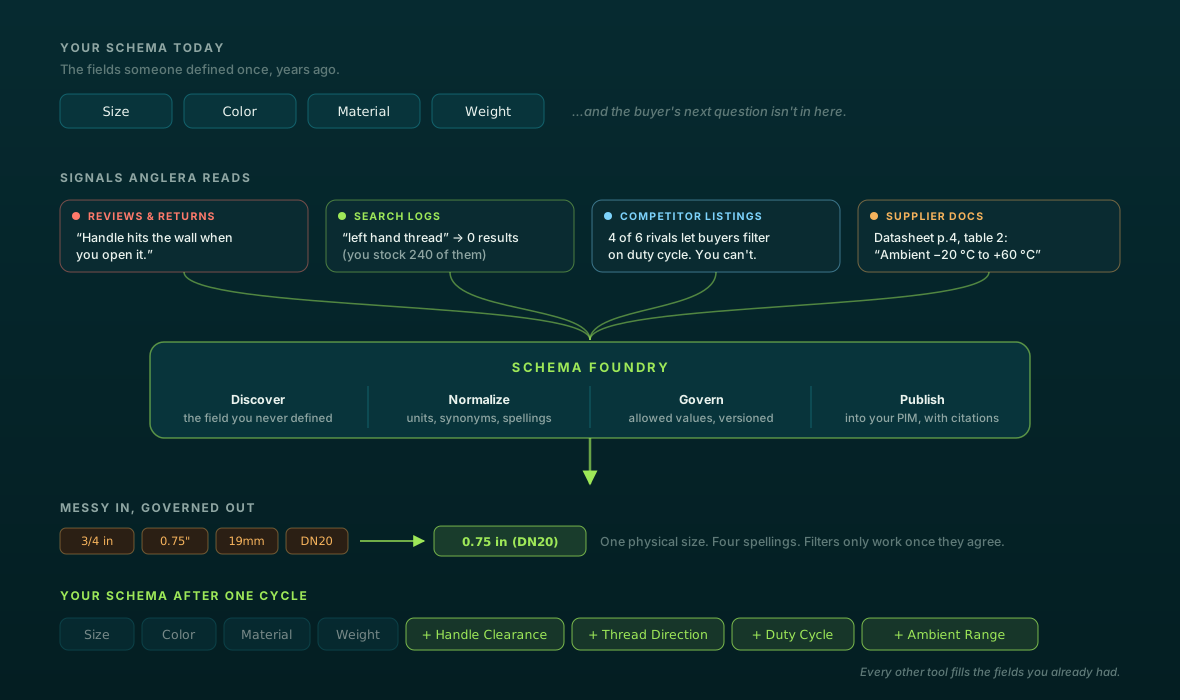
Filling the fields you defined has an invisible ceiling: a catalog can hit 100% complete and still miss the attribute that loses the sale, because completeness is measured against a schema someone drew years ago. Schema Foundry reads competitor listings, buyer searches, review complaints and your supplier docs, and proposes the fields you never defined — which is where Etilize stops.

How Schema Foundry works
Schema Foundry: signals from reviews, search logs, competitor listings and supplier documents reveal attributes missing from your schema; the Foundry discovers, normalizes and governs them, so your schema ends the cycle with more fields than it started with.

What Etilize does

Etilize is the normalized product-content catalog for IT, consumer electronics, and office products — one standardized, ecommerce-ready datasheet per MPN, licensed to tech distributors (Ingram Micro, D&H, Ma Labs, Novexco, Grand & Toy are named references), resellers, VARs, and office-supply dealers, and consumed via daily feeds, customized exports, and a web-service search API. Founded in 2000 in Denver with large content-production operations in Karachi, Pakistan, it was majority-acquired by GfK in December 2008 and ran for fifteen years as GfK Etilize. When GfK combined with NielsenIQ in July 2023 the business moved under NIQ (now NYSE-listed NIQ Global Intelligence), where it is branded NIQ Brandbank technology and durables content; etilize.com now 301-redirects to nielseniq.com, and the manufacturer-facing syndication platform is called SpexAccess. Note the common confusion: 1WorldSync acquired CNET Content Solutions — Etilize's historic rival pool — in 2020, so Syndigo's 2025 acquisition of 1WorldSync does not include Etilize. NIQ claims a catalog of 20M+ technology products (30M+ across tech and durables) spanning dozens of markets and 30+ languages, distributed to a network it sizes at 70,000 channel partners.

Pricing: Not publicly listed. Sold as subscription catalog licenses to distributors and resellers (historically scoped by country and category), and bundled through channel quoting tools — QuoteWerks includes an Etilize-powered product content subscription in its Pinnacle edition. Treat any specific figure as an estimate.

Etilize website

When Etilize is the right call

Tech distributors, VARs, MSP quoting workflows, and office-products dealers whose assortment is dominated by mainstream branded IT/CE MPNs and who need complete, normalized datasheets and images on day one. The catalog depth, distributor taxonomy mapping, and 30-language localization are real and hard-won.

We'd rather tell you here than in month three of an implementation.

Capability verdicts reviewed against Etilize's public documentation on July 17, 2026. Vendors ship quickly — if something here is out of date, tell us and we'll correct it.

See it on your own SKUs.

Bring one category and your supplier files. In 30 minutes you'll see it enriched — complete, structured, and consistent enough to launch on — plus the attributes your schema didn't have yet.

Book a demo