Buy Semantico to clear a backlog of bare SKUs into publishable, multi-language storefront listings fast and at a known price; buy Anglera if the catalog is an ongoing asset needing provenance, schema depth, and re-enrichment after launch.
Both claim to enrich product data. This page is about where that claim stops.
The frame for this comparison
Product data is a practice, not a project.
Semantico is built to turn an SKU or EAN into a live listing; the comparison worth having is about the second pass — what happens to that SKU's attributes after the copy is written, the export lands in Shopify, and the manufacturer's spec sheet quietly goes to Rev C.
01
Ground it
Mine every spec from every source.
Every value traced to a document you can open. The catalog is only as honest as what it was built from.
02
Align it
Aim the catalog at the buyer who actually buys.
Grounded data still loses if it answers questions nobody asked. Alignment is what turns specs into conversion.
03
Keep it alive
Product data is a practice, not a project.
Markets move, suppliers reissue, buyers change what they ask for. A catalog that is right in March is wrong by August unless something is watching.
Capability by capability
Where Semantico stops.
Scored against public documentation. Grouped by the three acts — so you can see which ones Semantico leaves on your desk.
01
Ground it
Mine every spec from every source.
CapabilitySemanticoAnglera
Source mining
Where does it get specs from?
SemanticoLimited
Web-crawls manufacturer sites, listings, PDFs from identifier
Can it produce usable images for SKUs that lack them?
SemanticoLimited
Sources and vision-validates images; enhancement, generation unclear
AngleraYes
Generates studio-grade imagery for photoless SKUs
03
Keep it alive
Product data is a practice, not a project.
CapabilitySemanticoAnglera
Continuous re-enrichment
What happens when the market moves after go-live?
SemanticoYour team
On-demand, credit-metered runs; no post-launch re-enrichment
AngleraYes
Re-enriches on its own after go-live
Quality scoring
Does it score its own output and track catalog health?
SemanticoNo
Flags weak images; no catalog health tracking
AngleraYes
Scored against your standards; nothing publishes below bar
Write-back
Does enriched data land back in your system of record?
SemanticoYes
Publishes to Shopify, Magento, WooCommerce, Amazon
AngleraYes
Writes back to PIM, ERP, warehouse, commerce
API, MCP & webhooks
Can your own tools and agents drive it headlessly?
SemanticoLimited
API and webhooks cited; custom API Enterprise-only; no MCP
AngleraYes
API, webhooks, and MCP servers
Who does the work
Does it do the work, or help your team do it?
SemanticoYour team
Software; 80% draft, customer's team reviews and publishes
AngleraYes
Anglera owns the work; review is a guardrail
KeyYesships itLimitedlimited or gatedYour teamyour team still does itNodoesn't do itAnglera differentiator
What “buyer signals” actually means
Six signals sitting in your market right now.
“Buyer signals” is the emptiest phrase in this category, so here is the literal thing. Each of these is an observation from a live market, the gap it exposes, and the field that gets created as a result.
Review signal·1- and 2-star reviews on a mid-range espresso grinder listing
"Listing says 64mm conical. What arrived is a 58mm flat burr. That's the whole reason I bought it."
Burr set is the buying decision, and it drifts across a model family as vendors re-source. Whatever the first pass captured was true against the sources read that day. The open question is what re-reads the manufacturer's current spec sheet in month six and fails the SKU before it republishes.
Field createdburr_geometry + burr_diameter_mmburr_geometry: conical | flat | ghost. burr_diameter_mm: integer, mm only — 58, 64, 83.
Search signal·Internal site search logs on a pet supplies store
"grain free salmon 12kg" returns 41 results; four of them are actually 12kg bags. The rest match "12" somewhere in the title.
Bag weight is what the shopper is buying on, so it has to be a governed facet across the whole family — the SKUs that came through a generator and the ones a buyer loaded by hand last quarter. A rule that only holds on the SKUs it was applied to isn't a facet; it's a coincidence.
Field creatednet_weight_value + net_weight_uom (plus pack_count for multipacks)net_weight_uom: g | kg | oz | lb, stored canonical in g. "12 Kg", "12KG", "12 kilo" all resolve to 12000 g.
Supplier signal·Revised spec sheet PDF emailed by a lighting vendor, filename ending -RevC
On the 3000K E26 SKU, Rev C moves dimming from "TRIAC" to "TRIAC / 0-10V" and drops the stated CRI from 90 to 80. The copy on the storefront was written from Rev A.
The listing was true the day it was generated. The source moved and the SKU didn't. Answering "which of my 1,200 lamps are still quoting Rev A?" needs a governed field carrying its source document and revision, plus a job that re-checks it — not a better first draft.
Field createddimming_protocol (multi-select) + cri, each with source_doc_revdimming_protocol: non-dimmable | TRIAC | ELV | 0-10V | DALI | Zigbee. cri: integer 0–100, Ra scale.
Why catalogs rot
Rot starts the day after the first pass
Semantico is built for the first pass. Give it a product reference and it crawls manufacturer sites, brand pages and PDFs, cross-verifies what it finds, normalizes units, and hands a human a listing to check for brand consistency before it exports to Shopify, WooCommerce, Magento or BigCommerce. That pass is dated the day it runs. In March a lighting vendor issues Rev C and moves dimming from TRIAC to TRIAC plus 0-10V. Merchandising rewrites a title for a promo. Someone fixes a burr diameter in the storefront because a customer complained. None of that is a generation problem; it is a standing-answer problem. The question a year on is whether the reviewer's judgment became a rule that binds the next 400 grinders, or was spent once, on one SKU. Catalogs rot in that gap.
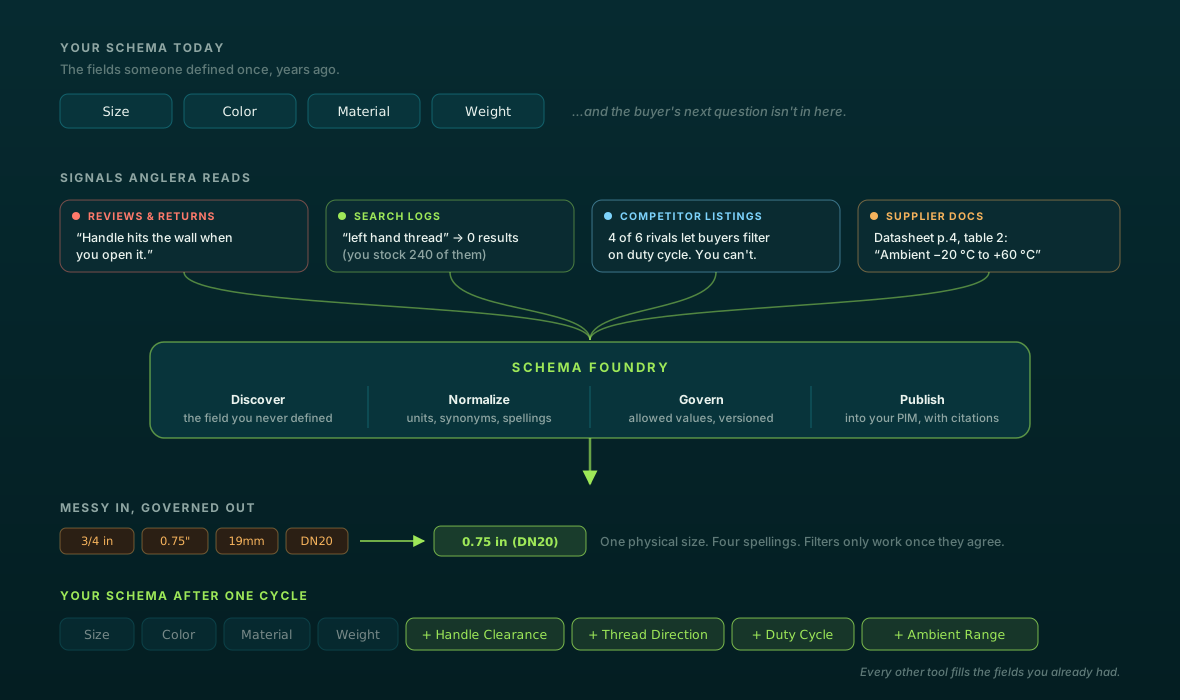
Messy in, governed out.
Values are normalized into a governed, versioned set of allowed values — so a filter works, and keeps working after the next import.
Nominal Size
3/4 in0.75"3/4"19mm3/4 inchDN20
0.75 in (DN20)
Six suppliers, six spellings, one physical size. Filters only work once they agree.
Finish
BlkblackBLACK MATTEMatte BlkRAL 9005
Black — Matte
Free text makes a colour filter useless. A governed value makes it a facet.
Material
SS316316 StainlessStainless Steel 316A4 Stainless
Stainless Steel — 316 / A4
Same alloy, four vocabularies, plus a trade name. Buyers search all of them.
And the part nobody else does
We don't just fill the template you handed us.
Filling the fields you defined has an invisible ceiling: a catalog can hit 100% complete and still miss the attribute that loses the sale, because completeness is measured against a schema someone drew years ago. Schema Foundry reads competitor listings, buyer searches, review complaints and your supplier docs, and proposes the fields you never defined — which is where Semantico stops.
Semantico is a Barcelona-based AI platform (launched 2024, 2-10 staff) that turns a bare product reference — SKU, EAN, or ISBN plus a brand name — into a complete ecommerce listing. It crawls manufacturer sites, brand pages, ecommerce listings and PDFs for specs, then generates titles, descriptions, bullets, SEO metadata and translations, auto-categorizes into taxonomies like Shopify's, normalizes attributes and units, sources and vision-validates images, and suggests pricing. Listings publish to Shopify, WooCommerce, Magento and Amazon via one-click export or API. Semantico describes the first pass as roughly 80% complete, with a human team reviewing before publish.
Pricing: Publicly listed, credit-metered, 1-year contracts: Basic €350/mo (2,000 credits, ~200 products), Pro €675/mo (10,000 credits, ~1,000 products), Advanced €850/mo (25,000 credits, ~2,500 products), all with unlimited users. Enterprise is custom-priced (unlimited credits, custom API, CSM with SLA). A separate Shopify app sells one-time credit packs: $9.99/10, $99/200, $299/1,000.
Small-to-mid Shopify, Magento, or WooCommerce retailers with a backlog of bare SKUs or EANs who need publishable, SEO-ready, multi-language listings quickly at a predictable per-product cost.
We'd rather tell you here than in month three of an implementation.
Capability verdicts reviewed against Semantico's public documentation on July 14, 2026. Vendors ship quickly — if something here is out of date, tell us and we'll correct it.
See it on your own SKUs.
Bring one category and your supplier files. In 30 minutes you'll see it enriched — complete, structured, and consistent enough to launch on — plus the attributes your schema didn't have yet.